Hong Kong Stadium: The Heart of the City's Sporting Legacy
Located in the valley of Caroline Hill in Causeway Bay, Hong Kong Stadium stands as the premier sports venue in the region. Known locally by the nickname Po Tau (meaning "Head of the Port"), this iconic arena is more than just a field of play; it is a landmark that has hosted some of the most significant international sporting events in Asia.
From its origins as the Government Stadium to its modern redevelopment, the venue has evolved to meet international standards, serving as the primary home for the Hong Kong national football team and a hub for global rugby and football stars.
Key Facts
- Capacity: 40,116 spectators.
- Location: 55 Eastern Hospital Road, Causeway Bay, Hong Kong.
- Surface: Natural grass field measuring 105 by 68 metres.
- Primary Tenants: Hong Kong national football team.
- Major Events: AFC Asian Cup, Hong Kong Sevens, and the Premier League Asia Trophy.
- Management: Owned and operated by the Leisure and Cultural Services Department.
History and Evolution
The site of the stadium, So Kon Po, has a unique history. It previously served as a burial ground for victims of the 1918 Fire at Happy Valley Racecourse before the tombs were relocated to Aberdeen. The original Government Stadium opened in 1953 as a U-shaped venue with a capacity of 28,000 and partially covered seating.
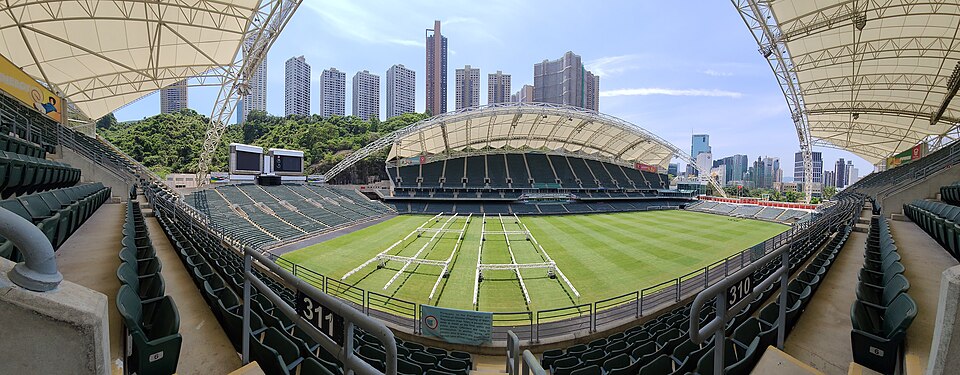
In the early 1990s, the facility underwent a massive reconstruction. Designed by architect HOK Sport at a cost of US$85 million, the stadium was transformed into a rectangular arena with a 40,000-seat capacity. Due to restricted land size, no running track was included in the design, focusing the venue entirely on field sports.
A Hub for International Football
Hong Kong Stadium is most renowned for its footballing heritage. It hosted the inaugural AFC Asian Cup finals in 1956, where South Korea emerged as champions. The venue has also been a frequent host for the AFC Women's Asian Cup, welcoming the tournament in 1975, 1981, 1986, and 1989.
Club Friendlies and Global Giants
The stadium has attracted some of the world's most famous football clubs. Notable matches include visits from Manchester United, Real Madrid, Barcelona, and AC Milan. More recently, it hosted a clash between Manchester City and Kitchee SC in 2019, and a high-profile friendly featuring Inter Miami in 2024.
The venue also holds the record for hosting the Premier League Asia Trophy more than any other stadium, with editions held in 2007, 2011, 2013, and 2017.
Historic Milestones
The stadium witnessed its first official "full house" (non-exhibition) football match during the 2009 AFC Cup semi-final between South China AA and Kuwait SC. That same year, it hosted the East Asian Games football final, where the Hong Kong U23 team defeated Japan to secure the city's first-ever international medal in football.
Rugby and Other Sporting Events
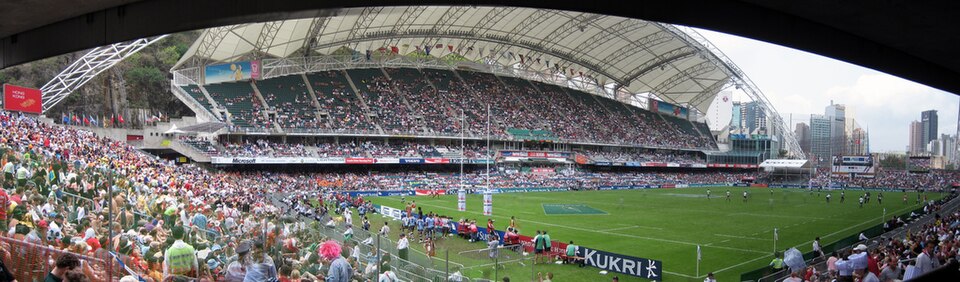
Beyond football, the stadium is synonymous with the Hong Kong Sevens, which was hosted annually from 1982 to 2024. It also served as the venue for the Rugby World Cup Sevens in 1997 and 2005.
In 2008, the stadium made history as the first venue outside of Australia and New Zealand to host a Bledisloe Cup test match, featuring the legendary All Blacks and Wallabies. Additionally, the ground hosted the Hong Kong International Cricket Sixes between 1996 and 1997.
Venue Specifications and Facilities
The stadium is designed for maximum visibility and accessibility, with a tiered seating arrangement that caters to different levels of spectators.
| Category | Details |
|---|---|
| Total Capacity | 40,116 |
| Main Level Seats | 18,260 |
| Upper Level Seats | 18,510 |
| Executive Level Seats | 3,173 |
| Wheelchair Spaces | 57 |
| Field Dimensions | 105m x 68m |
Non-Sporting Events
While primarily a sports venue, the stadium has hosted major entertainment events. In 1994, local artist Alan Tam became the first local performer to hold a concert at the venue. The stadium also welcomed the British electronic band Depeche Mode during their 1994 Exotic/Summer Tour.
Frequently Asked Questions
What is the maximum capacity of Hong Kong Stadium?
The stadium can accommodate a maximum of 40,116 spectators, distributed across the main, upper, and executive levels, including dedicated spaces for wheelchair users.
How do I get to Hong Kong Stadium via public transit?
The stadium is easily accessible via the MTR; the nearest exits are Exit A and F1 of the Causeway Bay station.
Which national team calls this stadium home?
The Hong Kong national football team uses the stadium as its primary home venue for international matches.
Has the stadium hosted any major rugby tournaments?
Yes, it hosted the annual Hong Kong Sevens from 1982 to 2024, the Rugby World Cup Sevens in 1997 and 2005, and a historic Bledisloe Cup match in 2008.
When was the stadium last majorly renovated?
The stadium underwent a significant reconstruction in 1994, transforming it from the old Government Stadium into the current rectangular design.