Interpol Notices: How International Police Alerts Work
In the complex world of global law enforcement, coordinating the pursuit of criminals across borders requires a standardized communication system. Interpol notices serve as this vital link, acting as international alerts that allow police in one member state or authorized international entity to share critical information about crimes, criminals, and threats with their counterparts worldwide.
These notices are not arrest warrants themselves, but they facilitate the location and apprehension of individuals wanted for serious crimes, the identification of missing persons, and the sharing of modus operandi (the specific methods or patterns used by criminals to commit crimes). All notices are published on a secure website, though extracts may appear publicly if the requesting entity agrees.
Key Facts
- Global Reach: Notices are issued in English, French, Spanish, and Arabic.
- Strict Neutrality: Interpol's constitution forbids activities of a political, military, religious, or racial character.
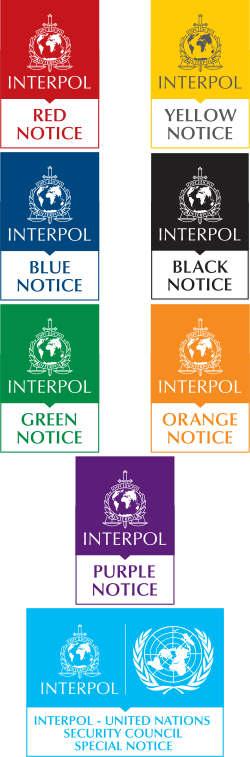
- Diverse Types: There are eight primary notice types, seven of which are color-coded.
- Red Notice: The most recognized tool, often described as the closest instrument to an international arrest warrant.
- Independent Oversight: The Commission for the Control of Interpol's Files (CCF) monitors data protection and handles legal petitions.
Types of Interpol Notices
Interpol utilizes a color-coded system to ensure that law enforcement agencies immediately understand the nature of the alert. While most are long-established, the system continues to evolve to meet modern criminal challenges.
| Notice Color/Type | Primary Purpose |
|---|---|
| Red | To seek the location and arrest of a person wanted for extradition. |
| Blue | To collect additional information about a person of interest in a criminal investigation. |
| Green | To provide warnings about persons who represent a possible threat to public safety. |
| Yellow | To help locate missing persons or identify those unable to identify themselves. |
| Black | To seek information regarding unidentified bodies. |
| Orange | To warn of imminent threats to people or property (events, objects, or processes). |
| Purple | To share information on criminal methods, objects, or hiding places. |
| Silver | To identify and trace criminal assets (currently in pilot phase as of 2025). |
| UN Special | To notify members that an entity or individual is subject to UN sanctions. |
Diffusions: A Less Formal Alternative
Beyond formal notices, member states may use a diffusion. This is a less formal alert sent directly by a member state to specific countries or the entire membership. While it is recorded in Interpol's databases, it is used more flexibly to request the location of an individual or gather investigation details.
Evolution and History
The international notice system was established in 1946 following the re-establishment of Interpol after World War II. The original system featured six colors: Red, Blue, Green, Yellow, Black, and Purple. As global threats evolved, the Orange notice was added in 2004.
In 2005, the Interpol-United Nations Security Council special notice was introduced via Resolution 1617. This specific tool helps the Security Council enforce travel bans, arms embargoes, and asset freezes against individuals and entities associated with the Taliban and Al-Qaeda.
Controversies and Human Rights
Despite its utility, the Red Notice system has faced criticism regarding potential political abuse. Human rights organizations, such as Fair Trials, have argued that oppressive regimes may use these notices to persecute journalists, political opponents, and human rights defenders.
Notable cases include the Russian government's failed attempts to secure a Red Notice for Bill Browder, which Interpol rejected as being predominantly political. Similarly, requests from Iran for a Red Notice against Donald Trump and other US officials were rejected on political grounds. In other instances, such as the case of footballer Hakeem al-Araibi, individuals have been detained based on notices that were later withdrawn due to illegality.
To combat these issues, Interpol introduced a refugee policy in 2015, stating that a Red Notice should not be issued against a refugee if requested by the country they fled. Additionally, the organization has implemented task forces to review requests more intensively.
The Commission for the Control of Interpol's Files (CCF)
To ensure accountability, the Commission for the Control of Interpol's Files (CCF) serves as an independent monitoring body. Integrated into Interpol's legal structure in 2008, the CCF focuses on three main areas:
- Monitoring the application of data protection rules for personal data.
- Advising on projects involving the processing of personal information.
- Processing requests for access to Interpol's files.
The CCF is most critical when reviewing petitions for the revocation of Red Notices. Petitions typically succeed if the notice is found to violate the Universal Declaration of Human Rights or if it was issued for racial, religious, military, or political reasons.
Frequently Asked Questions
Is a Red Notice the same as an international arrest warrant?
No. While it is the closest instrument to an international arrest warrant, a Red Notice is a request to law enforcement worldwide to locate and provisionally arrest a person pending extradition, rather than a warrant that is automatically enforceable in every country.
Can any country request an Interpol notice?
Requests are made by National Central Bureaus (NCBs) of member states or authorized international entities like the UN and the International Criminal Court. However, Interpol will refuse any request that violates its constitution, particularly those of a political, military, religious, or racial nature.
What is the purpose of a Purple Notice?
A Purple Notice is used to share information on the modus operandi, procedures, objects, devices, or hiding places used by criminals to help police recognize and prevent similar crimes elsewhere.
How can someone challenge a Red Notice?
Individuals can submit a legal petition to the Commission for the Control of Interpol's Files (CCF). The CCF will review the notice to determine if it infringes on Interpol's Constitution or the Universal Declaration of Human Rights.
What is the new Silver Notice?
Introduced as a pilot in 2025, the Silver Notice is specifically designed to help member states identify and trace assets used in criminal activities.