Internet Archive Headquarters: From Greek Revival Church to Digital Library
Located in the Richmond District of San Francisco, the headquarters of the Internet Archive serves as a unique intersection of classical architecture and cutting-edge digital preservation. The facility, once a place of spiritual gathering, now houses a significant portion of the world's digitized knowledge, mirroring the legacy of the ancient Library of Alexandria.
Architectural Origins and Evolution
The building's history is marked by rising ambitions and architectural elegance. Early cost estimates for the structure in 1922 ranged from $125,000 to $150,000, with projections by the San Francisco Chronicle in November 1923 increasing the estimated cost to $175,000.
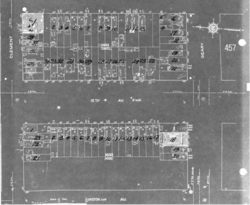
The structure served as the Fourth Church of Christ, Scientist, characterized by its Greek Revival design—an architectural style inspired by the temples of ancient Greece. This specific aesthetic was a primary motivator for the Internet Archive's acquisition of the property, as the design closely resembles the organization's logo, which pays homage to the Library of Alexandria.
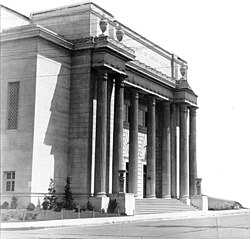
Transition to a Digital Sanctuary
In September 2009, as the church's congregation dwindled and maintenance costs rose, the building was sold to the Internet Archive for $4.5 million. The transition transformed the sanctuary into a hub for digital archiving.
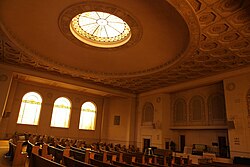
The main room, often described as cavernous and quiet, is illuminated by a golden light filtering through its windows. This space blends the sacred with the technical; the back wall houses servers that, as of 2024, contained one-tenth of the Archive's online materials. In a nod to web culture, the auditorium retains hymn numbers on either side of the stage—specifically 200, 404, and 451—which correspond to HTTP status codes (the standard response codes given by web servers) for a successfully loaded page, an unsuccessful request, and content blocked for legal reasons.
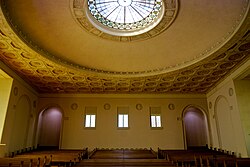
Beyond the technology, the room maintains a human element. Since 2009, it has displayed terracotta sculptures of employees who have dedicated more than three years of service to the Archive.
Challenges and Resilience
The facility has faced significant setbacks, most notably on November 6, 2013. A fire broke out in a side building that had been constructed in the 1940s as a Christian Science reading room. The blaze destroyed one of the organization's 30 scanning centers, resulting in the loss of cameras, lights, and scanning equipment valued in the hundreds of thousands of dollars.
While most of the affected books and film had already been digitized, approximately 20 boxes of materials were lost, some of which were irreplaceable. The nonprofit sought donations to cover the estimated $600,000 in damages caused by the fire, which also impacted nearby apartments.
Key Facts
- Acquisition Price: Purchased for $4.5 million in September 2009.
- Architectural Style: Greek Revival, mirroring the Internet Archive logo.
- Digital Capacity: The Great Room servers held 10% of online materials as of 2024.
- Cultural Easter Eggs: Auditorium hymn numbers 200, 404, and 451 represent HTTP status codes.
- Community Access: Founder Brewster Kahle frequently leads free public tours every Friday after lunch.
| Detail | Information |
|---|---|
| Original Use | Fourth Church of Christ, Scientist |
| Location | Richmond District, San Francisco |
| 2013 Fire Loss | Estimated $600,000 in damages |
| Employee Recognition | Terracotta sculptures for 3+ years of service |
Frequently Asked Questions
Why did the Internet Archive choose this specific building?
The Archive chose the building because its Greek Revival design resembles the organization's logo, which is inspired by the Library of Alexandria.
What is the significance of the numbers 200, 404, and 451 in the auditorium?
These numbers represent HTTP status codes: 200 for a successful page load, 404 for a page not found (unsuccessful), and 451 for content blocked for legal reasons.
What happened during the 2013 fire?
A fire destroyed a side building used as a scanning center, resulting in the loss of expensive equipment and approximately 20 boxes of books and film, with total damages estimated at $600,000.
Can the public visit the Internet Archive headquarters?
Yes, free public tours are offered every Friday after lunch, often led by the founder and Digital Librarian, Brewster Kahle.
How much of the Archive's data is stored on-site?
As of 2024, the servers located on the back wall of the main room held one-tenth of the Archive's online material.