Innovative Satellite Technology Demonstration-1
The Innovative Satellite Technology Demonstration-1 was a pioneering mission designed to test cutting-edge spacecraft components and systems in the harsh environment of space. Launched on January 18, 2019, this mission served as the inaugural flight of the Innovative Satellite Technology Demonstration Program, marking a significant milestone as the first multi-satellite launch performed by the Epsilon launch vehicle.
The program began with a call for proposals in 2015, leading to the selection of 14 projects in February 2016. While one proposal from IHI Corporation regarding a ship information receiving system was eventually dropped, 13 projects successfully reached orbit. These projects were distributed across various platforms: seven were integrated as parts or components on a primary satellite, three flew as independent microsatellites, and three were deployed as CubeSats—miniaturized satellites based on a standardized unit size.
Key Facts
- Launch Date: January 18, 2019.
- Launch Vehicle: Epsilon (first multi-satellite launch).
- Total Projects: 13 successful space-bound projects.
- Mission Structure: One primary satellite (RAPIS-1), three microsatellites, and three CubeSats.
- Testing Duration: Payloads were tested in space for one year.
RAPIS-1 and Integrated Payloads
The RAPid Innovative payload demonstration Satellite 1 (RAPIS-1) acted as the primary hub for the mission, hosting seven different projects as either parts or components. These integrated technologies allowed developers to gather operational data on specific hardware without needing a dedicated satellite for every experiment.
The payloads hosted on RAPIS-1 included:
- NBFPGA: A NanoBridge based Field Programmable Gate Array developed by NEC Corporation.
- HXTX / XMGA: A High data rate X-band Transmitter and X-band Middle Gain Antenna from Keio University.
- GPRCS: A Green Propellant Reaction Control System developed by Japan Space Systems.
- SPM: A Space Particle Monitor developed by Japan Space Systems.
- DLAS: A Deep Learning Attitude Sensor developed by the Tokyo Institute of Technology.
- TMSAP: A Thin Membrane Solar Array Paddle developed by JAXA.
- Fireant: A miniature spaceborne GNSS (Global Navigation Satellite System) receiver developed by Chubu University.
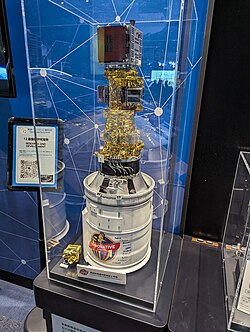
Independent Microsatellites
Beyond the RAPIS-1 hub, three independent microsatellites were deployed to test more complex, standalone systems.
MicroDragon
Proposed by Takashi Maeno of Keio University and developed by the Vietnam National Satellite Center (VNSC), MicroDragon served as a key collaborative effort in microsatellite development.
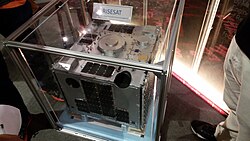
RISESAT
The Rapid International Scientific Experiment Satellite (RISESAT), formerly known as Hodoyoshi 2, was developed by Tohoku University. It focused on high-resolution multispectral observation and precise attitude control. Its High Precision Telescope (HPT) utilized a liquid crystal tunable filter to measure crop health and growth rates from orbit. RISESAT eventually decayed from orbit on March 14, 2023.
ALE-1
Developed by ALE Co., Ltd., ALE-1 (or ALEe) was designed to create artificial shooting stars. To achieve the necessary altitude for this mission, it used the DOM2500 deorbit mechanism—a 2.5m x 2.5m membrane sail. This sail lowered the satellite's altitude to below 400 km before being separated. The DOM2500 reentered the atmosphere on August 3, 2022, and ALE-1 was expected to follow in October 2023.
CubeSat Demonstrations
The mission also included three CubeSats, which are small, modular satellites used for rapid technology prototyping.
- OrigamiSat-1: A 3U CubeSat from the Tokyo Institute of Technology that tested the deployment of a 1m membrane from a folded state at an altitude of 400 km. It decayed on April 30, 2022.
- Aoba VELOX-IV: A 2U CubeSat jointly developed by the Kyushu Institute of Technology and Nanyang Technological University (NTU) of Singapore. It featured a low-light camera and pulsed plasma thrusters for maneuvering, a critical capability for future lunar missions. It decayed on March 24, 2023.
- NEXUS: Short for NExt generation X Unique Satellite, this 1U CubeSat from Nihon University served as an amateur radio satellite. It demonstrated packet radio in space using a transmitter with significantly higher data rates and lower power consumption than traditional models. It decayed on November 9, 2023.
Mission Summary Table
| Project | Type | Developing Agency |
|---|---|---|
| NBFPGA | Part | NEC Corporation |
| HXTX / XMGA | Component | Keio University |
| GPRCS | Component | J-spacesystems |
| SPM | Component | J-spacesystems |
| DLAS | Component | Tokyo Institute of Technology |
| TMSAP | Component | JAXA |
| Fireant | Component | Chubu University |
| MicroDragon | Microsatellite | Keio University / VNSC |
| RISESAT | Microsatellite | Tohoku University |
| ALE-1 | Microsatellite | ALE Co., Ltd. |
| OrigamiSat-1 | CubeSat | Tokyo Institute of Technology |
| Aoba VELOX-IV | CubeSat | Kyushu Institute of Technology / NTU |
| NEXUS | CubeSat | Nihon University |
Frequently Asked Questions
What was the primary purpose of the Innovative Satellite Technology Demonstration-1?
The mission was designed to test various innovative spacecraft parts, components, and small satellites in space for one year to provide developers with critical operational data.
How many projects were successfully launched?
Out of 14 originally selected projects, 13 successfully reached space after one proposal from IHI Corporation was dropped.
What made the Epsilon launch vehicle's role in this mission significant?
This mission marked the first time the Epsilon launch vehicle was used to deploy multiple satellites in a single launch.
What was the specific goal of the ALE-1 satellite?
ALE-1 was designed to demonstrate the creation of artificial shooting stars, utilizing a membrane sail called the DOM2500 to lower its orbital altitude.
How did RISESAT contribute to agricultural science?
RISESAT used a high-resolution multispectral camera and a High Precision Telescope with a liquid crystal tunable filter to measure the health and growth rates of crops from space.
What was the purpose of the pulsed plasma thrusters on Aoba VELOX-IV?
The thrusters provided maneuvering capabilities, which are essential for future lunar missions to maintain orbits within the Moon's irregular gravity field.