Imperial Public Library: A History of Russia's Premier Literary Treasure
The Imperial Public Library stands as a monument to the Russian Enlightenment, serving as a guardian of global knowledge and a repository of some of the world's most significant manuscripts. Established during the reign of Catherine the Great, the institution evolved from a collection of seized foreign volumes into a cornerstone of Russian academic and cultural life.
The Establishment of a National Treasure
The vision for a public library in Russia emerged in the early 18th century, but it was not until May 27, 1795, that Catherine the Great officially approved the project. The library's foundation was built upon the Załuski Library, a renowned Polish national library created by Bishop Załuski in Warsaw. This collection, totaling 420,000 volumes, was seized by Russian forces in 1794 following the Partitions of Poland. While many volumes were lost to theft during transport, the remaining collection formed the bedrock of the library's foreign-language department.
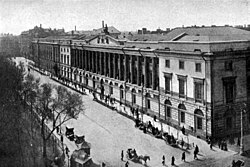
Construction began immediately at the intersection of Nevsky Avenue and Sadovaya Street in the heart of the imperial capital. Designed by architect Yegor Sokolov between 1796 and 1801, the building is a prime example of Neoclassical style—an architectural movement inspired by the classical antiquity of Greece and Rome.
Early Governance and Legal Frameworks
For its first five years, the library was managed by Comte Marie-Gabriel-Florent-Auguste de Choiseul-Gouffier, who implemented a specialized manual for library classification. A pivotal moment in the institution's history occurred in 1810 when Emperor Alexander I approved Russia's first library law. This legislation mandated that two legal copies of every printed work produced in Russia be deposited in the library, ensuring a comprehensive record of the nation's intellectual output.
The Rossica Project and Rare Manuscripts
Under the leadership of Count Alexander Stroganov in the early 19th century, the library launched the Rossica project, a massive effort to collect foreign publications concerning Russia. Stroganov was instrumental in acquiring the library's most prized treasures, including the Ostromir Gospel—the earliest known book written in the Old East Slavic dialect of Church Slavonic—and the Hypatian Codex of the Russian Primary Chronicle.
Furthermore, the diplomatic contributions of Peter P. Dubrowsky led to the creation of a dedicated manuscript depot on February 27, 1805, with Dubrowsky serving as its first keeper.
Expansion and the Golden Age (1814–1917)
Although planned for an 1812 opening, the inauguration was delayed by two years as valuable collections were evacuated to protect them from Napoleon's invasion. The library finally opened its doors to the public on January 14, 1814, attended by figures such as Gavrila Derzhavin and Ivan Krylov.
The mid-19th century marked a period of rapid growth. Under the direction of Aleksey Olenin and later Count Modest von Korff, the library became accessible to common people, leading to a surge in visitors. By the 1850s, the acquisition rate of new books grew fivefold, reaching far beyond the previous average of 5,000 volumes per year. To accommodate this growth, Vasily Sobolshchikov designed a new reading room between 1860 and 1862, which enclosed the library's court.
During this era, the library acquired world-renowned religious texts, including the Codex Sinaiticus (from the 340s), the Leningrad Codex (the oldest complete manuscript of the Hebrew Bible), and the Uthman Qur'an from the mid-7th century.
The 20th Century and the Modern Era
Following the Russian Revolution, the library was managed by Ernest Radlov and Nicholas Marr. While it remained a vital institution—even staying open during the Siege of Leningrad and receiving the Order of the Red Banner of Labour in 1939—its primary national status was eventually superseded by the Lenin State Library in Moscow.
In the late 20th century, the library embraced the digital age. Through the "Meeting on Frontiers" project with the Library of Congress, it began a large-scale digitization effort. By 2012, approximately 80,000 titles were made available electronically.
World War II and Cultural Assets
The aftermath of World War II saw the arrival of millions of German art objects, books, and archival materials in the Soviet Union. While some were returned to the GDR in the 1950s, Russia continues to hold a significant amount of German provenance material, including over 200,000 works of art and three million books.
Key Facts
- Founded: May 27, 1795, by Catherine the Great.
- Foundational Collection: Based on the seized Polish Załuski Library (420,000 volumes).
- Architectural Style: Neoclassical, designed by Yegor Sokolov.
- Legal Deposit: First library law passed in 1810 requiring two copies of all Russian prints.
- Digital Milestone: 80,000 titles digitized by 2012.
| Work | Approximate Date/Century |
|---|---|
| St. Petersburg Bede | 746 |
| Uthman Qur'an | Mid-7th Century |
| Codex Sinaiticus | 340s |
| Leningrad Codex | c. 1008 |
| Ostromir Gospel | 1056 |
| Trebizond Gospel | 10th Century |
| Codex Zographensis | c. 1000 |
| Spiridon Psalter | 1397 |
| Bible Historiale (Guyart de Moulin) | 1350s |
| Grandes Chroniques de France (Simon Marmion) | 1450s |
| Breviary of Mary Stuart | 1490s |
| Lancelot du Lac | c. 1500 |
Frequently Asked Questions
How was the Imperial Public Library started?
It was established in 1795 by Catherine the Great, utilizing the Załuski Library—a Polish national library seized by Russia in 1794—as its primary initial collection.
What is the significance of the Ostromir Gospel?
The Ostromir Gospel is one of the library's most invaluable treasures, as it is the earliest book written in the Old East Slavic dialect of Church Slavonic, the precursor to the modern Russian language.
Why was the library's public opening delayed?
Although scheduled for 1812, the inauguration was postponed until 1814 because the most valuable collections had to be evacuated to protect them from Napoleon's invasion of Russia.
What is the Rossica project?
The Rossica project was a vast initiative launched under Count Alexander Stroganov to collect foreign-language books and materials that discussed or touched upon Russia.
How has the library adapted to the modern era?
The library has engaged in large-scale digitization, partnering with the Library of Congress's "Meeting on Frontiers" project to make tens of thousands of titles available electronically.