Impatiens: The Vibrant World of Touch-Me-Nots and Balsams
The genus Impatiens comprises more than 1,000 species of flowering plants found across the tropics and the Northern Hemisphere. Known commonly as "touch-me-nots" or balsams, these plants are the primary members of the family Balsaminaceae, which also includes the single-species genus Hydrocera. From delicate garden ornamentals to aggressive invasive weeds, Impatiens are recognized for their striking colors and unique biological mechanisms.
Key Facts
- Species Diversity: Over 1,000 species exist globally.
- Defining Trait: Explosive seed pods that launch seeds several meters away.
- Growth Habit: Mostly herbaceous annuals or perennials with succulent stems.
- Distribution: Widespread in the Northern Hemisphere and tropical regions.
- Medicinal Use: Some species are used to treat insect bites and skin rashes.
Botanical Description
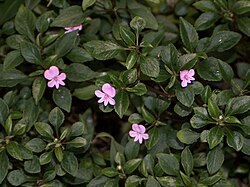
Most Impatiens are herbaceous plants with succulent stems, though a few woody species exist. They vary significantly in size, ranging from a mere five centimeters to 2.5 meters in height. A notable characteristic of their stems is the ability to form roots upon contact with the soil.
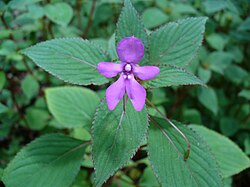
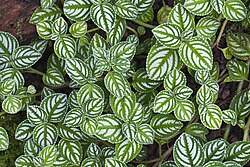
The leaves are typically entire, though they may be dentate (toothed) or sinuate (wavy), and often feature extrafloral nectaries. Some species possess leaves with a silvery sheen caused by tiny air bubbles trapped on the surface, a feature most visible when the plant is submerged in water.
The name Impatiens (Latin for "impatient") refers to the plant's explosive dehiscence. This is a process where mature seed capsules burst open suddenly, catapulting seeds away from the parent plant to ensure wider distribution.
Distribution and Environmental Impact
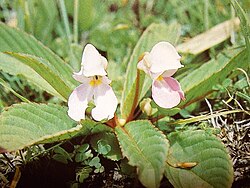
While many species are native to specific regions, human activity has spread several Impatiens species globally. The North American orange jewelweed (I. capensis) was introduced to various parts of Northern and Central Europe during the 19th and 20th centuries. In Europe, it shares habitats with the native touch-me-not balsam (I. noli-tangere), though they do not naturally hybridize.
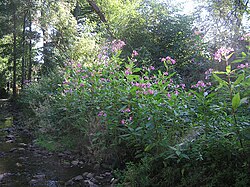
Some species, however, have become ecological liabilities. The Himalayan balsam (I. glandulifera) is a highly invasive weed that dominates riparian vegetation—plants growing along riverbanks—particularly in nitrogen-rich or polluted areas. Because it grows densely, it shades out smaller native plants. Furthermore, its shallow root system leaves riverbanks more susceptible to erosion.
Ecology and Pollination
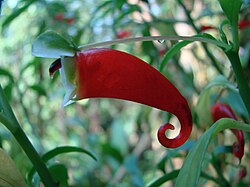
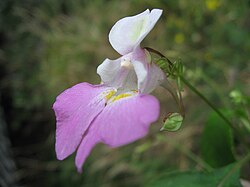
Impatiens exhibit a remarkable variety of flower architectures, which generally fall into three categories:
- Sacculate spur: Flowers with a pouch-like spur and two lips.
- Filiform spur: Flowers with a thread-like spur and a flat surface.
- Spur-less: A group of 125 species found specifically in Madagascar.
These variations are closely linked to their pollinators, which include bees, bumblebees, butterflies, moths, flies, and sunbirds. While most species rely on these pollinators for seed production, many are self-compatible. Some can switch from chasmogamous (open, pollinator-dependent) flowers to cleistogamous (closed, self-pollinating) flowers when light or nutrients are scarce.
The genus is also susceptible to various threats. The European dodder (Cuscuta europaea) acts as a parasite on these plants. Additionally, between 2011 and 2013, a severe outbreak of downy mildew, caused by the pathogen Plasmopara obducens, devastated Impatiens walleriana populations in the United States and Canada.
Phytochemistry and Medicinal Applications
Impatiens contain 2-methoxy-1,4-naphthoquinone, a compound with anti-inflammatory and fungicide properties used in some commercial hemorrhoid treatments.
In North America, species like orange jewelweed (I. capensis) and yellow jewelweed (I. pallida) are traditional herbal remedies for bee stings, insect bites, and stinging nettle rashes. They are also applied to prevent rashes from poison ivy. Scientific studies on their efficacy have yielded conflicting results; some suggest that a topical mash of the plant is more effective than a prepared extract in reducing contact dermatitis.

Cultivation and Ornamental Species
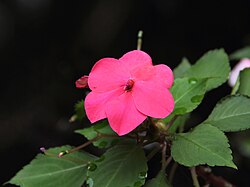
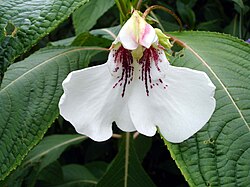
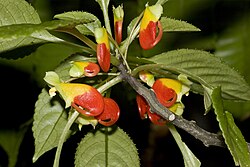
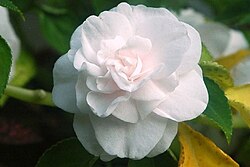
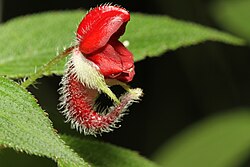
Due to their vibrant blooms, many Impatiens are cultivated as ornamental garden plants. Popular varieties include the "Busy Lizzie" (I. walleriana), the Congo cockatoo (I. niamniamensis), and the unique parrot flower (I. psittacina).
Summary of Notable Impatiens Species
| Scientific Name | Common Name | Key Characteristic/Status |
|---|---|---|
| I. glandulifera | Himalayan balsam | Invasive weed; disrupts riverbanks |
| I. capensis | Orange jewelweed | Used for skin irritations |
| I. walleriana | Busy Lizzie | Popular ornamental; prone to downy mildew |
| I. psittacina | Parrot flower | Ornamental with unique flower shape |
| I. noli-tangere | Touch-me-not balsam | Native to Central and Northern Europe |
Frequently Asked Questions
Why are they called "touch-me-nots"?
The name refers to the plant's explosive dehiscence, where the seed pods burst open at the slightest touch or upon maturity, scattering seeds several meters away.
Are all Impatiens invasive?
No. While some species like the Himalayan balsam (I. glandulifera) are highly invasive and harmful to ecosystems, many others are native to their regions or are kept as controlled ornamental garden plants.
Can Impatiens be used to treat poison ivy?
Some North American species, such as orange and yellow jewelweed, are used as traditional remedies. While some studies show a topical mash can decrease dermatitis, other research has provided conflicting results regarding their efficacy.
What is the "downy mildew" affecting Impatiens?
Downy mildew is a fungal-like disease caused primarily by the pathogen Plasmopara obducens. It caused significant losses of Impatiens walleriana in North American gardens between 2011 and 2013.
How do Impatiens flowers differ?
They vary by spur type: some have sacculate (pouch-like) spurs, some have filiform (thread-like) spurs, and a specific group of 125 species from Madagascar have no spurs at all.