Idealism in International Relations: History, Theory, and the Wilsonian Legacy
In the study of global politics, Idealism represents a school of thought centered on the belief that states are rational actors capable of achieving lasting peace and security. Rather than viewing conflict as an inevitable part of the human condition, idealists argue that through cooperation, international law, and shared moral frameworks, the world can move beyond the cycle of war.
Since the 1880s, this tradition has been shaped by a diverse array of thinkers, including Sir Alfred Zimmern, Norman Angell, John Maynard Keynes, John A. Hobson, Leonard Woolf, Gilbert Murray, Florence Stawell, Philip Henry Kerr, Arnold J. Toynbee, Lester Pearson, and David Davies.
Key Facts
- Core Belief: States can ensure peace through rationality and cooperation rather than relying on war.
- Primary Tools: Heavy reliance on international law and the establishment of international organizations.
- Democratic Peace Theory: The tenet that states with democratic governance are unlikely to fight one another.
- Political Reach: Idealism spans the political spectrum, from human rights advocates on the left to neoconservatives on the right.
- Defining Figure: U.S. President Woodrow Wilson, whose "Fourteen Points" and the League of Nations codified modern idealism.
Idealism vs. Realism: The Great Debate
Idealism is frequently contrasted with Realism, a worldview asserting that a nation's national interest outweighs ethical or moral considerations. Realist thinkers, such as Niccolò Machiavelli, Otto von Bismarck, Hans Morgenthau, and George F. Kennan, argue that power dynamics and security dilemmas drive state behavior.
The term "idealist" was popularized by E. H. Carr in his 1939 work, The Twenty Years' Crisis, which served as a fierce critique of inter-war idealist thought. While these two schools are often seen as opposites, they can converge; for example, American neoconservatism often blends elements of both.
Interestingly, some modern scholars, such as Lucian M. Ashworth and Richard Devetak, suggest that the "first great debate" between realism and liberalism may be a historical narrative rather than a series of actual exchanges. They argue that this dichotomy was largely constructed by Carr and later textbooks to structure the discipline of international relations.
The Influence of Woodrow Wilson
Woodrow Wilson is widely regarded as the central figure of idealism in foreign policy. His vision was deeply rooted in his religious faith, believing in a moral universe and the omnipotence of God. Historians like Arthur Link and Daniel Patrick Moynihan note that Wilson viewed world order as a manifestation of the "Holy Ghost of Reason." Some critics, such as Blum, argue that Wilson's convictions were also influenced by a belief in the superiority of Anglo-Saxons and a duty to reshape the world in their image.
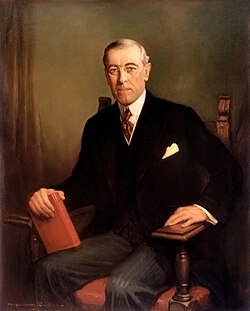
Wilson's practical application of idealism was most evident in his Fourteen Points speech. This program sought to create a world safe for democracy based on political, economic, and social standards. The centerpiece of this vision was the League of Nations, an organization designed to maintain peace and dismantle the tyranny that Wilson believed was the root cause of war.
A Lasting Global Legacy
Despite the failure of the U.S. Senate to ratify the Treaty of Versailles, Wilson's influence persisted. Diplomatic historian Walter Russell Mead notes that the fundamental pillars of modern European politics—self-determination, collective security, international law, and democratic government—are all Wilsonian in origin.
In the United States, historians like David Kennedy argue that every president since Wilson has embraced these core precepts, including those who leaned toward realism, such as Franklin D. Roosevelt, Henry Kissinger, and Richard Nixon. This influence remains vital in the 21st century, particularly in the wake of the events of September 11.
Summary of International Relations Perspectives
| Feature | Idealism | Realism |
|---|---|---|
| Primary Goal | Lasting peace and global security | Protection of national interest |
| View of States | Rational actors capable of cooperation | Competitive actors driven by power |
| Key Mechanisms | International law, Organizations, Democracy | Military strength, Strategic alliances |
| Key Figures | Woodrow Wilson, Norman Angell | Machiavelli, Hans Morgenthau |
Frequently Asked Questions
What is Democratic Peace Theory?
Democratic Peace Theory is a core tenet of idealism which posits that states with similar democratic modes of governance do not go to war with one another.
How does Idealism differ from Realism?
Idealism focuses on the potential for rational cooperation, international law, and morality to prevent war, whereas Realism argues that national interest and power dynamics are the primary drivers of international relations.
What were the Fourteen Points?
The Fourteen Points were a peace program proposed by Woodrow Wilson to establish a world safe for democracy, emphasizing liberty and the creation of the League of Nations to end tyranny.
Did the "Great Debate" between Idealism and Realism actually happen?
Some revisionist historians argue that there was no single, structured "great debate" consisting of direct exchanges, but rather a narrative created later to categorize the history of the discipline.
Which U.S. presidents have practiced Idealism?
While Woodrow Wilson is the primary figure, recent practitioners include Ronald Reagan and George W. Bush, and many subsequent presidents have integrated Wilsonian precepts into their foreign policy.