Ibrahim Babangida: The Military Presidency and Political Legacy of IBB
Ibrahim Badamasi Babangida, commonly known as IBB, remains one of the most influential and controversial figures in Nigerian history. A career military officer who rose to the rank of General, Babangida served as the military president of Nigeria from 1985 to 1993. His tenure, often referred to as the Babangida Era, was marked by sweeping economic reforms, a complex transition toward civilian rule, and a legacy of political instability.
Babangida's ascent to power was characterized by his involvement in nearly every major military coup in Nigeria's early post-independence years. After orchestrating a coup d'état against Muhammadu Buhari in August 1985, he ruled as an unelected dictator for eight uninterrupted years, leaving a lasting impact on the nation's political and economic landscape.
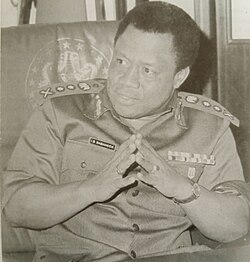
Key Facts
- Full Name: Ibrahim Badamasi Babangida (GCFR, GCB).
- Presidency: Served as the 8th President of Nigeria from August 27, 1985, to August 26, 1993.
- Military Rank: Attained the rank of General in the Nigerian Army.
- Economic Policy: Introduced the Structural Adjustment Program (SAP) in 1986.
- Major Controversy: Annulled the June 12, 1993, presidential election.
- Education: Trained at the Indian Military Academy and the Royal Armoured Centre (UK).
Early Life and Military Foundations
Born on August 17, 1941, in Minna, Northern Region of British Nigeria, Babangida began his education with Islamic studies before attending Government College Bida. He joined the Nigerian Army on December 10, 1962, and received his commission as a second lieutenant from the Indian Military Academy in September 1963.
His early career was defined by specialized training in armored warfare. He attended the Younger Officers Course at the Royal Armoured Centre in the United Kingdom, where he mastered gunnery and the Saladin armored car. This technical expertise paved the way for his rapid ascent through the military hierarchy.
Combat Experience and the Nigerian Civil War
During the Nigerian Civil War, Babangida served in the 1st Division. By 1968, he was the commander of the 44 Infantry Battalion, leading heavy fighting within Biafran territory. In 1969, during a reconnaissance operation from Enugu to Umuahia, he was shot in the right side of his chest. Despite the injury, he refused to have the bullet shrapnel removed, a physical reminder he carries to this day.
Following the war's end in January 1970, Babangida's career accelerated. He served as an instructor at the Nigerian Defence Academy and attended the Advanced Armoured Officers Course at the United States Army Armor School between 1972 and 1973. By 1975, he had become the commander of the Nigerian Army Armoured Corps.
The Path to the Presidency
Babangida was a central figure in Nigeria's cycle of military interventions. He was a key participant in the 1975 coup and played a decisive role in crushing the 1976 coup attempt that killed General Murtala Mohammed. By the early 1980s, as Director of Army Staff Duties and Plans, he became the primary architect of the 1983 coup that overthrew the Second Republic.
Although he initially installed General Muhammadu Buhari as the military head of state, Babangida eventually seized power himself on August 27, 1985, initiating a regime that would last nearly a decade.
The Babangida Era: Economics and Governance
Facing a severe economic crisis, Babangida implemented the Structural Adjustment Program (SAP) in 1986 with support from the International Monetary Fund (IMF) and the World Bank. This program aimed to restructure the economy through several key measures:
- Deregulation: Abolishing marketing boards and eliminating price controls in agriculture.
- Privatization: Selling off public enterprises to private owners.
- Currency Devaluation: Lowering the value of the Nigerian naira to boost export competitiveness.
- Social Re-orientation: Launching the Mass Mobilization for Self Reliance, Social Justice and Economic Recovery (MAMSER) to discourage waste and promote self-reliance.
The Third Republic and the June 12 Crisis
In 1989, Babangida began a transition toward civilian rule, establishing a two-party system consisting of the Social Democratic Party (SDP) and the National Republican Convention (NRC). He introduced a unique voting process known as Option A4, which required candidates to be adopted at local, state, and federal levels.
The process culminated in the presidential election of June 12, 1993. While results were not officially declared, data indicated that Moshood Abiola and Babagana Kingibe of the SDP had defeated the NRC candidates by over 2.3 million votes. However, Babangida annulled the election, citing national security considerations and electoral irregularities. This decision sparked widespread unrest, particularly in the South West, and remains one of the most contentious moments in Nigerian political history.
Post-Presidency and Later Years
After stepping aside in 1993, Babangida remained a significant figure behind the scenes. He briefly declared his intention to run for president in 2011 but withdrew following the Abuja bombing in October 2010. He later served as an informal advisor to President Goodluck Jonathan.
In recent years, Babangida has called for a generational shift in leadership to replace the military class of 1966. Notably, on February 20, 2025, during the release of his biography, he expressed regret for the 1993 annulment, admitting that the elections were free and fair and that MKO Abiola had indeed won.
Summary of Career and Honors
| Category | Details |
|---|---|
| Presidency Term | 1985 – 1993 |
| Highest Military Rank | General (attained 1987) |
| Key Economic Policy | Structural Adjustment Program (SAP) |
| Highest National Honor | Grand Commander of the Order of the Federal Republic (GCFR) |
| Notable Foreign Honor | Honorary Knight Grand Cross of the Order of the Bath (GCB), UK |
Frequently Asked Questions
Why did Ibrahim Babangida annul the June 12, 1993 election?
Babangida initially cited electoral irregularities and unspecified national security considerations as the reasons for the annulment. However, in 2025, he admitted the elections were free and fair and that MKO Abiola was the winner.
What was the Structural Adjustment Program (SAP)?
SAP was an economic restructuring plan launched in 1986 with IMF and World Bank support. It focused on privatizing public enterprises, deregulating agriculture, and devaluing the naira to make Nigerian exports more competitive.
What was the "Option A4" voting process?
Option A4 was a tiered adoption process used during the transition to the Third Republic, where candidates had to be adopted by voters at the local government, state, and federal levels before proceeding to the general election.
What role did Babangida play in the Nigerian Civil War?
He served as a commander in the 1st Division and led the 44 Infantry Battalion in heavy fighting within Biafran territory, where he was wounded in the chest in 1969.
How did Babangida come to power in 1985?
He orchestrated a military coup d'état against the then-military head of state, Muhammadu Buhari, on August 27, 1985.