Hypersonic Speed and the Physics of High-Mach Flight
In the realm of aerodynamics, hypersonic speed refers to velocities significantly faster than the speed of sound, typically defined as speeds exceeding Mach 5. While the transition from supersonic to hypersonic flight is not a sharp line, it marks a critical threshold where the physical behavior of airflow changes fundamentally.
At these extreme speeds, the kinetic energy of a moving object is converted into intense heat, causing the specific heat capacity of the air to change with temperature. This regime is not just about velocity; it is where molecular dissociation and ionization—the breaking apart of molecules and the stripping of electrons—become dominant factors in flight physics.
Key Facts
- Definition: Generally defined as speeds above Mach 5, though physical effects vary between Mach 5 and Mach 10.
- Thermal Impact: Kinetic energy transforms into internal energy, leading to extreme aerodynamic heating.
- Crewed Flight: Only the North American X-15 and the Space Shuttle orbiter have carried humans at speeds exceeding Mach 5.
- NASA Classifications: "High" hypersonic is defined as Mach 10–25, while re-entry speeds are Mach 25 or greater.
- Design Shift: Hypersonic vehicles often require blunt configurations to manage heat and use materials like cooled nickel or titanium.
The Characteristics of Hypersonic Flow
Hypersonic flow is distinguished by several unique physical phenomena that do not occur at lower supersonic speeds. Because of these complexities, the study of this field is often referred to as aerothermodynamics rather than simple aerodynamics.
Shock Layer and Stand-off Distance
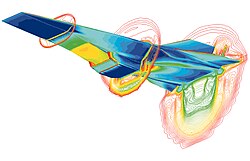
As a vehicle's Mach number increases, the density of the air behind the bow shock (the shock wave forming in front of the vehicle) increases. Due to the conservation of mass, this results in a decrease in volume, meaning the distance between the shock wave and the vehicle's body—the stand-off distance—becomes smaller.
The Entropy Layer and Viscous Interaction
Higher Mach numbers create a stronger entropy gradient across the shock, resulting in a highly vortical flow that mixes with the boundary layer. Simultaneously, viscous interaction occurs: kinetic energy is transformed into internal energy, raising the temperature. This temperature spike decreases the air density, causing the boundary layer to expand and potentially merge with the shock wave near the leading edge.
High-Temperature Real Gas Effects
When temperatures reach extreme levels, the air no longer behaves like a perfect gas. This leads to non-equilibrium chemical properties, including vibrational excitation, dissociation, and ionization of molecules, which create both convective and radiative heat flux against the vehicle's skin.
Classification of Mach Regimes
Aerodynamicists categorize flight into specific regimes based on the behavior of the airflow and the mathematical models required to analyze them.
| Regime | Mach No | General Characteristics | Example Vehicles |
|---|---|---|---|
| Subsonic | < 1 | Airflow is entirely below Mach 1; rounded features. | Commercial aircraft |
| Transonic | 0.8–1.2 | Mixed subsonic and supersonic flow; swept wings. | Northrop X-4 Bantam |
| Supersonic | > 1 | All airflow is supersonic; sharp edges and thin aerofoils. | SR-71 Blackbird, Concorde |
| Hypersonic | > 5 | Integrated design; nickel/titanium skins; interference effects. | NASA X-43, Boeing X-51 |
| High-Hypersonic | 10–25 | Thermal control is dominant; blunt configurations. | HTV-2, Avangard |
| Re-entry | ≥ 25 | Ablative heat shields; blunt shapes; minimal wings. | Space Shuttle, Dragon capsule |
Advanced Hypersonic Flow Regimes
Depending on the velocity and temperature, hypersonic flow is further divided into chemical and thermal states:
- Perfect Gas: Between Mach 5 and Mach 10–12, the gas behaves ideally, though simulations must account for constant-temperature walls.
- Dissociated Gas: At high temperatures (e.g., nitrogen at 2000 K), molecules break apart. The material of the vehicle's surface (catalysis) affects heating.
- Ionized Gas: At velocities of 3–4 km/s, electrons separate from atoms, creating a non-radiating plasma.
- Radiation-Dominated: Above 12 km/s, heat transfer shifts from conduction to radiation. This is split into optically thin (no re-absorption) and optically thick (radiation acts as a separate energy source) gases.
Frequently Asked Questions
What is the difference between supersonic and hypersonic speed?
Supersonic speed is any speed above Mach 1. Hypersonic speed generally begins at Mach 5. The primary difference is that at hypersonic speeds, high-temperature effects like molecular dissociation and ionization occur, which are negligible in standard supersonic flight.
Why are hypersonic vehicles often blunt rather than sharp?
Aerodynamic heating increases as the radius of curvature decreases. To manage the extreme heat flux and prevent the vehicle from melting, designers use blunt configurations to push the shock wave further away from the body.
What are real gas effects?
Real gas effects occur when the air can no longer be treated as an ideal gas. This happens at high temperatures where the internal energy of the gas causes molecules to vibrate, dissociate into atoms, or ionize into plasma.
Which crewed aircraft have flown at hypersonic speeds?
The only crewed spaceplanes to have officially flown faster than Mach 5 are the North American X-15 and the Space Shuttle orbiter.
What is a boost-glide vehicle?
A boost-glide vehicle is a type of hypersonic weapon designed to be launched (boosted) to a high altitude and speed, then glide through the atmosphere at speeds above Mach 5 while maneuvering toward a target.