Hypernymy and Hyponymy: The Hierarchy of Semantic Relations
In the study of linguistics and semantics, the way we categorize words is not random; it follows a structured hierarchy. Two of the most fundamental concepts in this organization are hypernymy and hyponymy. These terms describe the relationship between a general category and the specific instances that fall within it.
At its simplest, a hypernym (also known as a supertype, umbrella term, or blanket term) is a generic word that encompasses a broader category. A hyponym is a more specific term that names a subtype of that hypernym. For example, if we take the word "animal" as the hypernym, then "bird," "dog," and "fish" are its hyponyms. Because the semantic field—the range of meaning—of a hyponym is contained within the semantic field of its hypernym, we can say that a pigeon is a kind of bird, and a bird is a kind of animal.
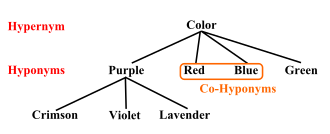
Key Facts
- Hypernyms are broad, generic terms (e.g., "Color").
- Hyponyms are specific instances of a hypernym (e.g., "Red").
- The relationship is transitive: if a violet is a purple, and purple is a color, then a violet is a color.
- These relations apply to the same word class (part of speech), such as nouns or verbs.
- In computer science, this is frequently referred to as an "is-a" relationship.
The Mechanics of Semantic Hierarchies
Hypernymy and hyponymy are converse relations. This means that if word X is a hyponym of word Y, then word Y must be a hypernym of word X. This structure creates a vertical arrangement of meaning, where the highest levels are the most general and the lowest levels are the most specific.
Beyond Nouns: Verbs and Abstract Terms
While these relations are most obvious with nouns, they also apply to other parts of speech. For instance, the verb "look" serves as a hypernym for more specific actions such as "stare," "gaze," "view," and "peer." However, applying this logic to abstract concepts like "knowledge" or "understand" can be more complex than with concrete objects.
Taxonymy and Co-hyponyms
A specific sub-variety of hyponymy is taxonymy. While simple hyponymy follows the logic of "An X is a Y," taxonymy is more discriminating, functioning as the vertical relation in a formal taxonomy (e.g., "An X is a kind of Y").
When multiple hyponyms share the same hypernym but are not hyponyms of each other, they are called co-hyponyms or coordinate terms. For example, "hammer," "screwdriver," and "knife" are all co-hyponyms of "tool." Most co-hyponyms are incompatible—a hammer cannot be a knife—though some may be compatible. For instance, "mother" and "queen" are both hyponyms of "woman," but a person can be both a mother and a queen simultaneously.
Autohyponyms and Vertical Polysemy
An autohyponym occurs when a single word serves as both the hypernym and its own hyponym. This is also known as vertical polysemy. In these cases, the word has a broad sense and a stricter, more specific sense that is a subset of the broad one.
Common examples include:
- Dog: Can refer to the entire species Canis familiaris (hypernym) or specifically to the male of the species (hyponym).
- Fingers: Can refer to all digits on the hand, or specifically to the non-thumb digits.
- Drink: Can mean consuming any beverage generally, or specifically consuming an alcoholic beverage.

Practical Applications in Technology and Translation
These semantic relations are vital for modern computational linguistics. In lexical databases like WordNet, hyponymy is the most frequently encoded relation among synsets (sets of synonyms). This allows computers to calculate semantic similarity by measuring the distance between two terms in a hierarchy.
Translation also relies heavily on these distinctions. For example, the English word "brother" is a hypernym for the Japanese words ani (older brother) and otōto (younger brother). A translator must determine the specific hyponym to use based on the context of the speakers' relative ages.
| Term | Definition | Example |
|---|---|---|
| Hypernym | A broad, umbrella term | Fruit |
| Hyponym | A specific instance of a category | Apple |
| Co-hyponym | Terms sharing the same hypernym | Apple and Orange |
| Autohyponym | A word that is its own hyponym | Dog (Species vs. Male) |
Frequently Asked Questions
What is the difference between a hypernym and a hyponym?
A hypernym is the general category (the "supertype"), while a hyponym is a specific member or subtype of that category. For example, "Color" is the hypernym and "Blue" is the hyponym.
Can a word be both a hypernym and a hyponym?
Yes. This happens in hierarchical chains. For example, "Purple" is a hyponym of "Color," but it is a hypernym for specific shades like "Violet."
What is an autohyponym?
An autohyponym is a word that possesses both a broad meaning and a more specific meaning that fits within that broad meaning, such as "drink" meaning any beverage or specifically an alcoholic one.
How is hyponymy used in computer science?
It is often modeled as an "is-a" relationship to create taxonomies and is used in lexical databases to determine how similar two words are based on their distance in a semantic tree.
What are co-hyponyms?
Co-hyponyms are words that share the same hypernym but are not subtypes of each other. For example, "cat" and "dog" are co-hyponyms because they are both types of "animal."