Hygrometers: The Science and Evolution of Humidity Measurement
Humidity—the measure of water vapor present in the air—is a critical variable in meteorology, industrial processes, and everyday comfort. To quantify this invisible gas, scientists use an instrument known as a hygrometer. Because water vapor content is intrinsically linked to temperature, measuring humidity often requires calculating the relationship between moisture, pressure, and thermal changes.
At its core, humidity measurement relies on observing how a substance reacts to moisture. This might involve measuring electrical changes, mechanical shifts, or changes in mass. Modern technology has advanced from simple charcoal bars to sophisticated electronic sensors that can detect minute changes in capacitance or the dew point—the specific temperature at which air becomes saturated and water vapor condenses into liquid.

Key Facts
- Hygroscopy: The property of a substance to absorb moisture from the surrounding air.
- Relative Humidity (RH): A measurement that changes with temperature, even if the absolute amount of water remains constant.
- Primary Standard: Gravimetric hygrometers are considered the most accurate method for measuring absolute humidity.
- Dew Point: The temperature at which condensation occurs; used by high-precision chilled mirror hygrometers.
- Historical Roots: Early humidity measurement dates back to the Shang dynasty in Ancient China.
The History of Humidity Sensing
The quest to measure moisture has spanned millennia. During the Shang dynasty in Ancient China, crude hygrometers utilized the weight difference of charcoal and earth to estimate humidity levels. As air became more humid, the materials would absorb water and increase in mass.
The formal scientific evolution of the device accelerated in the 15th and 16th centuries. Leonardo da Vinci developed a prototype in 1480, followed by significant improvements in the 1600s by Francesco Folli and Robert Hooke. In 1755, Swiss polymath Johann Heinrich Lambert created a more modern version, and in 1783, Horace Bénédict de Saussure introduced a revolutionary design using stretched human hair as a sensor.

Hair Tension Hygrometers
These devices exploit the hygroscopic nature of hair or whalebone. As the material absorbs moisture, its length changes. This minute physical shift can be magnified by a mechanical system to move a needle on a dial. This principle is even found in traditional folk art known as a "weather house."
Metal-Paper Coil Hygrometers
Common in inexpensive consumer devices, these use a salt-impregnated paper strip attached to a metal coil. As the paper absorbs water vapor, the coil changes shape, driving a needle across a scale. While convenient, these typically have a limited accuracy of 10% or more.
Classical Measurement: The Psychrometer
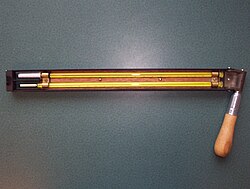
One of the most enduring methods of measuring humidity is the psychrometer, also known as a wet-and-dry-bulb thermometer. This instrument uses two calibrated thermometers: one kept dry and one covered with a moist wick.
As water evaporates from the wet wick, it cools the thermometer. The difference in temperature between the dry bulb and the wet bulb allows for the calculation of relative humidity. If the air is fully saturated, the two thermometers will show the same temperature. In the field, a sling psychrometer—where the thermometers are attached to a handle and spun manually—is often used to create the necessary airflow for stabilization.

Advanced Psychrometry and Calibration
For high-precision meteorological work, the Assmann psychrometer was developed. It uses concentric metal tubes and a fan to protect the thermometers from radiant heat and ensure consistent airflow. In freezing conditions, a heated psychrometer may be used to raise the air temperature above freezing, avoiding the complications of ice sublimation on the sensor.

Modern Electronic and Optical Technologies
Today, the industry relies on a variety of electronic sensors tailored to specific needs of cost, durability, and precision.
Chilled Mirror Dew Point Hygrometers
Regarded as some of the most precise instruments available, these devices use an optoelectronic mechanism to detect the exact moment condensation forms on a chilled mirror. Because they measure temperature—a fundamental SI unit—they serve as the gold standard for calibrating other instruments.
Capacitive and Resistive Sensors
Capacitive hygrometers measure changes in the dielectric constant of a material (like a polymer) as it absorbs moisture. They are robust and suitable for many applications, though they can be subject to aging and drift. Resistive hygrometers measure changes in electrical resistance in materials like salts or conductive polymers. While often less sensitive than capacitive versions, they can be engineered to be highly resistant to condensation.

Optical and Gravimetric Methods
For specialized scientific needs, optical hygrometers measure how much light is absorbed by water vapor in an air sample, following the Beer–Lambert law. Meanwhile, gravimetric hygrometers—the most accurate primary method for absolute humidity—work by physically extracting and weighing the water from a gas sample. Due to their complexity, they are primarily used as national calibration standards.
Summary of Hygrometer Types
| Type | Primary Mechanism | Typical Use Case |
|---|---|---|
| Hair Tension | Mechanical length change of hair/whalebone | Traditional/Folk weather devices |
| Psychrometer | Evaporative cooling (wet/dry bulb) | Meteorology and HVAC |
| Chilled Mirror | Optical detection of condensation | High-precision calibration |
| Capacitive | Change in dielectric constant | General electronic applications |
| Gravimetric | Mass measurement of extracted water | National metrology standards |
Frequently Asked Questions
Why does relative humidity change when temperature changes?
The maximum amount of water vapor air can hold (saturation) increases with temperature. Therefore, if the temperature rises but the amount of water stays the same, the relative humidity decreases.
What is the difference between absolute and relative humidity?
Absolute humidity refers to the actual mass of water vapor present in a specific volume of air, whereas relative humidity is a percentage representing how much moisture is present compared to the maximum amount the air could hold at that specific temperature.
How are hygrometers calibrated?
Hygrometers can be calibrated using chilled mirror dew point references, gravimetric methods, or saturated salt solutions. For example, a saturated sodium chloride bath provides a stable environment of approximately 75% humidity for testing.
Why is humidity measurement so difficult?
Humidity measurement is challenging because sensors are sensitive to temperature fluctuations, drift over time, and environmental contamination. Additionally, many sensors measure relative humidity, which is highly dependent on even slight temperature variations.
What is a dew point?
The dew point is the temperature at which a sample of moist air reaches saturation. If the temperature drops below this point, water vapor will condense into liquid water.