Hut Circles: The Ancient Roundhouses of Britain
Across the rugged uplands of Britain, the landscape is dotted with mysterious circular depressions known as hut circles. These archaeological features mark the footprints of prehistoric roundhouses—dwellings that once housed the inhabitants of the Bronze and Iron Ages. While only the foundations remain today, these sites provide a window into the domestic lives and architectural ingenuity of ancient peoples.
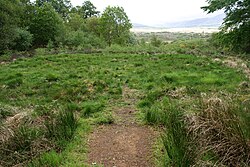
A hut circle is essentially a circular or oval depression in the ground. In many cases, these depressions are ringed by a low stone wall that served as the foundation for a larger structure. The superstructure of these homes was typically constructed from timber and topped with a conical roof of thatch. These dwellings were supported by posts, some of which were placed internally and others externally to maintain the stability of the rounded roof.
Key Facts
- Typical Dimensions: Internal diameters usually range from 5 to 25 feet (1.5 to 7.6 m).
- Wall Construction: Foundation stones are typically 2–3 feet wide and approximately 3 feet high.
- Primary Era: Most date to around the 2nd century BC, though some are older.
- Distribution: Found predominantly in upland areas of England, Wales, and Scotland.
- Materials: Foundations were stone, while upper structures were timber and thatch.
Regional Variations Across Britain
England and the Dartmoor Settlements
Hut circles are exceptionally numerous in England, particularly on Dartmoor, where an estimated 5,000 exist. One of the most significant sites is Grimspound, a Late Bronze Age settlement first inhabited around 1300 BC. Grimspound is remarkably well-preserved due to its robust stone construction.
The site features 24 hut circles enclosed by a massive granite perimeter wall that may have reached 5 feet 7 inches (1.7 m) in height. The individual roundhouses, averaging 11 feet (3.4 m) in diameter, were built using a double ring of granite slabs with a rubble infill—a precursor to modern dry-stone walling (the technique of constructing walls without mortar). In "Hut 3," a porchway remains visible with its jamb stones still standing, though the lintel has fallen.
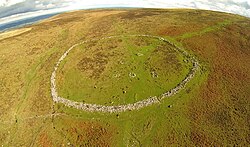
Victorian excavations at Grimspound uncovered pottery, scrapers, and pot boilers, though the acidic soil destroyed most organic materials. Every hut contained a central hearth characterized by remaining ashes.
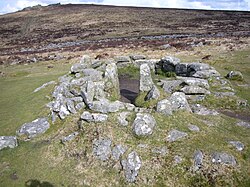
Other English sites include Halangy Down in the Isles of Scilly, where an Iron Age village of roundhouses sits below the Bant's Carn Bronze Age burial chamber.
Wales and the Northern Highlands
In Wales, over 100 registered hut circles and enclosures have been identified, particularly in the north. These sites are most often found in areas that have escaped ploughing, which has kept the stones undisturbed. Notable examples include the Holyhead Mountain hut circles, the Tre'r Ceiri Celtic Iron Age circles, and sites near Aber Falls in Conwy.
In Northern Scotland, hut circles appear in a different configuration. These are often found in pairs, spaced 20–30 yards (18–27 m) apart, and are typically surrounded by tumuli (burial mounds) of a sepulchral nature. These Scottish circles are larger than those found elsewhere, measuring approximately 40 feet (12 m) in diameter.
Summary of Hut Circle Characteristics
| Region | Typical Era | Key Characteristics | Notable Sites |
|---|---|---|---|
| Dartmoor, England | Late Bronze Age | Granite double-ring walls, rubble infill, perimeter walls | Grimspound |
| Wales | Iron Age | Common in northern uplands, often in unploughed land | Tre'r Ceiri, Holyhead Mountain |
| Northern Scotland | Unknown/Various | Larger diameter (40ft), found in pairs near tumuli | Arran (Torr Righ) |
Frequently Asked Questions
What exactly is a hut circle?
A hut circle is an archaeological feature consisting of a circular or oval depression in the ground, often ringed by a low stone wall. These served as the foundations for prehistoric roundhouses made of timber and thatch.
How large were these ancient houses?
Most hut circles have an internal diameter between 5 and 25 feet (1.5 to 7.6 m), though some in Northern Scotland are larger, reaching about 40 feet (12 m) in diameter.
What materials were used to build them?
The foundations were constructed from stone (such as granite on Dartmoor), while the walls and conical roofs were made from timber and thatch.
What evidence of daily life has been found inside them?
Excavations have revealed central hearths containing ashes, as well as pottery, scrapers, and pot boilers, providing evidence of cooking and tool-making.
Why are some hut circles better preserved than others?
Preservation depends on the building materials used—such as the solid granite at Grimspound—and whether the land has been disturbed by modern farming or ploughing.