Hugh J. Casey and the Engineering Feats of World War II
During the height of World War II, the success of military operations depended as much on infrastructure and logistics as it did on combat strategy. One of the most pivotal figures in this effort was Hugh J. Casey, a military engineer whose career spanned the design of the world's largest office building to the daunting task of building airstrips in the jungles of New Guinea.
The Design of the Pentagon
In October 1940, Casey returned to Washington, D.C., to serve as the chief of the Design and Engineering Section within the Construction Division of the Office of the Quartermaster General. Working under Brigadier General Brehon B. Somervell and alongside George Bergstrom, a former president of the American Institute of Architects, Casey focused on optimizing military housing. By increasing the size of standard barracks from 63 to 74 men, Casey reduced the total number of buildings required, thereby saving costs on land and utility infrastructure.
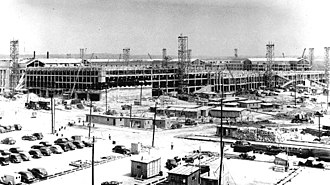
On July 17, 1941, Casey and Bergstrom were tasked with a monumental project: designing a single office complex to house 40,000 War Department staff members. Given a deadline of only one weekend, they conceptualized a four-story, five-sided structure with a total floor area of 5,100,000 square feet—double the size of the Empire State Building. This project became The Pentagon, with an estimated cost of $35 million. Although originally planned for the site of the old Washington Hoover Airport, President Roosevelt eventually moved the location away from Arlington National Cemetery.
Engineering Challenges in the Southwest Pacific
In September 1941, General Douglas MacArthur requested Casey's expertise as his chief engineer. Casey arrived in Manila in October, just before the conflict between the United States and Japan escalated. During the retreat to Bataan, Casey supervised critical demolitions, an effort for which he was awarded the Distinguished Service Cross. While most of MacArthur's headquarters relocated to Corregidor, Casey remained on Bataan with a small staff before eventually escaping via PT boat in March 1942.
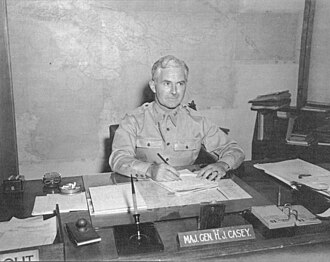
Upon arriving in Australia, Casey took over as Chief Engineer at MacArthur's General Headquarters (GHQ) for the Southwest Pacific Area (SWPA). The region presented extreme geographical hurdles; New Guinea's mountains and jungles lacked the ports, roads, and airstrips necessary for modern warfare. To manage this, Casey collaborated with Colonel Leif Sverdrup and Major General Clive Steele of the Australian Army, as well as civilian workers from the Allied Works Council.
Logistical Hurdles and Equipment Shortages
The engineering effort was plagued by severe supply chain issues. Equipment often arrived piecemeal across ports separated by thousands of miles. Critical shortages of concrete mixers, graders, tractors, and welding equipment hampered progress. The most pressing issue was the lack of spare parts; machinery operated 24/7 in harsh environments, and requisitions from the United States often took months to arrive, forcing a reliance on limited Australian supplies.
The Owen Stanley Range Expedition
In September 1942, Casey and Sverdrup investigated potential routes to outflank Japanese troops on the Kokoda Trail. They explored the Abau Trail, where Casey conducted depth soundings of the harbor using a native canoe. While Sverdrup determined the trail was impractical for troop movement after scaling heights of 5,000 feet, he discovered a plateau north of the Owen Stanley Range. This discovery allowed troops to be flown across the range, a strategic win for which Casey was awarded the Silver Star.
Command of ASCOM and the Philippines Campaign
As operations expanded, the Army Service Command (ASCOM) was formed in Brisbane on July 23, 1944, with Casey at the helm. ASCOM was designed to develop new bases and operate them until the United States Army Services of Supply (USASOS) could take over. For the Battle of Leyte, Casey commanded 43,000 men, including 21,000 engineers.
The campaign in Leyte was marked by environmental struggles. Heavy seasonal rains forced the abandonment of airbases in central Leyte, leading Casey to construct a new base on the coast. This required Lieutenant General Walter Krueger to move his headquarters to prioritize aircraft basing to prevent Japanese reinforcements. By February 1945, ASCOM was redesignated as the Luzon Base Section (LUBSEC), and Casey resumed his role as Chief Engineer, US Army Forces Pacific.
Key Facts
- The Pentagon: Designed in one weekend with a floor area of 5.1 million square feet.
- ASCOM Strength: Commanded 43,000 personnel (21,000 engineers) during the Battle of Leyte.
- Strategic Discovery: Identified a plateau in New Guinea that enabled aerial transport across the Owen Stanley Range.
- Major Awards: Recipient of the Distinguished Service Cross, Army Distinguished Service Medal, Silver Star, and Legion of Merit.
| Period/Date | Role/Project | Key Achievement/Outcome |
|---|---|---|
| July 1941 | Design of The Pentagon | Created a 5.1 million sq ft office complex for 40,000 staff. |
| 1942 | Bataan/Philippines | Supervised demolitions; awarded Distinguished Service Cross. |
| Sept 1942 | Owen Stanley Range | Located plateau for airstrips to bypass mountain trails. |
| July 1944 | Commander, ASCOM | Managed base development for the Philippines campaign. |
| 1945-1949 | Chief Engineer, US Army Forces Pacific | Oversaw post-war engineering and edited a 7-volume history. |
Frequently Asked Questions
How long did it take to design the initial layout of the Pentagon?
The initial design for the four-story, five-sided structure was roughed out over a single "very busy weekend" in July 1941, after Brigadier General Somervell gave the team until Monday morning to complete it.
What was the primary logistical challenge Casey faced in New Guinea?
The primary challenges were the lack of existing infrastructure (roads, ports, and airstrips) and a critical shortage of spare parts for heavy equipment, which was worn down by 24-hour use in harsh jungle conditions.
What was the purpose of the Army Service Command (ASCOM)?
ASCOM was formed to develop and operate new bases as far forward as combat operations allowed, eventually transferring those bases to the USASOS for long-term management.
Why was the location of the airbase in central Leyte changed?
Heavy seasonal rains made it impossible to develop the airbases in central Leyte, forcing Casey to move construction to the coast, which required the Sixth Army headquarters to relocate.
What happened to Hugh J. Casey after World War II?
He served as MacArthur's Chief Engineer in Japan until his retirement on December 31, 1949. He also edited the seven-volume series titled Engineers of the Southwest Pacific.