Huang Quan: Founding Master of Bird-and-Flower Painting
In the annals of Chinese art, few figures loom as large in the realm of nature studies as Huang Quan (903–965). A prolific artist who navigated the turbulent transition between the Five Dynasties period and the Song dynasty, Huang Quan is revered as a founding master of bird-and-flower painting—a specialized genre focusing on the meticulous depiction of flora and fauna.
Throughout his career, Huang served in the prestigious imperial painting academies of the Former Shu, Later Shu, and Song dynasties, cementing his status as a court favorite and a technical innovator. While his influence was vast, the physical remnants of his work are rare today, though historical records attest to his immense productivity.
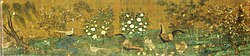
Key Facts
- Lifespan: 903–965 AD.
- Primary Genre: Bird-and-flower painting.
- Imperial Service: Worked for the Former Shu, Later Shu, and Song dynasties.
- Legacy: Co-founder of the bird-and-flower style alongside Xu Xi.
- Historical Record: The 1120 catalog Xuanhe Huapu critiques 349 of his works.
Early Life and Artistic Evolution
Huang Quan was born in 903 in Chengdu during a period of profound instability. The Tang empire had collapsed into a state of civil strife and warlordism, prompting many intellectuals and artists to seek refuge in the relatively peaceful Xichuan Circuit, then controlled by the warlord Wang Jian (who would later establish the Former Shu empire in 907).
At the age of 12, Huang began his formal training under Diao Guangyin, a bird-and-flower painter who had migrated from the Tang capital of Chang'an. Unlike his contemporary Kong Song, who focused on the faithful reproduction of Diao's techniques, Huang Quan was driven by a desire for original development. He expanded his horizons by studying the water paintings of Sun Wei and the landscape works of local master Li Sheng.
By synthesizing the strengths of these diverse mentors, Huang created a superior, individualized style that blended precision with artistic depth. His talent was recognized early; by the age of 16, in 919, he was appointed as an imperial attendant (daizhao) in the Painting Academy of Former Shu, a position he likely held until the empire's conquest by the Later Tang in 925.
Career and Legacy
Huang Quan's career spanned several political regimes, allowing him to maintain his influence across the Former Shu, Later Shu, and eventually the Song dynasty. His ability to adapt and excel within the imperial painting academies ensured that his work was highly valued by the ruling elite.
The scale of his output was staggering. The Xuanhe Huapu, a comprehensive catalog compiled in 1120, contains critiques of 349 of his pieces. Despite this prolific history, very few of his original paintings have survived to the present day, making the remaining records of his style invaluable to art historians.
| Category | Details |
|---|---|
| Born | 903, Chengdu, Tang |
| Died | 965, Kaifeng, Song |
| Courtesy Name | Yaoshu |
| Key Teachers | Diao Guangyin, Sun Wei, Li Sheng |
| Dynasties Served | Former Shu, Later Shu, Song |
| Children | Huang Jubao, Huang Jucai, and three other sons |
Frequently Asked Questions
Who was Huang Quan?
Huang Quan (903–965) was a renowned Chinese painter of the Five Dynasties and Song periods, recognized as a founding master of the bird-and-flower painting genre.
What makes Huang Quan's style unique?
Rather than simply copying his teacher Diao Guangyin, Huang Quan integrated the water painting techniques of Sun Wei and the landscape styles of Li Sheng to create a more comprehensive and superior artistic approach.
How many of his works survive today?
Very few of his works are extant, although the 1120 catalog Xuanhe Huapu mentions and critiques 349 of his pieces, indicating he was highly prolific.
Which imperial academies did he work for?
Huang Quan served in the imperial painting academies of the Former Shu, the Later Shu, and the Song dynasties.
Who were Huang Quan's children?
He had five sons, including Huang Jubao and Huang Jucai.