House of Yi: The Dynasty of the Joseon Kingdom and Korean Empire
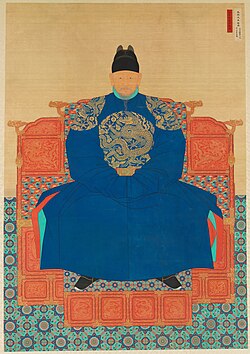
The House of Yi, a branch of the Jeonju Yi clan, served as the ruling dynasty of Korea for over five centuries. From the founding of the Joseon kingdom in 1392 to the formal annexation of the peninsula by Japan in 1910, the House of Yi shaped the political, social, and cultural landscape of the region. The dynasty evolved from a traditional kingdom into the short-lived Korean Empire as it struggled to maintain sovereignty amidst the imperial ambitions of neighboring powers.
Key Facts
- Founded: August 5, 1392, by Taejo of Joseon.
- Duration: 1392 to August 29, 1910.
- Titles: Rulers held the titles of King of Joseon and, later, Emperor of Korea.
- Final Ruler: Sunjong of Korea.
- Lineage: Originates from the Jeonju Yi clan, with approximately 105 extant cadet branches.
Early Governance and Noble Titles
Upon ascending the throne in 1392, Taejo of Joseon initially maintained the legal frameworks of the preceding Goryeo dynasty. During this early period, the title of "prince" (군) was granted to the king's sons, nephews, and sons-in-law. However, following a coup d'état in 1398, the system was restructured to include titles such as "duke" for the king's sons, "marquis" for royal descendants, and "earl" for senior first-rank officers.
This hierarchical system was short-lived; by 1401, it was abolished to avoid conflicting with the title laws of the Ming dynasty, which held significant influence over the region at the time.
The Middle Era and the Daewongun Title
As the dynasty progressed, the House of Yi faced complex issues regarding succession and biological lineage. In 1469, Seongjong ascended as the adopted heir to his uncle, Yejong. To honor his biological father, Crown Prince Uigyeong, Seongjong requested the Ming dynasty to ratify him posthumously as a king, granting him the temple name "Deokjong."
A similar situation occurred in 1568 when Seonjo succeeded as the adopted heir to his half-uncle, Myeongjong. Rather than elevating his biological father, Prince Deokheung, to the status of king, Seonjo created a new honorary title: Deokheung Daewongun. This established a precedent for the title of Daewongun, which was later granted to three other royals: Prince Jeongwon (later King Wonjong), Yi Kwang (Jeongye Daewongun), and Prince Heungseon.
The Transition to the Korean Empire
The late 19th century brought immense pressure from foreign powers. Following the Meiji Restoration, Japan utilized Western military technology to expand its influence, forcing Joseon to sign the Japan–Korea Treaty of 1876. Tensions between China and Japan eventually led to the First Sino-Japanese War, fought largely on the Korean peninsula. While the resulting Treaty of Shimonoseki (1895) officially recognized Korea's independence from China, it effectively placed Korean politics under Japanese control.
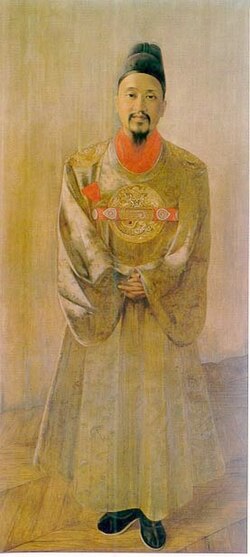
In an attempt to assert national integrity and independence, King Gojong declared the establishment of the Korean Empire in 1897, assuming the title of Emperor. This move placed him on equal diplomatic footing with the leaders of China and Japan. During this era, Korea sought military support from Russia to counter Japanese encroachment.
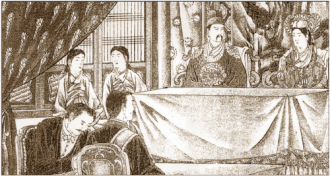
The period was marked by tragedy, including the 1895 assassination of Queen Min (Empress Myeongseong), which is believed to have been orchestrated by Japanese General Miura Gorō. The Queen had been a powerful political figure who sought to maintain neutrality by engaging with the Russian Empire.
Imperial Titles and Successors
As Emperor, Gojong and his successor, Sunjong, granted elevated titles to close relatives. Notable designations included Prince Imperial Ui (Yi Kang) and Prince Imperial Yeong (Yi Un). In 1910, Gojong's elder brother, Yi Jae-myeon, was named Prince Imperial Heung.
Japanese Annexation and Colonial Rule
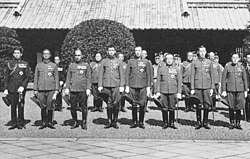
The rule of the House of Yi effectively ended on August 29, 1910, when Japan annexed the peninsula via the Japan–Korea Treaty of 1910. Under the terms of the annexation, members of the Yi imperial clan were incorporated into the Japanese nobility as Ōkōzoku (kings and dukes), ranking below the Japanese imperial family but above the general peerage.
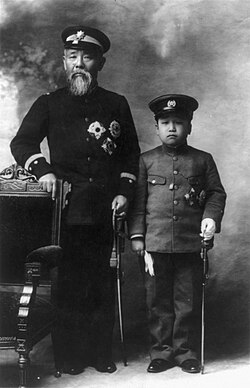
During the colonial period, the former imperial family lived under strict Japanese supervision. Crown Prince Yi Un, who became "King Yi" after Sunjong's death in 1926, married Princess Masako of Nashimoto (later known as Yi Bangja). Their children, Yi Jin and Yi Ku, were born into this complex political environment.
Summary of Imperial Clan Status (1910)
| Name | Japanese Title | Former Korean Title | Lifetime |
|---|---|---|---|
| Yi Hui | King Emeritus Yi of Deoksu | Emperor Emeritus (Gojong) | 1852–1919 |
| Yi Cheok | King Yi of Changdeok | Emperor (Sunjong) | 1874–1926 |
| Yi Un | Crown Prince of King Yi | Imperial Crown Prince | 1897–1970 |
| Yi Kang | Duke Yi Kang | Prince Imperial Ui | 1877–1955 |
| Yi Hui | Duke Yi Hui | Prince Imperial Heung | 1845–1912 |
Post-Liberation and Modern Legacy
Following Korea's liberation in 1945, the new government under President Syngman Rhee suppressed the imperial family to prevent any potential restoration of the monarchy. Many family members were stripped of their wealth and authority, leading some, such as Yi Haegyeong, to flee to the United States and Latin America.
It was not until 1963, under President Park Chung Hee, that some family members, including Princess Deokhye, were permitted to return to Korea. The Jeonju Lee Royal Family Association, founded in 1922 by Prince Imperial Ui and registered in 1957, continues to represent the descendants of the various cadet branches of the royal clan.
Frequently Asked Questions
Who founded the House of Yi?
The House of Yi was founded by Taejo of Joseon, who ascended to the throne on August 5, 1392, establishing the Joseon kingdom.
What was the difference between the Joseon period and the Korean Empire?
The Joseon period (1392–1897) was a kingdom where rulers were titled Kings. In 1897, to assert independence from foreign influence, the state was renamed the Korean Empire, and the ruler assumed the title of Emperor.
What happened to the royal family after the Japanese annexation in 1910?
The family lost sovereign power and was integrated into the Japanese nobility (Ōkōzoku), where they held titles such as King or Duke, positioning them below the Japanese Imperial House.
Who was the last ruler of the House of Yi?
The final ruler was Sunjong of Korea, who reigned until the formal deposition of the dynasty on August 29, 1910.
What is the Jeonju Lee Royal Family Association?
Founded in 1922, it is an organization consisting of descendants from the various cadet branches of the royal family, aimed at preserving the lineage and heritage of the House of Yi.