Horse Racing: A Global Sport of Speed, Tradition, and Economy
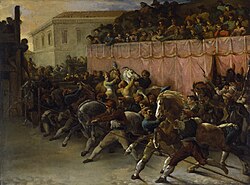
Horse racing is one of the world's most enduring sports, blending athletic prowess with deep-rooted cultural traditions. From the thundering hooves of flat races to the grueling demands of endurance treks, the sport is a worldwide phenomenon regulated by various national bodies and the International Federation of Horseracing Authorities. Whether held on turf, dirt, or synthetic surfaces, horse racing continues to captivate millions of spectators and stakeholders globally.
Beyond the spectacle of the race, the industry is a massive economic engine. While many participate for the love of the sport, gambling plays a pivotal role in its financial viability. In 2019, the global gambling market for horse racing was valued at approximately US$115 billion. This figure is projected to grow significantly, reaching US$235 billion by 2025 and potentially hitting US$512.4 billion by 2034.
Key Facts
- Global Reach: Practiced worldwide across diverse terrains and cultures.
- Economic Power: Gambling markets are projected to reach over US$500 billion by 2034.
- Elite Performance: The Thoroughbred Secretariat holds the fastest times in all three Triple Crown races (1973).
- Record Victories: North American jockey Russell Baze holds an unmatched 12,842 wins.
- High Earnings: Top horses, such as Romantic Warrior, have earned over $27 million in their careers.
Types of Horse Racing
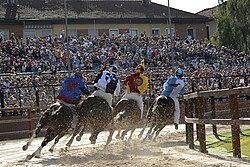
Horse racing is not a monolithic sport; it comprises several distinct disciplines, each requiring specific training and horse breeds.
Flat Racing
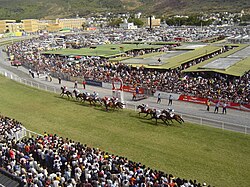
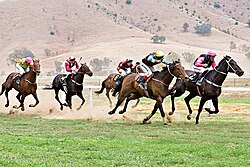
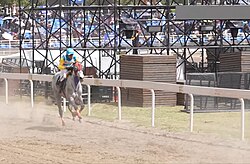
The most common form of racing, where horses compete on a level track without obstacles. In the United States, these races typically range from 5 to 12 furlongs (0.63 to 1.50 miles).
Jump Racing
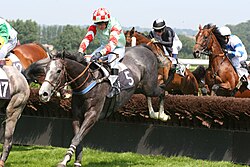
Also known as National Hunt racing, this involves horses leaping over fences or hurdles. A prime example is the Grand National, a race over 4 miles featuring treacherous fences, often described as the ultimate test of horse and rider.
![1890 engraving of horses jumping the Becher's Brook fence in the Grand National. With treacherous fences combined with the distance (over 4 miles), the race has been called "the ultimate test of horse and rider".[65]](/images/57/04/570408040c7d1918f11b94e264bbce8f73b9107ebf1e3e305f9485e2e7e36c38.jpg)
Harness Racing
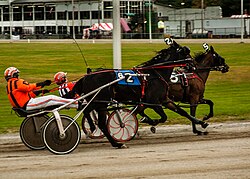
In this discipline, horses are pulled in a sulky (a lightweight two-wheeled cart) and must maintain a specific gait—either a trot or a pace—without breaking into a gallop.
Saddle Trotting and Endurance Racing
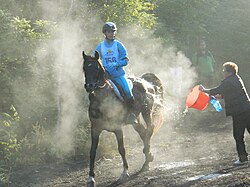
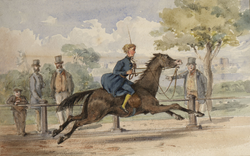
Saddle Trotting requires horses to trot from start to finish while carrying a rider under saddle. Endurance racing is a test of stamina where horses cover extreme distances, typically between 25 and 100 miles (40 to 161 km). Distances under 25 miles are classified as limited distance (LD) rides.
Primary Horse Breeds
Different breeds are utilized based on the requirements of the race type, focusing on muscle structure and cardiovascular capacity.
| Breed | Primary Racing Type | Key Characteristic |
|---|---|---|
| Thoroughbred | Flat and Jump Racing | High speed and stamina |
| Standardbred | Harness Racing | Ability to maintain a trot/pace |
| Arabian | Endurance Racing | Extreme stamina and hardiness |
| Quarter Horse | Short-distance Sprints | Explosive acceleration |
Regional Perspectives
North America
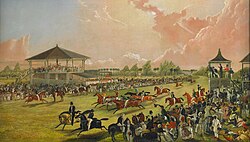
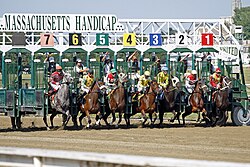
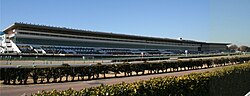
Organized racing in the U.S. gained momentum with the start of the American Stud Book in 1868. By 1890, 314 tracks were operational. Modern facilities like the Meadowlands Racetrack (opened 1977) and Lone Star Park (opened 1997) continue to host prestigious events like the Breeders' Cup.
Europe
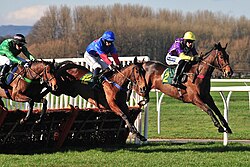
Europe boasts a rich tapestry of racing. In the Czech Republic, the Velka Pardubicka steeplechase has been a staple since 1874. Other nations like France, Great Britain, and Italy maintain deep traditions of both flat and jump racing.
Oceania
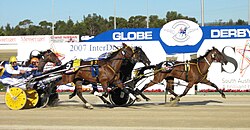
Australia is one of the top three Thoroughbred racing nations globally, famous for the Melbourne Cup. New Zealand's bloodstock industry is a major economic driver, exporting horses to Asia and Australia, generating over $120 million annually.
Asia and Africa
Racing varies widely across Asia. While Macau saw a peak in racing in the early 2000s before discontinuing in 2024, Japan and Hong Kong remain powerhouses. In the Philippines, racing evolved through three eras: the Philippine-pony, Arabian-horse, and the current Thoroughbred era. In Turkey, the Jockey Club of Turkey (founded 1950) revolutionized the breeding of Arabian and Thoroughbred horses.

Safety and Welfare
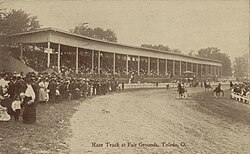
The sport faces ongoing scrutiny regarding horse safety. In the United States, statistics show approximately 1.5 horse deaths per 1,000 starts, with about 600 deaths reported in 2006. In contrast, Hong Kong reports a significantly lower rate of 0.58 deaths per 1,000 starts. Some experts speculate that the use of certain medications banned in other regions may contribute to the higher mortality rates in the U.S.
Frequently Asked Questions


What is the difference between flat racing and jump racing?
Flat racing takes place on a level track without obstacles, focusing on pure speed. Jump racing requires horses to clear hurdles or fences, testing both speed and agility over often longer distances.
Which horse breed is fastest for short sprints?
The Quarter Horse is specifically bred for explosive acceleration and is the primary breed used for short-distance sprint racing.
How does harness racing differ from traditional racing?
In harness racing, the horse does not carry a jockey on its back; instead, it pulls a driver in a two-wheeled cart called a sulky and must maintain a trot or pace.
What is the distance of an endurance race?
Endurance races typically range from 25 to 100 miles (40 to 161 km). Any ride shorter than 25 miles is considered a limited distance (LD) ride.
Why are death rates different between the US and Hong Kong?
While exact causes vary, there is speculation that the use of certain drugs in the United States, which are prohibited in other jurisdictions like Hong Kong, may contribute to the higher death rate per start.