Hornbills: The Majestic Ox-Horned Birds of Africa and Asia
Hornbills are a distinctive group of birds known for their oversized, curved bills and striking appearances. Belonging to the family Bucerotidae—a name derived from the Ancient Greek words for "ox" (boûs) and "horn" (kéras)—these birds are found across a vast range spanning from Sub-Saharan Africa to the Philippines and the Solomon Islands. From the tiny black dwarf hornbill to the massive southern ground hornbill, this family exhibits a remarkable diversity in size, color, and ecology.
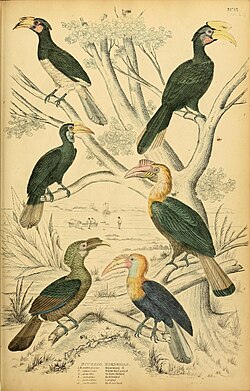
Key Facts
- Species Diversity: Approximately 62 living species across 16 genera.
- Size Range: Varies from the black dwarf hornbill (99.1 g) to the southern ground hornbill (up to 6.3 kg).
- Distribution: Found in Africa and Asia, though no single genus exists in both regions.
- Diet: Primarily frugivorous (fruit-eating), though some species are terrestrial insectivores.
- Conservation: Many Asian species are critically endangered due to habitat loss and the illegal ivory trade.
Physical Characteristics and Dimorphism
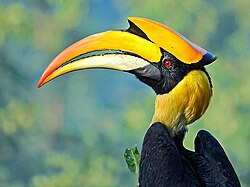
Hornbills are characterized by significant variation in their physical forms. The smallest member, the black dwarf hornbill, measures just 32 cm in length. In contrast, the southern ground hornbill is a giant of the family, with a wingspan reaching approximately 180 cm. Other long species include the Abyssinian ground hornbill and the great hornbill, while the helmeted hornbill may exceed 150 cm in length due to its extended tail feathers.
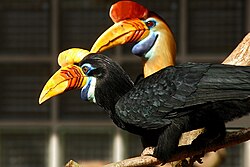
Sexual dimorphism—the physical difference between males and females—is present in all species, with males consistently being larger. This variation is most pronounced in bill length (8–30%) and wing length (1–21%), while body mass differs by only 1–17%.
Distribution and Habitat
The distribution of hornbills is split between two primary regions. In Africa, 24 species exist, with 13 inhabiting open woodlands and savannas—some even in arid environments—and the rest in dense forests. Asia's hornbills are predominantly forest-dwellers, with only one species adapted to open savannas.
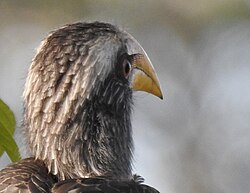
Regional highlights include:
- Indian Subcontinent: Home to 10 species, including the widespread Indian grey hornbill and the endemic Sri Lanka grey hornbill.
- Indonesia: Hosts 13 species, with a high concentration in Sumatra and Kalimantan.
- Philippines: Home to 11 endemic species, many of which are among the most endangered birds globally.
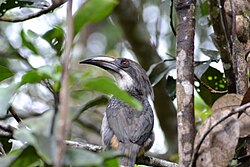
Behavior, Diet, and Ecology
Hornbills are diurnal (active during the day) and typically travel in pairs or small family groups. During the non-breeding season, they may form larger flocks, with some roosting sites hosting up to 2,400 individuals.
Their diet heavily influences their social structure. Species that specialize in fruit often travel long distances to find patchily distributed food sources and are generally less territorial. In contrast, other species may defend fixed territories.
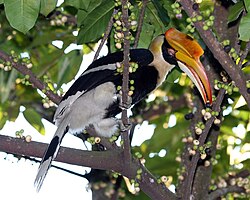
Hornbills also engage in fascinating interspecies relationships. In Africa, some species maintain a mutualistic relationship with dwarf mongooses, foraging together and providing mutual warnings about predators. Others exhibit commensal behavior, following monkeys to eat insects flushed out by the primates' movement.
![Male hornbill transfers a fig to the female.[20]](/images/6b/46/6b46685146f20af6d31a773c769aa9f344c363479229fbddc6fc440f796e95f5.png)
Taxonomy and Evolutionary History
The family Bucerotidae was first introduced by Constantine Samuel Rafinesque in 1815. Genetic research suggests that ground hornbills and the genus Bycanistes represent an early African lineage, while other Bucerotiformes likely evolved in Asia. Some scientists hypothesize that the hornbill evolutionary tree spread from the Indian microcontinent after the breakup of Gondwana before India merged with Asia.
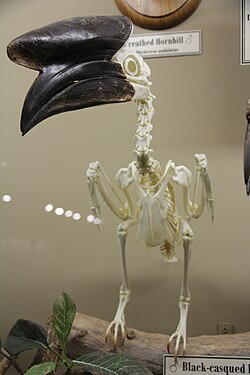
The fossil record indicates that hornbills have existed since the Early Miocene, approximately 19 million years ago. Remains have been found in Uganda (the oldest known specimen), as well as Morocco and Bulgaria, suggesting they once inhabited North Africa and Southern Europe during the Neogene period.
| Species | Key Characteristic | Primary Region | Conservation Status |
|---|---|---|---|
| Southern Ground Hornbill | Largest/Massive size | Africa (Savanna) | Not seriously threatened |
| Helmeted Hornbill | Longest tail/Solid casque | Asia | Critically Endangered |
| Sulu Hornbill | Extremely rare | Philippines | Critically Endangered |
| Black Dwarf Hornbill | Smallest species | Africa | Not seriously threatened |
| Great Hornbill | State bird of Kerala | Asia | Vulnerable |
Conservation Status
While African hornbills are generally stable, Asian species face severe threats from hunting and the loss of primary forests. The helmeted hornbill is particularly targeted for the trade in "hornbill ivory" (its solid casque). In the Philippines, the situation is critical; the Sulu hornbill is one of the world's rarest birds, with only about 40 mature individuals remaining. The Ticao hornbill was declared extinct in 2013.
Frequently Asked Questions
What is the difference between the smallest and largest hornbill?
The black dwarf hornbill is the smallest, weighing about 99.1 g and measuring 32 cm. The southern ground hornbill is the most massive, weighing up to 6.3 kg with a wingspan of approximately 180 cm.
Why are some hornbills endangered?
Asian hornbills are primarily threatened by the loss of primary forests and hunting. Specifically, the helmeted hornbill is hunted for its casque, which is traded as ivory.
Do hornbills live in groups?
Yes, they are generally diurnal and travel in pairs or small family groups, though they can form massive assemblies of up to 2,400 birds at certain roosting sites.
Where are hornbills found geographically?
They are distributed across Sub-Saharan Africa and from the Indian subcontinent through to the Philippines and the Solomon Islands. Interestingly, no single genus is found in both Africa and Asia.
What do hornbills eat?
Many species are frugivorous, meaning they primarily eat fruit. However, others, such as the ground hornbills, are terrestrial and eat insects and small animals.