Hoopoe: The Distinctive Crested Bird of Three Continents
The hoopoe is one of the most recognizable birds in the world, known for its striking crown of feathers and long, curved bill. Belonging to the family Upupidae, these birds are found across vast stretches of Europe, Asia, and Africa. Their names in Latin (Upupa) and Ancient Greek (epops) are onomatopoeic, meaning they were created to imitate the bird's unique call.
First classified by the Swedish naturalist Carl Linnaeus in 1758, the genus Upupa originally included several other species, such as the northern bald ibis and the red-billed chough, before modern taxonomy refined its boundaries to the specific crested birds we recognize today.
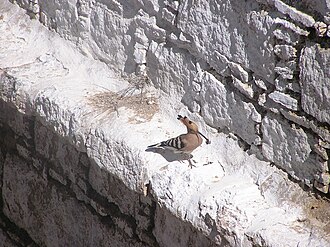
Key Facts
- Scientific Name: Upupa epops (Eurasian) and Upupa marginata (Madagascar).
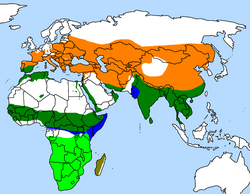
- Distribution: Widespread across Europe, Asia, North Africa, Sub-Saharan Africa, and Madagascar.
- Diet: Primarily insectivorous, specializing in ground-dwelling larvae and crickets.
- National Symbol: The Eurasian hoopoe is the national bird of Israel.
- Distinctive Feature: A retractable crest used for communication and display.
Species and Distribution
There are currently two recognized extant species within the genus Upupa. The Eurasian hoopoe (Upupa epops) is the most widespread, inhabiting Europe, Asia, and Africa. In contrast, the Madagascar hoopoe (Upupa marginata) is endemic to the island of Madagascar.
Migration patterns vary significantly by region. While African populations are generally sedentary, birds in Europe and North Asia migrate to the tropics during the winter. These birds are remarkably hardy; one individual was recorded at an altitude of approximately 6,400 meters (21,000 ft) during a Mount Everest expedition. While they typically prefer warmer climates, they have occasionally appeared as vagrants in Alaska.
Behavior and Ecology
Diet and Foraging
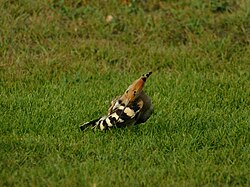
Hoopoes are primarily solitary foragers that feed on the ground. They use their long bills to probe soil, leaf piles, and bark for insect larvae, pupae, and mole crickets. While they prefer prey between 20–30 millimeters in length, they can consume insects ranging from 10 to 150 millimeters. To handle larger prey, hoopoes beat the insect against a stone or the ground to kill it and remove indigestible parts like legs and wings.
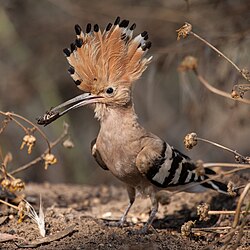
Though they mostly feed on the ground, they are capable of fast, maneuverable flight to catch swarming insects in the air. Their diet occasionally includes small reptiles, frogs, seeds, and berries.
Breeding and Life Cycle
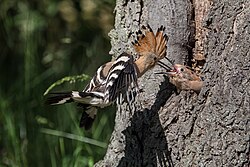
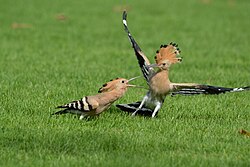
Hoopoes are monogamous for a single season and highly territorial. Males frequently call to mark their territory and may engage in brutal fights with rivals, sometimes resulting in injury or blindness. They nest in tree holes or wall cavities, where the female is solely responsible for incubating the eggs.
Clutch sizes vary by latitude: birds in the tropics may lay around four eggs, while those in central and northern Europe and Asia can lay up to 12. Interestingly, in times of food abundance, females may lay extra eggs to provide supplemental food for existing chicks. In some populations, such as those studied in Spain, a higher incidence of cannibalism among hatchlings has been linked to higher overall fledging success.
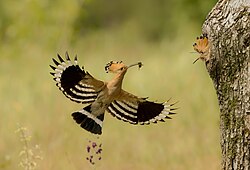
The incubation period lasts 15 to 18 days. Because incubation begins as soon as the first egg is laid, chicks hatch asynchronously. Young birds fledge in 26 to 29 days and remain with their parents for approximately one additional week.
Cultural Significance and Folklore
The hoopoe appears in various religious and mythological texts. In the Quran, the hudhud (hoopoe) serves as a messenger for King Solomon, bringing news of the Queen of Sheba. In Greek mythology, Ovid's Metamorphoses describes the character Tereus being transformed into a hoopoe, with the bird's crest symbolizing his royal status and its beak representing his violent nature.
Beyond mythology, the bird serves as a modern emblem. It is the national bird of Israel and the official mascot of the University of Johannesburg. In the state of Manipur, India, traditional healers have historically used the hoopoe in folk medicine, believing various parts of the bird could treat abdominal pain, kidney disorders, or even banish nightmares.
Summary of Hoopoe Species
| Common Name | Scientific Name | Primary Distribution | Migration Status |
|---|---|---|---|
| Eurasian Hoopoe | Upupa epops | Europe, Asia, North & Sub-Saharan Africa | Migratory (North) / Sedentary (Africa) |
| Madagascar Hoopoe | Upupa marginata | Madagascar | Sedentary |
Frequently Asked Questions
What do hoopoes eat?
Hoopoes primarily eat insects, including crickets, locusts, beetles, and ants. They also occasionally consume small reptiles, frogs, berries, and seeds.
Why is the hoopoe significant in Israel?
The Eurasian hoopoe was officially chosen as the national bird of Israel in May 2008 following a national survey of 155,000 citizens.
How do hoopoes hunt for food?
They typically stride across open ground and probe the soil with their long bills to detect larvae and pupae, which they then extract using their strong feet.
Do all hoopoes migrate?
No. While populations in Europe and North Asia migrate to the tropics for winter, African populations are sedentary and remain in their habitat year-round.
What is unique about their breeding habits?
Hoopoes are monogamous for one season and exhibit asynchronous hatching. In some cases, females lay extra eggs specifically to serve as food for the older chicks to increase the nest's overall success rate.