Hooded Crow: The Ash-Grey Intelligence of Eurasia
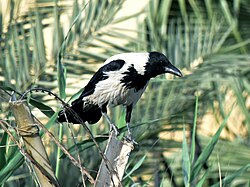
The hooded crow (Corvus corone cornix), often affectionately called the "hoodie," is a striking Eurasian bird known for its distinctive two-tone plumage. Found across Northern, Eastern, and Southeastern Europe, as well as parts of the Middle East, this member of the Corvidae family is a master of adaptation. With its ashy-grey body contrasted against a black head, wings, and tail, the hooded crow is as visually distinct as it is intelligent.
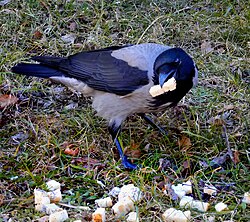
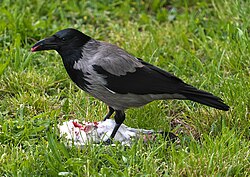
Like most corvids, the hooded crow is an omnivore—an animal that eats both plants and animals—and an opportunistic forager, meaning it takes advantage of whatever food sources are available in its environment.
Key Facts
- Appearance: Ash-grey torso with a black head, throat, wings, tail, and thighs.
- Distribution: Widespread across Northern, Eastern, and Southeastern Europe and the Middle East.
- Diet: Opportunistic omnivore.
- Taxonomy: Currently classified as a subspecies of the carrion crow (Corvus corone).
- Conservation Status: Least Concern (IUCN).
- Lifespan: Maximum recorded age is 16 years and 9 months.
Taxonomy and Classification
The hooded crow has a complex taxonomic history. Originally described by Carl Linnaeus in 1758 as Corvus cornix, the bird's classification has shifted over centuries. In 2002, the British Ornithologists' Union separated it from the carrion crow, treating it as a distinct species. However, by 2025, the global AviBase re-classified the hooded and carrion crows as a single species (Corvus corone) divided into six subspecies.
Subspecies of the Hooded Crow
There are four primary "hooded" (grey-and-black) subspecies:
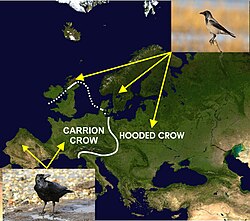
- C. c. cornix: Found in Ireland, Scotland, and much of northern and southeastern Europe.
- C. c. sharpii: A paler grey form located from western Siberia through the Caucasus to Iran.
- C. c. pallescens: The smallest subspecies, found in Cyprus, southern Turkey, the Levant, and Egypt.
- C. c. capellanus: A very pale, almost white-looking form found in Iraq and southwestern Iran.
Genetics and the "Contact Zone"
One of the most fascinating aspects of the hooded crow is its relationship with the all-black carrion crow. In regions where their ranges overlap—known as the contact zone—the two types can hybridize and produce fertile offspring. Despite this, they often remain distinct due to assortative mating, where birds prefer partners that look like themselves.
Genetic sequencing has revealed that the two are nearly identical. The difference in color is caused by the lack of expression of a tiny portion (less than 0.28%) of the genome on avian chromosome 18. Essentially, the hooded crow's grey color is a result of a small genetic "switch" being turned off.
Physical Description and Identification
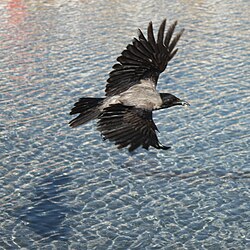
The hooded crow typically measures between 48 and 52 cm in length with a wingspan of 105 cm and an average weight of 510 g. While males are generally larger than females, they are otherwise similar in appearance. Their flight is characterized as slow, heavy, and usually straight.
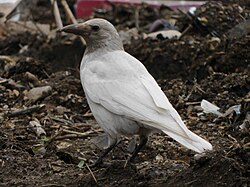
Juveniles differ significantly from adults; they are much blacker when hatched and possess duller plumage with bluish or greyish eyes and a red mouth. Adults undergo a single annual moult in autumn.
Diet and Behavior
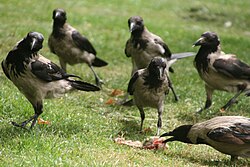
As opportunistic feeders, hooded crows consume a wide variety of foods. Their diet is flexible, allowing them to thrive in both wild and urban environments.
Nesting and Reproduction
Nesting timing varies by climate, occurring as early as February in the Persian Gulf and as late as June in northwest Russia. They build bulky stick nests in tall trees, though they may also use cliff ledges, pylons, or old buildings. In coastal areas, they often incorporate seaweed, animal bones, and wire into the structure.
The female typically lays four to six brown-speckled blue eggs, which she incubates alone for 17 to 19 days while the male provides food. The young fledge after 32 to 36 days.
Summary Table: Hooded Crow Profile
| Feature | Detail |
|---|---|
| Average Length | 48–52 cm |
| Wingspan | 105 cm |
| Average Weight | 510 g |
| Clutch Size | 4–6 eggs |
| Incubation Period | 17–19 days |
| IUCN Status | Least Concern |
Cultural Significance
The hooded crow appears frequently in European folklore. In Irish mythology, it is associated with the Morrígan and the dying hero Cú Chulainn. In the Scottish Highlands, they were once linked to fairies, leading shepherds to leave offerings to protect their sheep. In Faroese tradition, the bird's flight patterns during Candlemas were used as a divination tool to predict a maiden's future marriage.
Frequently Asked Questions
Is the hooded crow a different species from the carrion crow?
While they were separated into different species in 2002, they are currently classified as the same species (Corvus corone) by AviBase, with the hooded crow serving as one of several subspecies.
Why is the hooded crow grey while the carrion crow is black?
The difference is caused by the lack of expression of a very small part of the genome (less than 0.28%) on avian chromosome 18, which results in the lighter torso plumage.
Where can the hooded crow be found?
They are widely distributed across Northern, Eastern, and Southeastern Europe, as well as parts of the Middle East, including Iraq, Iran, and Egypt.
What do hooded crows eat?
They are opportunistic omnivores, meaning they eat a diverse range of food sources, including plants, insects, and animal flesh.
Are hooded crows protected by law?
In some regions, yes. For example, in the UK, they have been protected under the Wildlife and Countryside Act since 1981, making it illegal to knowingly kill or capture them.