Honam High-Speed Railway: Connecting South Korea's Southwest
The Honam High-Speed Railway (Honam HSR) serves as a vital transportation artery in South Korea, linking the central hub of Osong to the southwestern terminus of Mokpo. As a critical component of the Korea Train Express (KTX) system, this high-speed line has fundamentally transformed travel dynamics between the capital region and the Jeollanam-do province, fostering economic opportunities and enabling efficient daily commuting.
By providing a rapid alternative to the conventional Honam Line, the HSR has significantly reduced travel times, bridging the gap between major urban centers like Gwangju and the metropolitan area of Seoul. This infrastructure project represents a major milestone in South Korea's commitment to advanced rail technology and regional connectivity.
Key Facts
- Route: Connects Osong Station to Mokpo Station via Gwangju Songjeong.
- Inauguration: Officially opened on April 1, 2015.
- Total Length: 230.99 km (143.53 mi).
- Maximum Operating Speed: 305 km/h (190 mph).
- Primary Operator: Korea Train Express (KTX).
- Major Impact: Reduced Seoul to Gwangju travel time from 2h 40m to 90 minutes.
Technical Specifications and Infrastructure
The Honam HSR is engineered for high-performance transit, utilizing a standard gauge of 1,435 mm. The line is fully electrified via a 25 kV/60 Hz catenary system, supporting advanced rolling stock such as the KTX-I, KTX-Sancheon, and SRT models.
The physical construction of the line is a feat of modern engineering, featuring a significant amount of elevated and underground structures to maintain high speeds across the landscape. Specifically, the 230.99 km route includes approximately 111.7 km of viaducts (48.35%) and 49.12 km of tunnels (30.52%).
Route Summary Table
| Station Name | Line Distance (km) | Distance from Seoul (km) | All-Stops Travel Time |
|---|---|---|---|
| Osong | 0.00 | 121.4 | 0h 49m |
| Gongju | 43.8 | 165.2 | 1h 06m |
| Iksan | 89.8 | 211.2 | 1h 23m |
| Jeongeup | 131.9 | 253.3 | 1h 40m |
| Gwangju Songjeong | 182.4 | 303.8 | 1h 58m |
| Naju | 198.2 | 319.6 | 2h 08m |
| Mokpo | 249.2 | 370.6 | 2h 35m |
History and Development
The origins of the Honam HSR date back to early feasibility studies in 2003. Initially, planners proposed a two-stage construction process due to concerns regarding immediate demand. The first stage focused on connecting a second Seoul terminus to the Gyeongbu HSR and creating a branch to Iksan. The second stage aimed to extend the service to Gwangju and Mokpo.
Despite early skepticism regarding profitability, the South Korean government reversed its stance in late 2005 to ensure the project's completion to Gwangju by 2015. The project was financed through a split of 50% direct government funds and 50% loans. Construction on the primary sections began in earnest in December 2009, with the ground-breaking ceremony held at Gwangju Songjeong Station.
Service Evolution and Ridership
Before the dedicated high-speed line was completed, KTX services utilized the existing Honam Line, which significantly improved travel times compared to older conventional rail. For example, the initial KTX service reduced the Seoul to Mokpo journey from 4 hours 32 minutes to 2 hours 58 minutes.
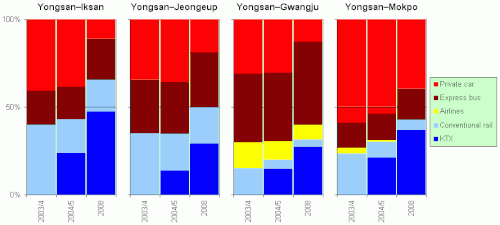
Since the full HSR line opened in 2015, ridership has seen significant growth. While initial figures were lower than the most optimistic forecasts, the service successfully captured market share from air transport and private vehicles. By 2008, the total rail modal share for routes between Yongsan and mid-way cities along the Honam Line had surpassed 50%.
Frequently Asked Questions
What is the maximum speed of the Honam HSR?
The Honam High-Speed Railway has an operating speed of up to 305 km/h (190 mph).
Which stations does the Honam HSR serve?
The line serves seven primary stations: Osong, Gongju, Iksan, Jeongeup, Gwangju Songjeong, Naju, and Mokpo.
How much time does the HSR save compared to conventional rail?
The HSR has drastically reduced travel times; for instance, the journey between Seoul and Gwangju was cut from 2 hours 40 minutes to just 90 minutes.
What rolling stock is used on this line?
The service utilizes various high-speed train models, including the KTX-I, KTX-Sancheon, and SRT.
How is the Honam HSR project funded?
The project is financed through a combination of 50% direct government funding and 50% loans.