Gyeongbu HSR: The High-Speed Backbone of South Korea's Rail Network
The Gyeongbu High-Speed Railway (Gyeongbu HSR) serves as the vital artery of South Korea's transportation infrastructure, connecting the nation's capital, Seoul, with the major southern port city of Busan. Since its inception, this high-speed line has fundamentally transformed domestic travel, drastically reducing journey times and fostering economic integration across the peninsula.
Managed by the Korea Rail Network Authority and operated by Korea Train Express (Korail), the line utilizes advanced rolling stock, including the KTX-I and the KTX-Sancheon, to move millions of passengers annually at impressive speeds.
Key Facts
- Primary Route: Seoul Station to Busan Station.
- Total Line Length: Approximately 387.3 km (240.7 mi) as of 2014.
- Maximum Operating Speed: 305 km/h (190 mph).
- First Regular Service: 1 April 2004.
- Major Rolling Stock: KTX-I, KTX-Sancheon, and SRT.
The Evolution of the Gyeongbu Line
The development of the Gyeongbu HSR was a multi-phase endeavor that began with a dedicated test track. Construction of a 57 km section between Cheonan and Daejeon commenced on 30 June 1992 to facilitate rigorous testing of high-speed technology.
Phase 1: Seoul to Daegu
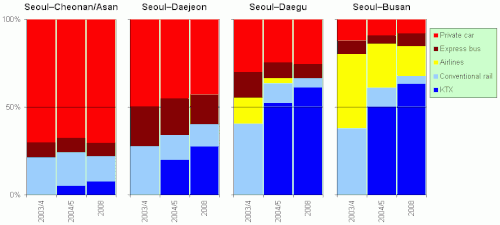
The first phase of regular service officially launched on 1 April 2004, covering the sections from Seoul to Daejeon and Daejeon to Daegu. This initial rollout revolutionized travel, cutting the time between Seoul and Busan from over four hours to just 2 hours and 40 minutes.
Phase 2: Daegu to Busan
The second major expansion was completed on 1 November 2010, extending the high-speed service from Daegu to Busan. This phase included significant infrastructure upgrades, such as the electrification of existing lines and the construction of new high-speed tracks to bypass urban congestion in Daejeon and Daegu.
By 2015, further improvements were made to provide more direct access to the downtown areas of both Daejeon and Daegu, optimizing the route for urban commuters.
Technical Specifications and Infrastructure
The Gyeongbu HSR is a highly engineered system designed for stability and speed. It utilizes a standard gauge of 1,435 mm and is powered by a 25 kV/60 Hz catenary system. To maintain high speeds safely, the line features a minimum curve radius of 7,000 meters.
| Feature | Specification |
|---|---|
| Track Gauge | 1,435 mm |
| Electrification | 25 kV/60 Hz catenary |
| Design Speed | 350 km/h |
| Operating Speed | 305 km/h |
| Minimum Radius | 7,000 m |
Service and Connectivity
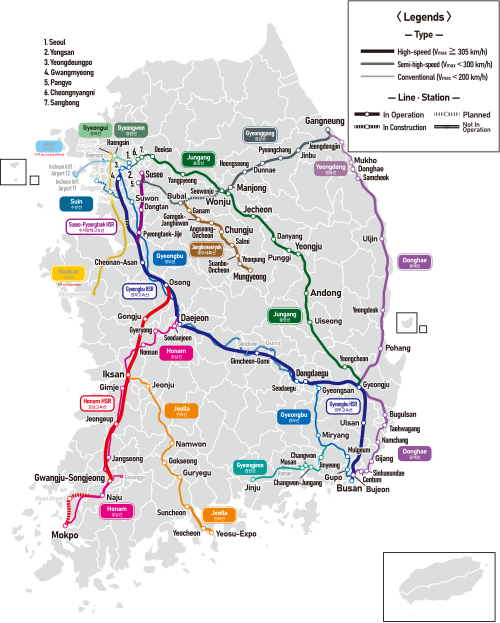
The Gyeongbu HSR is not an isolated line; it serves as a hub for several other critical rail services. For instance, the Honam HSR branches off from the Gyeongbu line at the newly constructed Osong station, providing high-speed access to Mokpo.
Passengers can choose from various service patterns. While the fastest services make minimal stops at major hubs like Daejeon and Daegu, other routes may utilize the conventional Gyeongbu Line to serve locations such as Gupo or Suwon, offering a balance between speed and accessibility.
Major Stations on the Route
The high-speed line includes several strategically placed stations designed to serve major metropolitan and regional centers:
- Gwangmyeong: Located in the southwestern suburbs of Seoul.
- Cheonan-Asan: Serving the Asan-si region.
- Osong: A critical junction for the Honam HSR.
- Gimcheon (Gumi): Serving the Gyeongsangbuk-do province.
- Dongdaegu: A major transit hub in Daegu.
- Gyeongju: Providing access to the historic city of Gyeongju.
- Ulsan: Serving the industrial and metropolitan area of Ulsan.
- Busan: The southern terminus of the line.
Frequently Asked Questions
What is the maximum speed of a KTX train on the Gyeongbu line?
While the line is designed for speeds up to 350 km/h, the current maximum operating speed is 305 km/h (190 mph).
How long does it take to travel from Seoul to Busan?
The fastest services can complete the journey in approximately 2 hours and 10 minutes to 2 hours and 18 minutes, depending on the specific stopping pattern.
Which trains operate on the Gyeongbu HSR?
The line is primarily served by KTX-I and KTX-Sancheon (KTX-II) rolling stock, as well as SRT services.
Where does the Gyeongbu HSR connect to other high-speed lines?
The Honam HSR branches from the Gyeongbu HSR at Osong station.
Are there different classes of service available?
Yes, passengers can choose between First Class and Standard Class. First Class offers additional amenities, including multi-channel audio broadcasts.