Holy See: The Sovereign Governance of the Catholic Church
The Holy See (Latin: Sancta Sedes) is the central governing body of the Catholic Church and a unique sovereign entity under international law. While often used interchangeably with Vatican City, the Holy See represents the spiritual and legal authority of the papacy, whereas Vatican City is the physical territory that provides the Holy See with a secure base of operations.
Operating as an apostolic theocracy, the Holy See is governed as a unitary theocratic Catholic elective absolute monarchy. Its leadership is headed by the Pope, supported by key officials including the Cardinal Secretary of State and the Camerlengo of the Holy Roman Church.
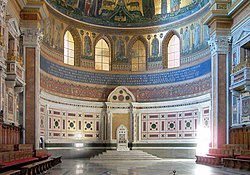
Key Facts
- Legal Status: A sovereign entity under international law, distinct from the state of Vatican City.
- Government Type: Unitary theocratic Catholic elective absolute monarchy.
- Diplomacy: Maintains formal relations with 183 sovereign states, the European Union, and the Sovereign Military Order of Malta.
- Official Languages: Latin (official) and Italian (working language).
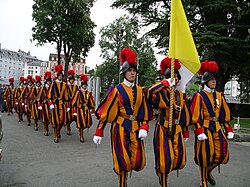
- Military: Protected by the Swiss Guard, consisting of 135 members.
Historical Evolution of Papal Sovereignty
The origins of the Holy See date back to the 1st century with Saint Peter, the "Prince of the Apostles." Its transition into a political power began in 380 AD when the Edict of Thessalonica made Christianity the state church of the Roman Empire. Following the fall of the Western Roman Empire in 476 AD, the temporal legal jurisdiction of papal primacy—the authority of the Pope over the Church—was codified in Canon law.
Territorial sovereignty was established through several key grants: the Donation of Sutri in 728 by the Lombard King Liutprand and the Donation of Pepin in 756 by the Frankish King Pepin. These events led to the creation of the Papal States, which held extensive territory and military forces from 756 until 1870.
The papacy's temporal power peaked during the medieval period, notably with the Dictatus papae in 1075. However, this authority faced challenges, including the Avignon Papacy (1309–1376) and the Peace of Westphalia in 1648, which diminished papal influence across Europe. In 1870, the Kingdom of Italy captured Rome, leaving the Pope as a "prisoner in the Vatican" for nearly six decades.
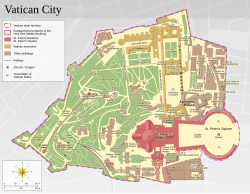
The Lateran Treaty and Modernity
The current status of the Holy See was resolved in 1929 through the Lateran Treaty with Italy. This agreement established Vatican City as an independent city-state. Under this arrangement, Vatican City is under the full ownership and sovereign jurisdiction of the Holy See, ensuring the papacy's independence from any single secular government.
Organization and Financial Management
The Holy See manages its global operations through a complex administrative structure. Financial assets are handled by the Amministrazione del Patrimonio della Sede Apostolica (APSA), which manages the patrimony of the Holy See, including European holdings and currency trading. In 2001, the entity reported a revenue of approximately 422.098 billion Italian lire (roughly US$202 million).
The administration is divided between the employees of the Holy See, who work within the Roman Curia and diplomatic missions, and the employees of the Vatican City State, who manage the physical infrastructure of the territory.
International Law and Global Diplomacy
The Holy See is recognized as a permanent subject of general customary international law. Its diplomatic activities are directed by the Secretariat of State through the Section for Relations with States. It maintains 180 permanent diplomatic missions abroad and hosts 69 diplomatic missions in Rome.
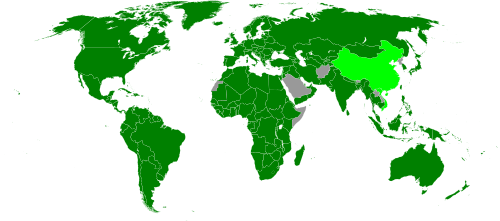
A notable aspect of its diplomacy is its relationship with China; the Holy See is the only European subject of international law that maintains diplomatic relations with the Republic of China (Taiwan) as the representative of China, rather than the People's Republic of China.
Security and the Swiss Guard
The security of the Holy See and the Pope is provided by the Swiss Guard. As of 2026, the Guard maintains a fixed strength of 135 members. Recruitment is strictly regulated by an agreement with Switzerland, requiring recruits to be unmarried Catholic males with Swiss citizenship, basic military training, and a minimum height of 175 centimeters.
Summary of the Holy See and Vatican City
| Feature | Holy See (Sancta Sedes) | Vatican City State |
|---|---|---|
| Nature | Sovereign legal entity / Universal government of the Church | Physical city-state / Sovereign territory |
| Function | Diplomacy, Canon Law, Spiritual Governance | Administrative and territorial support |
| International Status | Subject of international law | Independent state |
| Relationship | The governing authority | The territory owned by the Holy See |
Frequently Asked Questions
What is the difference between the Holy See and Vatican City?
The Holy See is the central government of the Catholic Church and the legal entity that conducts diplomacy. Vatican City is the physical territory and independent state that provides the Holy See with a sovereign base of operations.
How is the Holy See governed?
It is an apostolic theocracy and a unitary theocratic Catholic elective absolute monarchy, with the Pope serving as the supreme authority.
Who is eligible to join the Swiss Guard?
Recruits must be Swiss citizens, Catholic, unmarried males aged 19 to 30, at least 175 cm tall, and have completed basic training with the Swiss Armed Forces.
Does the Holy See have diplomatic relations with all countries?
The Holy See maintains formal diplomatic relations with 183 sovereign states, though there are 12 internationally recognized states with which it does not have relations.
What was the purpose of the Lateran Treaty?
Signed in 1929, the Lateran Treaty ended the dispute between the papacy and the Kingdom of Italy, recognizing Vatican City as an independent state and ensuring the Holy See's sovereign authority.