Hodgkin-Huxley Model and the Ionic Basis of Action Potentials
The foundation of modern neuroscience rests heavily on the discovery of how electrical signals travel through neurons. Between 1945 and 1963, a series of groundbreaking experiments and mathematical formulations revealed the biophysical mechanisms of the action potential—the rapid rise and fall in electrical membrane potential that allows neurons to transmit information over distances.
The Path to Discovery
Following his military service in World War II, Alan Hodgkin returned to research at Cambridge. Collaborating with W. A. H. Rushton, Hodgkin first focused on the mathematical calculation of membrane resistance, membrane capacity, axoplasm resistance, and the resistance of external fluids based on experimental data.
By the late 1940s, Hodgkin joined forces with Bernard Katz and Andrew Huxley. Spending several summers at the Plymouth Marine Laboratory, the team utilized the giant axon of the squid, a biological specimen large enough to allow for precise internal measurements of resting and action potentials.
To isolate specific electrical currents, they employed a technique called the voltage clamp, building upon the work of Kenneth S. Cole. This method allows researchers to hold the membrane voltage at a fixed level, making it possible to measure the flow of individual ions across the membrane.

The Hodgkin-Huxley Model
In 1949, the team published a series of five seminal papers in The Journal of Physiology. They proposed that the action potential is driven by changes in the selective permeability of the cell membrane to specific ions: sodium (Na+), potassium (K+), and chloride (Cl-).
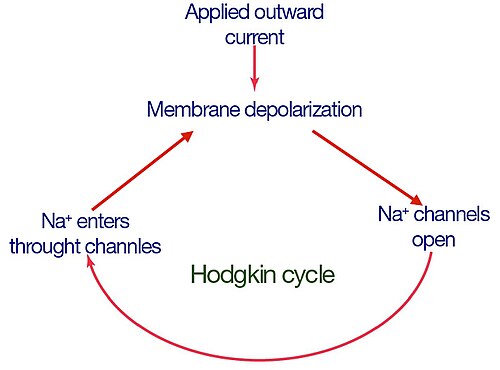
Their findings described a self-reinforcing loop now known as the Hodgkin cycle. In this process, a small depolarization of the membrane triggers an increase in sodium permeability. This allows sodium ions to diffuse inward, which further depolarizes the membrane, leading to an even greater increase in sodium permeability.
The team translated these biological observations into a mathematical model using differential equations. By representing the excitable cell as a set of electrical elements, they created a theoretical framework that aligned closely with their empirical measurements.
Key Facts
- Core Mechanism: Action potentials are caused by changes in the membrane's selective permeability to sodium and potassium ions.
- The Hodgkin Cycle: A positive feedback loop where depolarization increases sodium permeability, leading to further sodium influx and more depolarization.
- Experimental Tool: The voltage clamp was essential for measuring ionic currents while maintaining a constant membrane voltage.
- Biological Model: The giant axon of the squid provided the necessary scale for these electrophysiological measurements.
- Ion Restoration: The Na+/K+-ATPase enzyme restores ionic gradients by exporting three sodium ions for every two potassium ions imported using ATP.
Restoring the Equilibrium
After explaining how the action potential occurs, Hodgkin and Richard Keynes investigated how the cell reverses these ionic changes to prepare for the next signal. They identified a secretory mechanism that moves sodium and potassium against their electrochemical gradients.
This hypothesis was later validated by Danish scientist Jens Christian Skou, who discovered the enzyme Na+/K+-ATPase. This enzyme uses energy from ATP to actively transport ions, maintaining the necessary gradients for continued neuronal excitability.
While Hodgkin and Huxley hypothesized the existence of ion channels (specialized proteins that allow ions to pass through the membrane), these were not physically confirmed until decades later through the development of the patch clamp technique by Erwin Neher and Bert Sakmann, and further structural work by Roderick MacKinnon.
Summary of Scientific Contributions
| Scientist(s) | Key Contribution | Recognition |
|---|---|---|
| Hodgkin & Huxley | Ionic mechanism of action potentials & mathematical model | Nobel Prize (1963) |
| Neher & Sakmann | Development of the patch clamp to confirm ion channels | Nobel Prize (1991) |
| Jens Christian Skou | Discovery of Na+/K+-ATPase enzyme | Nobel Prize (1997) |
| Roderick MacKinnon | Structural insights into ion channels | Nobel Prize (2003) |
Frequently Asked Questions
What is the Hodgkin-Huxley model?
It is a mathematical model that describes how action potentials in neurons are initiated and propagated. It uses differential equations to represent the cell membrane as an electrical circuit, focusing on the changing permeability of sodium and potassium ions.
How does the Hodgkin cycle work?
The Hodgkin cycle is a positive feedback loop: a slight depolarization of the cell membrane increases the permeability of sodium channels, allowing sodium ions to flow into the cell, which in turn causes further depolarization.
What is the role of the voltage clamp?
The voltage clamp is an electrophysiological technique used to hold the membrane potential of a cell at a set level, allowing researchers to measure the specific ionic currents flowing across the membrane without the voltage changing.
How is the ionic balance restored after an action potential?
The balance is restored by the Na+/K+-ATPase enzyme, which actively pumps three sodium ions out of the cell and brings two potassium ions in, using ATP as an energy source to move ions against their gradients.
Why was the squid giant axon used in these experiments?
The squid giant axon is significantly larger than typical mammalian axons, making it physically possible for researchers to insert electrodes and measure internal membrane potentials and currents.