Hoary Plantain (Plantago media)
The hoary plantain, scientifically known as Plantago media, is a resilient flowering plant belonging to the Plantaginaceae family. Native to central and western Europe, including Great Britain, this species has also been introduced to parts of the north-east United States. While its name may cause confusion, it is entirely unrelated to the starchy banana commonly referred to as a plantain; instead, its generic name is derived from the Latin word for "sole."
Key Facts
- Scientific Name: Plantago media L.
- Conservation Status: Secure (NatureServe).
- Habitat: Damp grassy meadows and calcicole soils (chalk or limestone).
- Pollination: Hermaphrodite; pollinated by wind or insects, especially bees.
- Edibility: Edible leaves with a history of use dating back to the Roman era in Britain.
Botanical Description
Plantago media is characterized by a basal rosette of finely-haired leaves from which a slender stalk emerges. This stalk typically ranges in height from 5 to 50 cm (2 to 20 in). Between May and September, the plant produces delicate pink-white flowers.
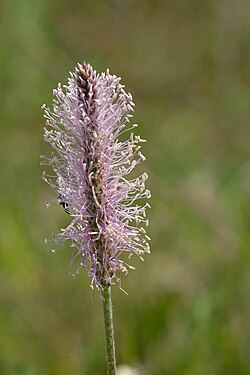
The plant is a hermaphrodite, meaning it possesses both male and female reproductive organs. This allows it to be efficiently pollinated by both the wind and various insects, with bees playing a particularly significant role in its reproduction.
Distribution and Habitat
Primarily native to Eurasia, the hoary plantain is common in eastern England, though it remains scarce in Ireland and Scotland. It is specifically a calcicole, a term used to describe plants that thrive in lime-rich soils, such as those found on chalk or limestone.
Its preferred environments include:
- Damp grassy meadows (up to altitudes of 2,000 m / 6,600 ft).
- Lawns and grasslands.
- Waste places.
Nutritional Value and Historical Use
Archaeological evidence indicates that Plantago media was utilized during the Roman era in Britain. Today, it is recognized as an edible plant. The fresh leaves provide a modest amount of energy and are particularly high in fiber.
| Nutrient | Amount |
|---|---|
| Energy | 22.586 kcal |
| Protein | 3.33 g |
| Net Carbohydrates | 1.99 g |
| Fiber | 2.25 g |
| Fat | 0.2 g |
Frequently Asked Questions
Is the hoary plantain the same as the fruit plantain?
No. Despite the similar name, Plantago media is a flowering herb in the Plantaginaceae family and is completely unrelated to the starchy banana known as a plantain.
Where does the hoary plantain typically grow?
It grows in damp grassy meadows, lawns, and waste places, particularly in soils rich in chalk or limestone (calcicole soils), at altitudes up to 2,000 meters.
How is the hoary plantain pollinated?
The plant is a hermaphrodite and is pollinated by both wind and insects, with bees being particularly important pollinators.
Is Plantago media edible?
Yes, the plant is edible. Historical records show it was used during the Roman era in Britain, and nutritional analysis confirms it contains protein and fiber.
What is the conservation status of this species?
According to NatureServe, the conservation status of the hoary plantain is listed as Secure.