Aquilegia atrata: The Dark Columbine of the European Mountains
The Aquilegia atrata, commonly known as the dark columbine, is a striking perennial flowering plant belonging to the Ranunculaceae family. Native to the rugged terrains of the Alps and Apennine Mountains, this species is celebrated for its deep, moody hues and its ability to thrive in high-altitude environments.
Unlike many of its brighter relatives, the dark columbine is defined by its somber palette, making it a unique specimen of European mountain flora. Its presence in rocky limestone areas and high-altitude forests highlights its specialized adaptation to alpine and subalpine conditions.
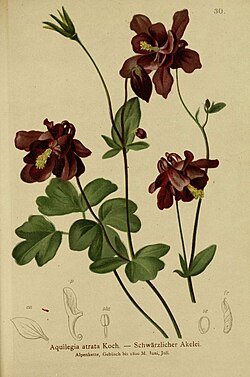
Key Facts
- Common Name: Dark columbine.
- Native Range: Alps and Apennine Mountains (Germany, Switzerland, Liechtenstein, Austria, Slovakia, France, Italy, and Slovenia).
- Flower Colors: Typically brown, purple, or wine-colored.
- Habitat: Rocky limestone areas and forests of beech, silver fir, and Scots pine.
- Bloom Period: June to July.
- Height: Approximately 60 cm (24 in).
Botanical Description and Identification
The dark columbine is a perennial herb that typically reaches a height of about 60 cm. While it shares similarities with the more widespread Aquilegia vulgaris, it is generally smaller in stature. A key identifying feature is its stamens, which protrude further from the flower than those of its common relative.
The most distinguishing characteristic is the flower color. As the name suggests, the blooms are usually dark—ranging from deep purple and wine-red to brown—though variations can occur. The specific epithet atrata is derived from Latin, meaning "blackened" or "darkened," directly referencing this unique coloration.
Taxonomy and Classification
Taxonomically, Aquilegia atrata is placed within the Aquilegia vulgaris complex. While it is currently accepted as a distinct species, genetic research indicates that it is not genetically distinguishable from other members of this complex. This suggests a close evolutionary relationship and a high degree of similarity across the group.
| Rank | Classification |
|---|---|
| Kingdom | Plantae |
| Clade | Angiosperms (Flowering plants) |
| Order | Ranunculales |
| Family | Ranunculaceae |
| Genus | Aquilegia |
| Species | A. atrata |
Distribution and Habitat
This species is indigenous to the mountainous regions of Central and Southern Europe, specifically in Germany, Switzerland, Liechtenstein, Austria, Slovakia, France, Italy, and Slovenia. It has also been introduced to Russia (western Siberia) and the Czech Republic.
The dark columbine prefers alpine and subalpine habitats. It is most frequently found in rocky limestone areas or within the shelter of forests dominated by beech, silver fir, and Scots pine.
Ecology and Environmental Interactions
The flowering season for Aquilegia atrata occurs between June and July. Throughout its life cycle, the plant interacts with various insects and fungi:
- Insects: The plant serves as a host for the columbine sawfly (Pristiphora rufipes), the leaf miner (Phytomyza aquilegiae), and the tortrix moth (Cnephasia sedana).
- Fungal Pathogens: The leaves are susceptible to powdery mildew (caused by Erysiphe aquilegiae var. aquilegiae) as well as the rust fungi Puccinia scarlensis and Puccinia agrostidis.
Conservation Status
Currently, Aquilegia atrata has not been evaluated for the IUCN Red List. However, it receives legal protection in several Swiss regions. It is fully protected in the cantons of Aargau, Appenzell Ausserrhoden, and Obwalden, and enjoys partial protection in Bern and St. Gallen.
Frequently Asked Questions
How does Aquilegia atrata differ from Aquilegia vulgaris?
Aquilegia atrata is generally smaller, reaching about 60 cm, and possesses stamens that protrude further from the flower. It is also characterized by its darker flower colors, such as wine, purple, or brown.
What does the name "atrata" mean?
The name atrata is Latin for "blackened" or "darkened," which refers to the species' characteristic dark-colored flowers.
Where can the dark columbine be found in the wild?
It is native to the Alps and Apennine Mountains across countries including Italy, France, Switzerland, and Austria, typically growing in rocky limestone areas and specific coniferous or deciduous forests.
Is the dark columbine an endangered species?
It has not been formally evaluated by the IUCN; however, it is protected by law in several Swiss cantons to ensure its preservation in the wild.
Which pests and diseases affect this plant?
The plant is targeted by the columbine sawfly, leaf miners, and tortrix moths. It is also prone to fungal infections including powdery mildew and various species of rust fungi.