HMS Maidstone: The Versatile History of a Royal Navy Depot Ship
Throughout its long and varied service, HMS Maidstone served as a critical support hub for the Royal Navy. As a depot ship—a specialized vessel designed to provide maintenance, supplies, and living quarters for smaller warships—Maidstone played a pivotal role in submarine operations across the globe, from the heat of the Mediterranean to the icy waters of Northern Ireland.
Key Facts
- Primary Role: Served as a depot ship for multiple submarine flotillas.
- WWII Reach: Operated in Gibraltar, Algiers, Ceylon, and Western Australia.
- Notable Event: Served as a prison ship in Belfast during Operation Demetrius.
- Final Fate: Scrapped in 1978 at Inverkeithing, Scotland.
- Legacy: The ship's bell is currently preserved at Maidstone Grammar School.
Service During the Second World War
At the outbreak of war in September 1939, HMS Maidstone served as the depot ship for the ten submarines of the 1st Submarine Flotilla. By March 1941, the vessel had moved to Gibraltar, and by November 1942, it was based at Algiers Harbour, which functioned as the primary Allied base in the Mediterranean.
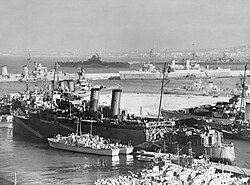
The ship's operational reach expanded significantly in November 1943 when it was assigned to the Eastern Fleet. By September 1944, Maidstone and the 8th Submarine Flotilla transferred from Ceylon to Fremantle, Western Australia, to support operations in the Pacific theater.
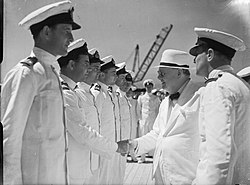
As the war concluded in late 1945, Maidstone began its journey back to the UK. During this passage, the ship was diverted to Macassar to rescue 400 British naval prisoners of war from HMS Exeter, HMS Encounter, and HMS Stronghold. After a stop at the Selborne dry dock in Simonstown, South Africa, the ship finally arrived at Portsmouth in November 1945.
Postwar Operations and Nuclear Transition
In 1946, Maidstone became the mother ship for the 2nd Flotilla (operational boats) and the 7th Flotilla (trials and training). While it maintained a semi-permanent mooring off Monkey Island in Portland, it frequently put to sea with its subsidiary ships.
The ship's history is marked by several notable incidents during this era. In 1951, it made a brief, unofficial visit to Corunna to land a sick crewman, marking the first time a British warship entered a Spanish harbour since the Spanish Civil War. In 1953, it participated in the Fleet Review for the Coronation of Queen Elizabeth II.
The HMS Sidon Tragedy
On June 16, 1955, a disaster occurred in Portland harbour when the submarine HMS Sidon sank alongside Maidstone following an explosion in its forward torpedo compartment. Although a rescue party from Maidstone saved several crew members, 13 men perished. The subsequent investigation revealed the accident was caused by high-test peroxide fuel in a torpedo. Surgeon Lieutenant Charles Rhodes was posthumously awarded the Albert Medal for his bravery during the rescue.
Modernization and Retirement
By 1956, Maidstone served as the flagship for the Commander-in-Chief, Home Fleet. In 1957, a visit to Helsinki alongside the aircraft carrier HMS Ocean sparked a protest from the Soviet Union. To keep pace with evolving technology, the ship underwent an extensive refit in 1959 to accommodate nuclear submarines.
Maidstone later moved to Faslane on the Gareloch in 1961 to support the 3rd and 10th Submarine Squadrons. After visits to Liverpool and Rothesay, the ship sailed to Rosyth Dockyard in 1968 to prepare for retirement. While the Norwegian navy and the HM Prison Service considered purchasing the vessel, the latter decided the facilities were only suitable for approximately 50 prisoners.
The Belfast Years: From Barracks to Prison Ship
In October 1969, HMS Maidstone was refitted and re-commissioned as accommodation for 2,000 troops. Towed to Belfast, it served as barracks for security forces during a period of intense unrest. In 1971, the ship's role shifted during Operation Demetrius, where it was used as a prison ship to hold internees without trial, including Gerry Adams.
The holding area was located at the stern, featuring two bunkhouses and two mess rooms. The former captain's cabin served as the governor's office, and the deck—surrounded by 10-foot high barbed wire—was used for exercise. The ship was moored in the Herdman Channel, just 20 feet from land, guarded by sand-bagged army emplacements.
The ship became the center of a major security embarrassment on January 17, 1972. Seven Provisional IRA members escaped by using cables connecting Maidstone to the repair ship HMS Hartland Point. The men swam nearly 300 yards through icy water across Belfast Lough and hijacked a bus. By April 9, 1972, all remaining internees were moved to Long Kesh prison (HM Prison Maze).
Until early 1975, the ship remained at Sydenham Wharf to provide short-notice accommodation for the Army and visiting UK Service Personnel, while its presence continued to highlight disputes regarding the constitutional status of Northern Ireland's territorial waters.
Summary of HMS Maidstone's Service
| Period | Location/Role | Key Event/Function |
|---|---|---|
| 1939–1945 | Mediterranean & Pacific | Depot ship for 1st and 8th Submarine Flotillas; POW rescue in Macassar. |
| 1946–1959 | Portland / Home Fleet | Mother ship for 2nd and 7th Flotillas; HMS Sidon rescue. |
| 1961–1968 | Faslane / Rosyth | Support for nuclear submarines (3rd and 10th Squadrons). |
| 1969–1975 | Belfast | Troop barracks and internment prison ship. |
| 1978 | Inverkeithing | Broken up for scrap. |
Frequently Asked Questions
What was the primary purpose of HMS Maidstone?
HMS Maidstone was primarily a depot ship, meaning it provided essential logistics, maintenance, and housing for submarine flotillas, acting as a mobile base of operations.
How was HMS Maidstone involved in the rescue of POWs?
In late 1945, while returning to the UK from Fremantle, the ship was diverted to Macassar to pick up 400 British naval prisoners of war from HMS Exeter, HMS Encounter, and HMS Stronghold.
What happened during the HMS Sidon incident?
In 1955, the submarine HMS Sidon sank alongside HMS Maidstone due to a torpedo fuel explosion. While Maidstone's crew saved several sailors, 13 people died in the accident.
Why was HMS Maidstone sent to Belfast?
It was sent to Belfast in 1969 to provide accommodation for 2,000 troops and security forces, and later served as a prison ship for internees during Operation Demetrius.
How did the IRA prisoners escape from the ship?
Seven Provisional IRA members escaped on January 17, 1972, by using cables that connected HMS Maidstone to the repair ship HMS Hartland Point to swim across Belfast Lough.
Where is the ship now?
The ship was scrapped in May 1978. However, its bell is preserved at Maidstone Grammar School, where it is used to signal the start of assembly.