Highlands and Islands of Scotland
The Highlands and Islands is a vast and diverse region of Scotland. It broadly encompasses the Scottish Highlands along with the archipelagoes of Orkney, Shetland, and the Hebrides (also known as the Western Isles). Because of its unique geography and history, the region is defined in several ways depending on the context, ranging from historical legislation to modern administrative and electoral boundaries.
Historically, the region was defined by the Crofters Holdings (Scotland) Act 1886, which applied to eight specific counties: Argyll, Caithness, Inverness, Nairn, Orkney, Ross and Cromarty, Shetland, and Sutherland. In modern times, Highlands and Islands Enterprise (HIE) and Eurostat (at the NUTS level 2) utilize a broader definition. Additionally, the region has served as a distinct electoral region for the Scottish Parliament since 1999.
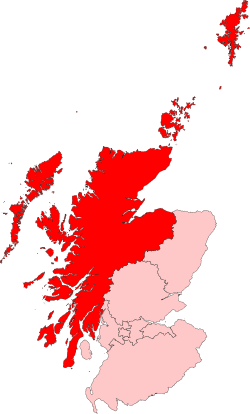
Key Facts
- Geography: Includes the Scottish Highlands, Orkney, Shetland, and the Hebrides.
- Population: Estimated at 469,365 in 2018.
- Employment: Historically higher self-employment and employment rates compared to the Scottish average.
- Governance: Represented as a specific electoral region in the Scottish Parliament.
- Transport: Primarily managed by HITRANS, with ZetTrans covering Shetland.
Society and Economy
The demographic history of the Highlands and Islands is marked by significant fluctuations. After enduring substantial depopulation during the 18th and 19th centuries, the region saw a reversal of this trend in the 21st century, with growth particularly concentrated around Inverness. To further support this growth, the Scottish Government committed in 2019 to increasing the population to better align with emerging economic opportunities, specifically in the renewable energy sector.
Economic data from 2018 highlights a resilient workforce. The region's population of 469,365 showed a 0.5% increase from 2011. Notably, the employment rate stood at 78.6% (compared to 74.7% across Scotland), and the unemployment rate was lower at 2.3% (versus 3.2% nationally). Self-employment was also more prevalent, at 11.0% compared to the Scottish average of 8.7%.
However, the global pandemic caused significant economic disruption. By summer 2020, unemployment rose to 5.7%, a sharp increase from 2.4% in 2019. The hardest-hit areas included Argyll and the Islands, as well as Lochaber, Skye, and Wester Ross. Reports from December 2020 indicated that unemployment had surged by more than 97% between March and December of that year, with a bleak outlook for the spring of 2021.
Public Services and Infrastructure
Public service delivery in the region is tailored to its sprawling geography. The Highlands and Islands Fire and Rescue Service covers the council areas of Highland, Orkney, Shetland, and the Western Isles. Law enforcement is managed by Police Scotland, which, as of early 2021, operated six Command Areas: North Highland, Inverness, South Highland, Orkney Islands, Shetland Island, and Western Isles. Each area is led by a Chief Inspector and a Local Area Commander, working in partnership with the respective local councils.
Transport coordination is split between different partnerships. HITRANS (Highlands and Islands Partnership for Transport), established in 2006, manages most council areas including Moray, Highland, Argyll and Bute, Orkney, and the Western Isles. Shetland is managed separately by ZetTrans, while Helensburgh and Lomond fall under the Strathclyde Partnership for Transport.
To facilitate better communication between the government and local entities, the Scottish Government established the Convention of the Highlands and Islands, which enables dialogue with the NHS and local authorities.
Political Representation
The region holds significant weight in Scottish politics. As an electoral region of the Scottish Parliament, its results were pivotal in the 2007 election; it was the last region to declare its votes, which ultimately allowed the Scottish National Party (SNP) to overtake Scottish Labour for the largest representation by a single seat.
As of 2024, the parliamentary representation for the area includes several key figures:
- Scottish Liberal Democrats: Alistair Carmichael (Orkney and Shetland), Angus Macdonald (Inverness, Skye, and West Ross-shire), and Jamie Stone (Caithness, Sutherland, and Easter Ross).
- Labour: Torcuil Crichton (Na h-Eileanan an Iar).
- SNP: Graham Leadbitter (Moray West, Nairn, and Strathspey) and Brendan O'Hara (Argyll and Bute).
| Category | Detail/Statistic |
|---|---|
| Estimated Population (2018) | 469,365 |
| Employment Rate (2018) | 78.6% |
| Unemployment Rate (2019) | 2.4% |
| Unemployment Rate (Summer 2020) | 5.7% |
| Self-Employment Rate (2018) | 11.0% |
Frequently Asked Questions
What areas are included in the Highlands and Islands?
The region broadly covers the Scottish Highlands and the island groups of Orkney, Shetland, and the Hebrides (Western Isles).
How did the pandemic affect unemployment in the region?
Unemployment rose significantly from 2.4% in 2019 to 5.7% by summer 2020, with some reports indicating an increase of over 97% between March and December 2020.
Who manages transport in the region?
Most of the region is covered by HITRANS, while Shetland is managed by ZetTrans and Helensburgh and Lomond are covered by the Strathclyde Partnership for Transport.
Which political parties represent the region in the UK Parliament as of 2024?
The region is represented by the Scottish Liberal Democrats, the SNP, and the Labour Party.
What is the goal of the Scottish Government regarding the region's population?
In 2019, the government committed to increasing the population to align with new economic opportunities, particularly in the renewable energy sector.