Hidatsa History: From Ancient Villages to the Three Affiliated Tribes
For centuries, the Knife River region of present-day North Dakota served as the ancestral heartland of the Hidatsa. With the earliest villages dating back to the 13th century, the Hidatsa developed a sophisticated society based on agriculture, craft, and strategic trade. Their journey is one of resilience, moving from a collection of distinct village groups to a unified people navigating the pressures of colonial expansion and intertribal conflict.
The Origins of the Hidatsa People
The modern Hidatsa tribe is an amalgamation of three closely related groups that originally spoke different dialects and maintained discrete histories. These groups only unified after settling along the Missouri River (Awati/Awáati).
- Awaxawi (Amahami): Known as the "Village on the Hill" or "Broken Land," their traditions describe an emergence from the Earth at Devil's Lake (Miri xopash). They later migrated westward to the Painted Woods.
- Awatixa (Awadixá): The "Village of the Scattered Lodges" or "High Village" believe they originated from the sky, led by Charred Body. They historically resided between the Heart River and the Knife River.
- Hidatsa Proper (Hiraacá/Hiratsa): The "People of the Willows" were the largest group, consisting of nomadic bands from the north (modern-day western Minnesota). After moving through Devil's Lake, they allied with the Mandan and adopted permanent agricultural village life at the mouth of the Knife River.
Initially, the Hidatsa were linked to the people who would become the River Crow, whom the Hidatsa referred to as Gixaa'iccá ("Those Who Pout Over Tripe").
Trade, Diplomacy, and Early Conflict
Due to their advantageous geography and surplus of agricultural goods, the Hidatsa became central hubs in the Great Plains Indian trading networks. Their villages were frequented by a diverse array of nations, including the Cree, Assiniboine, Crow, Cheyenne, Arapaho, Kiowa, Plains Apache, and Comanche. By the 1790s, European traders, such as David Thompson of the North West Company, began visiting these settlements.
While they maintained strong trade ties, the Hidatsa faced significant external pressures. They were pushed southwestward by the Lakota (Itahatski) and faced periodic threats from the Iron Confederacy, dominated by the Cree and Assiniboine. Despite these tensions, the Hidatsa proved their military strength; around 1790, the village of Big Hidatsa successfully repelled a major Sioux siege, resulting in over 100 Sioux casualties.
In 1804, the famous expedition of Lewis and Clark visited three Hidatsa villages (which they recorded as the "Minnetaree") at the mouth of the Knife River. Later, in July 1825, the tribe entered into treaties of peace and trade with the United States, a friendship that remained intact without military conflict.
Crisis and the Formation of the Three Tribes
The mid-19th century brought devastating challenges. In 1834, Sioux attacks destroyed two lower villages, forcing the Awaxawi and Awatixa to seek refuge in Big Hidatsa. This was followed by the catastrophic smallpox epidemic of 1837–1838, which reduced the Hidatsa population to approximately 500 people.
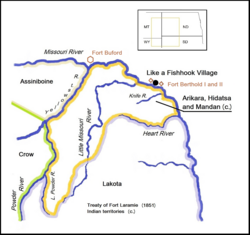
To survive, the remaining Hidatsa and Mandan united and moved further up the Missouri River in 1845 to escape Sioux raids on their horses and hunting parties. They established Like-a-Fishhook Village (Mua iruckup hehisa atis) near the Fort Berthold trading post. In 1862, they were joined by the Arikara, forming the alliance known today as the Three Affiliated Tribes.
The Late 19th Century and Reservation Life
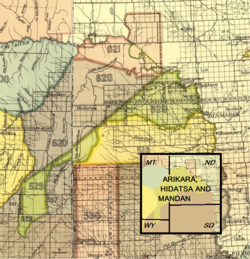
The 1851 Treaty of Fort Laramie granted the Hidatsa, Mandan, and Arikara land north of the Heart River. However, the Lakota largely annexed this territory despite the treaty. This period was marked by continued volatility; for example, the prominent war chief Four Bears was killed by Yankton Sioux in 1861, and parts of Like-a-Fishhook Village were burned in 1862.
Internal divisions also emerged around 1870, when a "dissident" band led by Bobtail Bull and Crow Flies High split from the conservative group. They established a village near Fort Buford, where some men served as scouts for the U.S. Army, living as non-reservation Indians until 1894.
By 1875, a peace agreement mediated by Colonel G. A. Custer ended the primary conflicts with the Lakota. The tribes' focus then shifted toward legal and political disputes with government officials regarding land. The final treaty reducing the Fort Berthold Indian Reservation was signed in 1886 and ratified in 1891.
Key Facts
- Ancestral Home: The Knife River area of North Dakota, with villages dating back to the 13th century.
- Tribal Composition: Formed from the amalgamation of the Awaxawi, Awatixa, and Hidatsa proper.
- Economic Role: Served as a primary trade hub for Great Plains tribes and early European traders.
- The Three Affiliated Tribes: An alliance of the Hidatsa, Mandan, and Arikara formed at Like-a-Fishhook Village.
- Major Hardships: A devastating smallpox epidemic in 1837–1838 reduced the population to about 500.
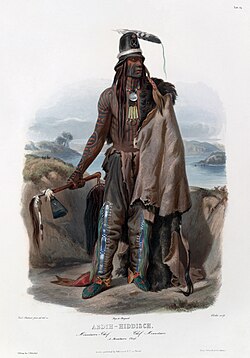
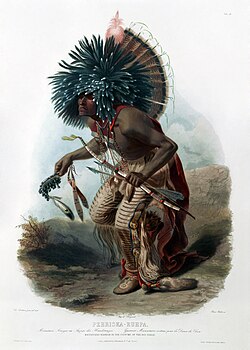
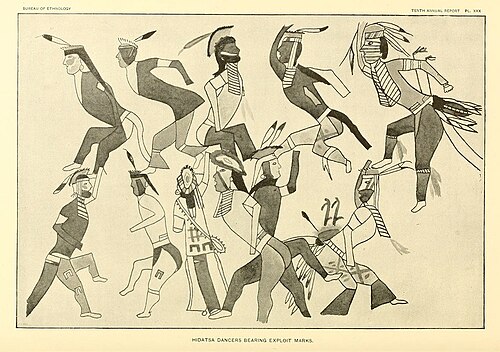
- Cultural Record: Extensively documented by artists George Catlin and Karl Bodmer in the 1830s.
| Group Name | Alternative Name | Origin Tradition | Primary Region |
|---|---|---|---|
| Awaxawi | Amahami | Emergence from Earth (Devil's Lake) | Painted Woods |
| Awatixa | Awadixá | Origin from the Sky | Heart and Knife Rivers |
| Hidatsa Proper | Hiraacá / Hiratsa | Nomadic bands from the North | Mouth of Knife River |
Frequently Asked Questions
Who are the Three Affiliated Tribes?
The Three Affiliated Tribes are a confederation consisting of the Hidatsa, Mandan, and Arikara people, who united for mutual protection and survival at Like-a-Fishhook Village near Fort Berthold.
What caused the Hidatsa to leave the Knife River?
The migration was driven by a combination of devastating smallpox epidemics in 1837–1838 and persistent attacks by the Sioux, who targeted hunting parties and stole horses.
How did the Hidatsa contribute to the Great Plains economy?
The Hidatsa utilized their strategic location and agricultural surpluses to become central traders, hosting various tribes and early European traders like those from the North West Company.
What was the significance of the 1851 Treaty of Fort Laramie?
The treaty officially designated land north of the Heart River for the Hidatsa, Mandan, and Arikara, though much of this land was later annexed by the Lakota.
Who were the primary artists to document Hidatsa culture?
George Catlin and Karl Bodmer provided critical visual and written records of Hidatsa and Mandan societies during their visits in the 1830s.