Hesperornitheans: The Specialized Diving Birds of the Cretaceous
During the Late Cretaceous period, the oceans and freshwater systems of the Northern Hemisphere were home to a remarkable group of aquatic avialans known as Hesperornithes. These highly specialized predatory divers represent a fascinating evolutionary branch of the Ornithurae (the clade containing modern birds and their closest extinct relatives). While they shared a common ancestor with the birds we see today, hesperornitheans adapted so aggressively for an aquatic lifestyle that many species completely abandoned the ability to fly.
From the small, cormorant-sized divers of Eurasia to the massive Canadaga arctica, which could reach lengths of 2.2 meters (7.2 ft), these animals were the only Mesozoic avialans known to have successfully colonized the open oceans.
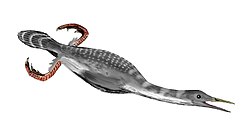
Key Facts
- Temporal Range: Lived during the Late Cretaceous, approximately 100 to 66 million years ago (Ma).
- Habitat: Inhabited both marine and freshwater environments across the Northern Hemisphere.
- Physical Traits: Characterized by long bodies, dense bones for buoyancy control, and sharp teeth.
- Locomotion: Most were flightless, powerful swimmers with legs positioned far back on the body.
- Extinction: Wiped out during the Cretaceous–Paleogene extinction event.
Anatomy and Ecology
The anatomy of hesperornitheans reveals a creature perfectly engineered for the water but severely limited on land. Most species possessed a long body and a snout tipped with a slightly hooked beak. Unlike modern birds, they retained a series of simple, sharp teeth set into longitudinal grooves in their jaws, which they used to seize slippery fish.
A unique feature of their jaw was the retention of a joint between the lower jaw bones. This allowed them to rotate the back portion of the mandible independently, helping the lower teeth disengage during feeding.
Swimming and Diving Adaptations
To excel as divers, hesperornitheans evolved several key physiological traits:
- Bone Density: Their bones were dense, which decreased buoyancy and made diving more efficient.
- Leg Structure: They had short femurs and metatarsuses paired with long tibiae. Their legs were set far back on the body, similar to modern loons, grebes, or penguins.
- Propulsion: Rather than traditional webbing, evidence suggests they had lobes of skin on their toes for underwater propulsion, similar to modern grebes.
Life on Land
While they dominated the water, hesperornitheans were extremely ungainly on land. Because their hip and knee joints could not move dorsoventrally (up and down), they could not walk upright. In a resting position, their feet projected sideways. Researchers believe they likely spent very little time ashore—except for nesting—and may have had to slide on their bellies, pushing themselves forward with their legs.
Evolution and Classification
Hesperornitheans are recognized as a specialized lineage that is not ancestral to modern birds. They likely diverged from the ancestors of modern birds during the earliest Cretaceous. The earliest known member of the group is Enaliornis, though the majority of known species are found in the Late Cretaceous deposits of North America, including the Hell Creek and Lance Formations.
Historically, these birds were grouped with Ichthyornis in a category called "Odontornithes" (toothed birds). However, modern phylogenetic analysis has refined this. In 2004, researcher J.A. Clarke defined Hesperornithes as all species closer to Hesperornis regalis than to modern birds. The more inclusive group Hesperornithidae includes those closer to Hesperornis than to Baptornis.
While they share some physical similarities with loons and grebes, these are now considered results of convergent evolution—where unrelated species evolve similar traits because they occupy similar ecological niches.
| Feature | Hesperornithean Trait | Modern Comparison |
|---|---|---|
| Flight | Mostly flightless (vestigial wings) | Penguins |
| Dentition | Sharp teeth in grooves | None (Beaks only) |
| Leg Position | Set far back on body | Loons / Grebes |
| Foot Type | Lobed skin | Grebes |
| Bone Structure | Dense (low buoyancy) | Diving ducks / Cormorants |
Frequently Asked Questions
Were hesperornitheans the ancestors of modern birds?
No. They are a specialized lineage that diverged from the ancestors of modern birds early in the Cretaceous period and eventually went extinct.
Could all hesperornitheans fly?
No. While some smaller, basal species like those in the Brodavidae and Enaliornithidae groups might have been capable of flight, larger species like Hesperornis and Baptornis had only vestigial wings and were completely flightless.
How did they move on land?
Due to the structure of their hip and knee joints, they could not walk upright. It is believed they slid on their bellies and pushed themselves forward with their legs.
What did hesperornitheans eat?
They were predatory divers that primarily ate fish, using their long snouts and sharp teeth to seize their prey.
When did they go extinct?
Hesperornitheans were wiped out during the Cretaceous–Paleogene extinction event, approximately 66 million years ago, along with all other non-avian dinosaurs.