Unlocking Plant Secrets: An Introduction to Herbchronology
When we think of counting rings to determine the age of a plant, our minds immediately go to massive oaks or ancient redwoods. This science, known as dendrochronology, has long provided a window into the past. However, a similar and equally fascinating process occurs beneath our feet in the world of non-woody plants. This is the field of herbchronology: the analysis of annual growth rings within the secondary root xylem (the woody water-conducting tissue) of perennial herbaceous plants.
While the leaves and stems of perennial herbs typically die back at the end of each growing season, their roots often persist for many years, or even for the plant's entire lifespan. For many perennial forbs—herbaceous plants belonging to the dicotyledon group—these roots undergo secondary growth, adding a new layer of tissue every year. In the strongly seasonal zones of the Northern Hemisphere, approximately two-thirds of all perennial dicotyledonous herb species with persistent roots exhibit these distinct annual growth rings.
Key Facts
- Definition: Herbchronology is the study of annual growth rings in the roots of perennial herbs.
- Longevity: Some perennial herbs have been found to live for 50 years or more.
- Visibility: Unlike tree rings, herb rings usually require a microscope and specific staining to be seen.
- Growth Mechanism: Rings are produced by the vascular cambium, adding a new layer of xylem each year.
- Environmental Indicator: The width of a growth ring reflects the favorability of the conditions during that year's growth.
The Science of Annual Growth Rings
The biological mechanism behind herbchronology is remarkably similar to that of woody plants. Perennial herbs possess a growth zone called the vascular cambium, located between the root bark and the root xylem. During the growing season, this cambium is active, producing a new layer of xylem tissue. This process of adding lateral layers is known as secondary growth.
Each annual ring is composed of two distinct types of tissue:
- Earlywood: Formed at the start of the growing season, characterized by wider vessels or a denser arrangement of vessels.
- Latewood: Formed during the summer and fall, characterized by narrower vessels or lower vessel density.
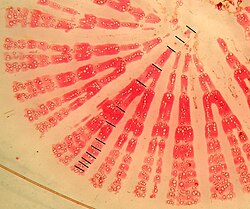
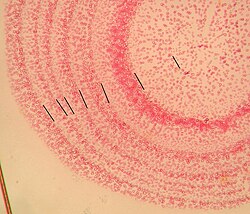
Because these structures are so small, they are generally invisible to the naked eye. Researchers use microscopes and specific staining methods, such as Phloroglucinol/HCL, to make the lignified (woody) tissue appear reddish and distinguishable. It is important to note that any ring-like patterns visible without a microscope are often "false rings" and cannot be used for accurate dating.
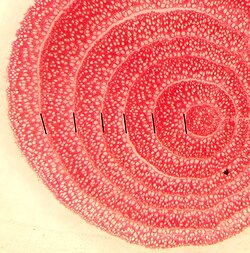
The physical characteristics of these rings provide a historical record of the plant's life. In a favorable year with optimal resources, the resulting growth ring is wider; in a year with poor conditions, the ring is narrower.
Applications in Ecological Research
Herbchronology is more than just a method for dating plants; it is a powerful tool used across various biological and ecological disciplines, including population biology, community ecology, and invasion biology.
Estimating Plant Age and Population Structure
By counting rings, scientists can determine the exact age of an individual plant. This data is essential for creating accurate flora books and understanding the life history strategies of different species. Furthermore, analyzing the age structure of an entire population helps researchers understand population dynamics and the spreading patterns of invasive species.
Analyzing Long-Term Growth Rates
One of the greatest advantages of herbchronology is that it allows researchers to assess annual growth rates over a plant's lifetime without needing to monitor it for decades. This retrospective analysis provides insights into:
- The impact of climatic fluctuations on plant growth.
- How changes in site conditions, such as increased competition from neighboring plants, affect development.
- General lifetime growth patterns of the species.
Summary of Herbchronology Components
| Feature | Earlywood | Latewood |
|---|---|---|
| Formation Period | Beginning of growing season | Summer and Fall |
| Vessel Width | Wide | Narrow |
| Vessel Density | Denser arrangement | Lower density |
| Primary Function | Rapid water transport | Seasonal growth completion |
Frequently Asked Questions
What is the difference between herbchronology and dendrochronology?
While both study annual growth rings to determine age and environmental history, dendrochronology focuses on woody plants (trees), whereas herbchronology focuses on the secondary root xylem of perennial herbaceous plants.
Can I determine the age of a garden herb by looking at its roots?
Generally, no. Annual growth rings in herbs are usually only visible under a microscope and require specific chemical staining to be identified. Patterns visible to the naked eye are often "false rings."
How old can perennial herbs actually get?
Through the use of herbchronology, researchers have discovered that some perennial herbs can live for 50 years or more.
What causes a growth ring to be wider or narrower?
The width of the ring is determined by the environmental conditions during that specific growing season. Favorable conditions lead to wider rings, while unfavorable conditions result in narrower rings.
Which plants are suitable for herbchronological study?
The method is primarily applicable to perennial dicotyledonous herbs (forbs) that possess persistent roots and undergo secondary growth, particularly those found in the strongly seasonal zones of the Northern Hemisphere.