Hellebore: A Comprehensive Guide to the Genus Helleborus
The genus Helleborus, belonging to the Ranunculaceae family, comprises a fascinating group of plants known for their striking blooms and complex histories. From the snowy petals of the Christmas rose to the nodding green bells of the stinking hellebore, these plants have captured the interest of botanists and gardeners alike for centuries. Whether growing in the wild across Europe and Asia or cultivated in ornamental gardens, hellebores offer a unique blend of beauty and biological intrigue.
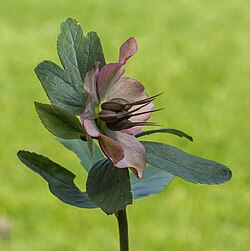
Key Facts
- Scientific Classification: Part of the Ranunculales order and Ranunculaceae family.
- Diversity: There are 22 recognized species divided into six distinct sections.
- Common Names: Includes Christmas rose, Lenten rose, and stinking hellebore.
- Growth Habits: Species are categorized as either caulescent (having stems) or acaulescent (stemless).
- Toxicity: Many species are toxic if ingested, containing compounds like protoanemonin.
Etymology and Historical Context
The name "hellebore" dates back to the 1300s, originating from the Ancient Greek word helléboros. While folk etymology often translates this as "plant eaten by fawns," linguistic experts suggest it may actually be a Pre-Greek word. Interestingly, despite the plant's toxic reputation, the name is not etymologically related to the word "hell."
In Anglo-Saxon England, the understanding of the plant was fluid. Around 900 AD, the term elleborus was linked to tunsingwyrt (likely an Allium species) in the Old English Herbarium. By the 11th century, the term wodewistle was used as a gloss, potentially referring to hemlock or similar toxic plants, reflecting the evolving botanical vocabulary of the era.
Taxonomy and Species Diversity
The genus was formally established by Carl Linnaeus in 1753. Today, the genus is organized into six sections. These species vary significantly in their morphology, distribution, and flower color.
Classification of Helleborus Species
| Scientific Name | Common Name | Distribution | Flower Color |
|---|---|---|---|
| Helleborus foetidus | Stinking hellebore | SW – M Europe | Green, red rim |
| Helleborus niger | Christmas rose | S. Europe/Central Europe | White, pink |
| Helleborus orientalis | Lenten rose | N. Turkey, Caucasus | White, yellow, pink |
| Helleborus argutifolius | Corsican hellebore | Corsica, Sardinia | Green, white |
| Helleborus thibetanus | H. thibetanus | China | Pink |
| Helleborus viridis | Green hellebore | Austria, N. Italy, Germany | Green |
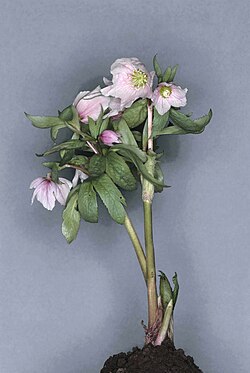
Growth Habits: Caulescent vs. Acaulescent
Botanists distinguish between species based on their stem structure. Caulescent species possess visible stems, such as H. argutifolius and H. foetidus. In contrast, acaulescent species are stemless, with flowers appearing to emerge directly from the ground; this group includes the popular H. niger and H. orientalis.
Hellebore Hybrids in Horticulture
Beyond wild species, gardeners have long experimented with interspecific hybrids—crosses between different species. Notable examples include:
- H. × nigercors: A cross between H. niger and H. argutifolius (created in 1931).
- H. × sternii: A cross between H. argutifolius and H. lividus, named after Sir Frederick Stern.
- Modern Cultivars: Recent creations include Ashwood Nurseries' H. 'Pink Ice' (H. niger × H. thibetanus) and H. 'Briar Rose' (H. niger × H. vesicarius).
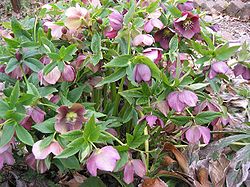
Several hellebore varieties have earned the Royal Horticultural Society's (RHS) Award of Garden Merit, including H. argutifolius, H. foetidus, H. lividus, H. niger, and the H. × sternii 'Blackthorn Group'.
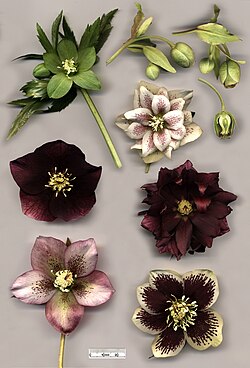
Pests, Diseases, and Toxicity
Common Pests and Diseases
Hellebores can be susceptible to various biological threats. The Hellebore aphid (Macrosiphum hellebori) is a common sap-feeding insect that forms dense colonies on foliage, often leaving behind honeydew that encourages sooty mold.
In terms of disease, Pseudomonas viridiflava—a bacterium—has been reported to cause black leaf spots, stem lesions, and petal necrosis, notably in H. orientalis crops in New Zealand. Other fungal and bacterial threats include Botrytis cinerea and Coniothyrium hellebori.
Understanding Toxicity
It is vital to note that many hellebores are toxic. Helleborus niger contains protoanemonin and ranunculin, which can cause irritation to the mouth, throat, and eyes, as well as gastrointestinal distress. While historical accounts attributed lethal cardiac effects to the plant, modern research suggests that the lethal reputation may have stemmed from commercial preparations that accidentally mixed H. niger with other toxic species like H. viridis.
Frequently Asked Questions
What is the difference between Christmas rose and Lenten rose?
The Christmas rose is the common name for Helleborus niger, while the Lenten rose typically refers to Helleborus orientalis or its hybrids.
Are hellebores poisonous to humans and pets?
Yes, many species contain toxic compounds like protoanemonin that can cause vomiting, irritation, and other serious health issues if ingested.
What are the most common pests for hellebores?
The Hellebore aphid (Macrosiphum hellebori) is a primary pest, feeding on the sap of flowers and leaves.
Why are some hellebores called "stemless"?
Acaulescent species, such as H. niger, are referred to as stemless because their flowers and leaves appear to emerge directly from the base of the plant.
Which hellebores are best for gardening?
Varieties that have received the RHS Award of Garden Merit, such as H. argutifolius and H. niger, are highly recommended for their reliability and beauty.