Heat Index: How Humidity and Temperature Affect Human Perception
Have you ever stepped outside on a day where the thermometer reads a moderate temperature, yet you feel as though you are standing in an oven? This sensation is not just in your head; it is a measurable phenomenon known as the heat index. The heat index, often called the "feels like" temperature, combines air temperature and relative humidity to estimate how hot it actually feels to the human body.
The science behind this discomfort lies in how our bodies regulate temperature. Humans primarily cool themselves through the evaporation of sweat. When the air is dry, sweat evaporates quickly, carrying heat away from the skin. However, when relative humidity is high, the air is already saturated with moisture, making evaporation much less effective. This causes heat to build up, increasing the risk of heat stress.
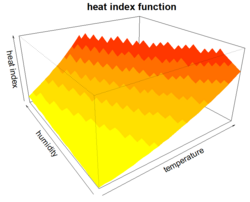
Key Facts
- The heat index combines dry-bulb temperature and relative humidity to measure perceived heat.
- High humidity prevents effective evaporative cooling, making temperatures feel much higher than they are.
- The heat index is calculated for shaded areas and does not account for direct sunlight or wind.
- A sustained wet-bulb temperature of 35°C (95°F) is considered a critical threshold where the body can no longer adequately cool itself.
- Exposure to direct sunlight can increase the perceived heat by up to 8°C (14°F).
The Science of Perceived Temperature
The theoretical framework for the heat index was developed in 1979 by Robert G. Steadman. His work established that the perceived temperature depends on several physiological and environmental factors. While the heat index formula uses constants to represent variables like clothing, physical activity, and wind speed (assumed at 5 knots), individual perception can vary based on metabolism, hydration, body shape, and acclimatization.
Mathematically, the heat index is defined by a specific vapor pressure baseline. For example, an apparent temperature of 24°C (75°F) refers to the same level of "sultriness" as a dry-bulb temperature of 24°C with a vapor pressure of 1.6 kPa. As temperatures rise, the impact of humidity becomes even more dramatic. At 27°C (81°F), the heat index may match the actual temperature if humidity is around 45%, but at 43°C (109°F), even a low humidity of 18% will cause the heat index to exceed the actual temperature.
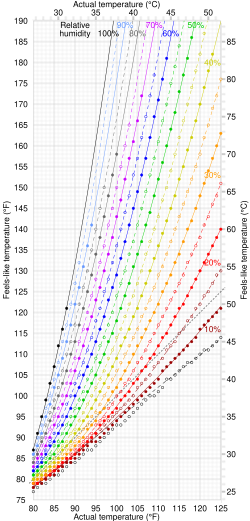
Regional Variations: Heat Index vs. Humidex
While the heat index is widely used in the United States, Canada utilizes a similar metric called the humidex. Although both rely on dew point calculations, they differ in their baseline. The humidex uses a dew point base of 7°C (45°F), whereas the heat index uses a base of 14°C (57°F). Additionally, the heat index employs complex heat balance equations that account for more variables than the vapor pressure used in the humidex calculation.
Health Risks and Safety Thresholds
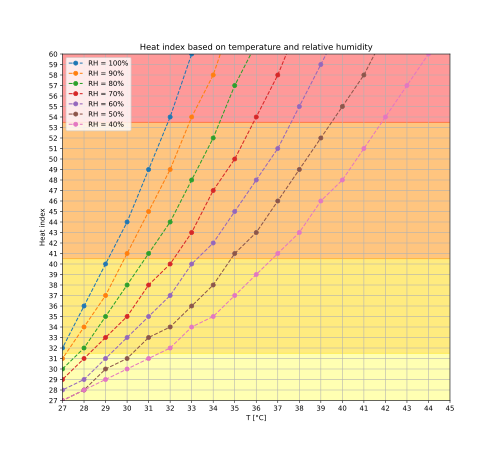
Understanding the heat index is vital for preventing heat-related illnesses. As the index climbs, the physiological danger increases significantly. The following table outlines the general safety categories based on NOAA data.
| Heat Index Range | Caution Level | Potential Health Effects |
|---|---|---|
| 27–32°C (81–90°F) | Caution | Fatigue possible with prolonged activity; heat cramps possible. |
| 32–41°C (90–106°F) | Extreme Caution | Heat cramps and heat exhaustion possible; heat stroke risk. |
| 41–54°C (106–129°F) | Danger | Heat exhaustion likely; heat stroke probable with activity. |
| Over 54°C (129°F) | Extreme Danger | Heat stroke is imminent. |
Extreme Meteorological Events
While it was once believed that the highest attainable heat index on Earth was roughly 71°C (160°F), recent records have proven otherwise. In 2003, Dhahran, Saudi Arabia, recorded a heat index of 81°C (178°F). More recently, in August 2024, a station in southern Iran reported a potential record of 82.2°C (180.0°F).
Limitations of the Metric
Despite its utility, the heat index is not a perfect tool. It can struggle with extreme conditions like supersaturation (where air is more than 100% saturated). Some researchers, including physicists at UC Berkeley, have noted that the heat index may underestimate the severity of intense heat waves. Furthermore, the index assumes a healthy individual with easy access to water and shade, which may not apply to everyone in real-world scenarios.
Frequently Asked Questions
How does humidity make it feel hotter?
High humidity slows down the evaporation of sweat from your skin. Since evaporation is the body's primary method of shedding heat, a lack of evaporation causes your internal temperature to rise, making you feel much hotter than the actual air temperature.
Does the heat index account for sunlight?
No. The standard heat index is calculated for shaded areas. If you are standing in direct sunlight, the perceived temperature can increase by as much as 8°C (14°F).
What is the difference between heat index and wet-bulb temperature?
The heat index is an estimate of perceived temperature based on air temperature and humidity. The wet-bulb temperature is a more technical measure used to determine the body's ability to eliminate heat; a sustained wet-bulb temperature of 35°C (95°F) is considered a fatal threshold for healthy humans.
Why is the heat index sometimes lower than the actual temperature?
The heat index formula is generally designed for temperatures of 27°C (81°F) or higher and relative humidity above 40%. Below these thresholds, the calculation may return a value equal to or lower than the actual temperature, which is often considered invalid for practical use.
What are other ways to measure apparent temperature?
Other metrics include the Canadian humidex, the wet-bulb globe temperature, the "relative outdoor temperature," and proprietary measures like "RealFeel."