Hazur Sahib Nanded: History, Heritage, and Legacy
Hazur Sahib stands as a profound site of spiritual significance, marking the location where Guru Gobind Singh ji established his camp in 1708. This sacred space serves not only as a place of worship but as a historical testament to the final days of the tenth Sikh Guru and the transition of spiritual authority to the eternal Guru.
The Final Days of Guru Gobind Singh ji
In 1708, Guru Gobind Singh ji held his court and congregation at this site while recovering from an assassination attempt. During the attack, one assailant stabbed the Guru, who responded by killing the attacker with a single stroke of his talwar (a traditional curved sword). A second attacker was killed by the Guru's followers while attempting to flee.
The Guru's wound was severe. He initially received medical treatment from an English surgeon dispatched by Bahadur Shah I, who had previously served as a doctor to Dara Shikoh. Although the wound was stitched and appeared to heal, it reopened several days later while the Guru was stringing a bow for one of his Sikhs.
Following this event, Guru Gobind Singh ji declared the Guru Granth Sahib (the central religious scripture of Sikhism) as his successor before merging into the Primal, a state known as Joti Jot.
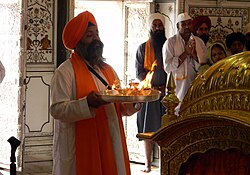
The Inner Sanctum and Sacred Relics
The architectural layout of the shrine includes a specific division of access to preserve the sanctity of the Guru's belongings. While priests carry out all religious functions in the outer room, the inner room serves as a secure vault.
This vault houses highly valuable objects, including the weapons and personal belongings of Guru Gobind Singh ji. To ensure the security and sanctity of these relics, access to the vault is strictly limited; no one is permitted to enter except for the head priest.
Heritage Conservation and Controversies
In recent years, the management of the Takht Hazur Sahib complex has faced criticism from Sikh historians and scholars regarding the preservation of historical structures. Concerns have been raised that the management committee has destroyed original heritage sites under the guise of Kar Seva (voluntary community service) renovations.
Despite restoration plans proposed by restoration architect Kiran Kalamdani and consultant engineer Sharad Chalikwar to save these buildings in their original state, several structures were demolished. Notable losses include:
- Ramgarhia Bunga: A structure built under the patronage of Maharaja Ranjit Singh, demolished in January 2007.
- Baradari: Another structure patronized by Maharaja Ranjit Singh, demolished in October 2007.
The gurdwara management committee, led by chairman P.S. Pasricha, defended these demolitions. The committee cited the dilapidated condition of the buildings, the need for "beautification," and the requirement for space to implement development plans, which include a new museum and a 31-room sarai (inn).
Key Facts
- Historical Significance: Site of Guru Gobind Singh ji's camp in 1708.
- Succession: The location where the Guru Granth Sahib was declared the successor.
- Sacred Vault: Houses the Guru's weapons and personal belongings, accessible only by the head priest.
- Lost Heritage: The Ramgarhia Bunga and Baradari, both patronized by Maharaja Ranjit Singh, were demolished in 2007.
- Current Development: Plans include a museum and a 31-room sarai.
| Category | Detail | Timeline/Status |
|---|---|---|
| Guru's Camp | Establishment of court and congregation | 1708 |
| Succession | Guru Granth Sahib named successor | 1708 |
| Ramgarhia Bunga | Patronized by Maharaja Ranjit Singh | Demolished Jan 2007 |
| Baradari | Patronized by Maharaja Ranjit Singh | Demolished Oct 2007 |
| Inner Vault | Storage of personal belongings and weapons | Restricted Access |
Frequently Asked Questions
Why is Hazur Sahib significant in Sikh history?
It is the site where Guru Gobind Singh ji spent his final days, held his court, and designated the Guru Granth Sahib as the eternal successor to the Sikh Gurus.
What happened to the historical buildings at the complex?
The Ramgarhia Bunga and the Baradari, both built under the patronage of Maharaja Ranjit Singh, were demolished in 2007 by the management committee for beautification and development purposes.
Who is allowed to enter the inner vault of the shrine?
Only the head priest is permitted to enter the inner vault, which houses the Guru's weapons and personal belongings.
How did Guru Gobind Singh ji pass away?
After being wounded in an assassination attempt, the Guru's wound reopened while he was stringing a bow for a Sikh. He subsequently merged into the Primal (Joti Jot).
What is the current stance of the management committee regarding the demolitions?
The committee, specifically chairman P.S. Pasricha, stated that the buildings were dilapidated and needed to be removed to make room for development, including a new museum and a 31-room sarai.