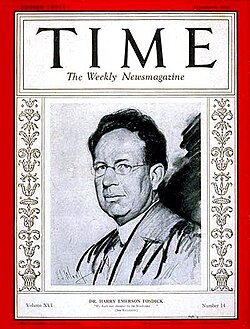
Harry Emerson Fosdick: The Voice of Modernist Protestantism
Harry Emerson Fosdick was one of the most influential and provocative figures in early 20th-century American religion. A prominent Mainline Protestant pastor, Fosdick became a lightning rod for the fundamentalist–modernist controversy—a theological struggle over how to reconcile traditional Christian faith with modern science and historical criticism.
Though ordained as a Baptist, Fosdick's career transcended denominational boundaries. He served diverse congregations in New Jersey and New York City, eventually leading the historic, inter-denominational Riverside Church. His approach to faith emphasized progress, development, and the social application of the Gospel, making him a champion of liberal theology during a period of intense religious polarization.
Key Facts
- Lifespan: May 24, 1878 – October 5, 1969.
- Primary Role: Protestant Christian minister and leading liberal theologian.
- Major Work: The landmark 1922 sermon "Shall the Fundamentalists Win?"
- Key Affiliations: First Baptist Church (Montclair), First Presbyterian Church (Manhattan), and Riverside Church.
- Theological Stance: Advocate for theistic evolution and a non-literal interpretation of the Bible.
- Legacy: A major influence on Martin Luther King Jr., who called him the century's greatest preacher.
Early Life and Education
Born in Buffalo, New York, to Frank Sheldon and Amy Inez Fosdick, Harry Emerson Fosdick pursued a rigorous academic path. He graduated from Colgate University in 1900, where he was a member of the Delta Upsilon fraternity. He furthered his studies at Colgate Seminary (1900–1901) and earned a Bachelor of Divinity from Union Theological Seminary in 1904, followed by a Master of Arts from Columbia University in 1908.
Fosdick was ordained as a Baptist minister on November 18, 1903, at the Madison Avenue Baptist Church in Manhattan. His early ministry began at the First Baptist Church in Montclair, New Jersey, where he served from 1904 to 1915.
The Fundamentalist–Modernist Controversy
Fosdick's rise to national prominence occurred during his tenure at the First Presbyterian Church in Manhattan. On May 21, 1922, he delivered a sermon titled "Shall the Fundamentalists Win?" This address defended the modernist position—the belief that Christianity should evolve and adapt to modern knowledge—rather than adhering to a literalist interpretation of scripture.
In this sermon, Fosdick presented the Bible as a record of the unfolding of God's will rather than the literal "Word of God." This sparked a fierce backlash from fundamentalists, who viewed his views as apostasy. The controversy escalated when the Rev. Clarence Edward Macartney responded with his own sermon, "Shall Unbelief Win?"
The conflict led to an investigation by the General Assembly of the Presbyterian Church in 1923. Fosdick was defended by lay elder John Foster Dulles (who later became U.S. Secretary of State). To avoid a formal trial and potential censure, Fosdick resigned from his pulpit in 1924.
The Riverside Church and Public Influence
Following his resignation, Fosdick moved to the Park Avenue Baptist Church, supported by industrialist John D. Rockefeller Jr. This partnership culminated in the creation of the ecumenical Riverside Church in Morningside Heights, Manhattan. When the church opened in October 1930, Fosdick became its pastor.
The Riverside Church was designed as a community hub, featuring a 22-story belltower with classrooms, a gymnasium, and dining rooms to serve the social needs of New Yorkers. Fosdick's influence extended beyond the pulpit through his role as the preacher for NBC Blue's National Vespers from 1927 to 1946.
Social Activism and Intellectual Contributions
Fosdick was a vocal opponent of racism and injustice. He played a pivotal role in the 1933 retrial of the Scottsboro Boys—nine Black youths falsely accused of rape in Alabama—by persuading Ruby Bates to testify for the defense.
Intellectually, Fosdick was a staunch advocate for theistic evolution (the belief that God works through the process of evolution) and rejected creationism, leading to public disputes with figures like William Jennings Bryan. He also provided an early, influential review of the first edition of Alcoholics Anonymous in 1939, which helped legitimize the AA movement.
His literary output was vast, including the hymn "God of Grace and God of Glory" and the book A Guide to Understanding the Bible, which analyzed the development of faith from ancient Hebrew beliefs to the New Testament.
Summary of Career and Education
| Category | Details |
|---|---|
| Education | BA (Colgate), BD (Union Theological Seminary), MA (Columbia) |
| Key Congregations | First Baptist (Montclair), First Presbyterian (NYC), Riverside Church (NYC) |
| Major Theological Shift | Transition from literalism to Modernism/Liberalism |
| Notable Allies | John D. Rockefeller Jr., John Foster Dulles |
| Key Publications | Shall the Fundamentalists Win?, A Guide to Understanding the Bible |
Frequently Asked Questions
What was the main point of Fosdick's "Shall the Fundamentalists Win?" sermon?
Fosdick argued that the Bible should be viewed as a record of God's unfolding will and that Christianity is a process of development and progress, rather than a static set of literal truths.
How did Fosdick influence Martin Luther King Jr.?
Martin Luther King Jr. regarded Fosdick as the greatest preacher of the 20th century and drew upon Fosdick's writings and sermons to shape his own preaching.
What was Fosdick's stance on evolution?
He was a proponent of theistic evolution, defending its teaching in schools and rejecting the tenets of creationism.
What role did John D. Rockefeller Jr. play in Fosdick's life?
Rockefeller Jr. was a member of Fosdick's congregation at Park Avenue Baptist Church and funded the construction of the ecumenical Riverside Church, where Fosdick served as pastor.
How did Fosdick contribute to the Scottsboro Boys case?
Fosdick used his influence to persuade Ruby Bates to testify for the defense during the 1933 retrial, challenging the racially charged accusations against the nine Black youths.