Harris & Ewing: The Premier Photographic Studio of Washington, D.C.
At the turn of the 20th century, capturing the political pulse of the United States required more than just a camera; it required access and timing. Harris & Ewing Inc. emerged as the definitive visual chronicler of the U.S. capital, evolving from a small partnership into the largest photographic studio in the United States. By combining high-end portraiture with a fast-paced news photo service, the firm documented the faces and events that shaped American history.
Key Facts
- Founded: 1905 at 1313 F Street NW, Washington, D.C.
- Founders: George W. Harris and Martha Ewing.
- Peak Scale: Five studios and 120 employees by the late 1930s.
- Legacy: Approximately 700,000 negatives donated to the Library of Congress.
- Specialization: Formal government portraits and a comprehensive news photo service.
The Origins of a Photographic Empire
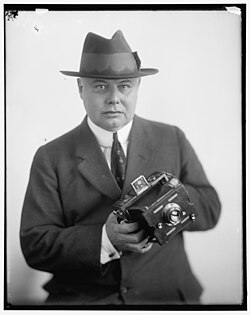
The journey of George W. Harris began in the field as a rookie news photographer, notably covering the devastating Johnstown flood of 1889 in Pennsylvania. Between 1900 and 1903, Harris honed his skills at the Hearst News Service in San Francisco. His career took a pivotal turn when he joined the press entourage of President Theodore Roosevelt during a train trip.
The catalyst for the studio's creation was a gap in the market for timely imagery of national figures. Whether it was President Roosevelt himself or a frustrated San Francisco editor—angry over the lack of a photograph of George Frisbie Hoar following his death—Harris was urged to establish a permanent presence in Washington, D.C. In 1905, Harris partnered with Martha Ewing, an artist and colorist. Ewing provided the necessary financing and managed the studio's operations, allowing Harris to focus on the lens.
Growth and National Influence
The studio quickly gained prestige, particularly for its ability to capture the essence of power. In 1908, the firm achieved widespread fame with a series titled The Anatomy of a Smile, which featured candid photographs of William Howard Taft reacting to the news of his presidential nomination via telephone.
While the firm was renowned for formal portraits of government officials and various performers, it operated as a full-service entity. By the late 1930s, Harris & Ewing had expanded to five studios and employed 120 people. Their news photo service operated similarly to Underwood & Underwood, utilizing a vast network of freelance photographers to capture breaking events.
Evolution of Ownership and Facilities
The physical footprint of the business grew alongside its reputation, leading to the construction of a new Harris & Ewing Photographic Studio building in 1924. Internally, the partnership shifted in 1915 when Harris bought out Martha Ewing's share of the company. Despite this change in ownership, Ewing remained a vital asset, utilizing her extensive social connections to assist the studio's growth.
The End of an Era and Lasting Legacy
George Harris remained the primary photographer until his retirement in 1955, eventually passing away in 1964 at the age of 92. The studio's news service was sold in 1945, and the entire operation finally closed its doors in 1977.
The true legacy of the firm lives on through its massive archive. Upon retiring, Harris donated roughly 700,000 glass and film negatives to the Library of Congress. This collection, housed in the Prints and Photographs Division, serves as a visual record of people, architecture, and events in and around Washington between 1905 and 1945. Additional works are preserved at the City Museum of Washington, D.C., the National Portrait Gallery, and the Newseum.
| Category | Details |
|---|---|
| Primary Location | 1313 F Street NW, Washington, D.C. |
| Key Figures | George W. Harris (Photographer), Martha Ewing (Manager/Financier) |
| Notable Work | The Anatomy of a Smile (William Howard Taft) |
| Archive Size | ~700,000 negatives |
| Major Repository | Library of Congress |
Frequently Asked Questions
Who founded Harris & Ewing?
The studio was founded in 1905 by George W. Harris, a news photographer, and Martha Ewing, an artist and colorist who financed and managed the business.
What was the studio's most famous series of photographs?
The studio became well known for The Anatomy of a Smile, a series of candid images capturing William Howard Taft receiving news of his presidential nomination by telephone in 1908.
Where can the Harris & Ewing photographs be found today?
The majority of the collection—approximately 700,000 negatives—is held by the Library of Congress. Other photographs are located at the National Portrait Gallery, the Newseum, and the City Museum of Washington, D.C.
How did the studio grow to be the largest in the U.S.?
By the late 1930s, the firm had expanded to five studios and 120 employees, offering both high-end formal portraits of government figures and a wide-reaching news photo service using freelance photographers.
What happened to the studio after George Harris retired?
George Harris retired in 1955. The news service had already been sold in 1945, and the studio eventually closed permanently in 1977.