Hanjin: The Rise and Fall of a Global Logistics Giant
From its humble beginnings in the aftermath of World War II to becoming one of the largest shipping entities on the planet, Hanjin represents a dramatic arc of industrial ambition and eventual collapse. What started as a transportation service for military forces evolved into a diversified conglomerate spanning air travel, container shipping, and global logistics.
Key Facts
- Founded: November 1945.
- Early Growth: Driven by major contracts with the U.S. Army in Korea and Vietnam.
- Diversification: Expanded into aviation via the Korean Air Corporation and container shipping via Sea-Land Service, Inc.
- Peak Status: Hanjin-Senator was once the world's seventh-largest container transportation and shipping company.
- Bankruptcy: Hanjin Shipping filed for bankruptcy on August 31, 2016.
Foundations and Military Logistics
Hanjin entered the market in November 1945, shortly after the end of World War II. In its early years, the company established a critical relationship with the U.S. Army, specializing in the transportation of materials to Korea and Vietnam. This partnership was solidified through a major contract with the US 8th Army in November 1956.
The company's growth accelerated significantly in March 1966 when it signed a contract with all U.S. armed forces in Vietnam, including the Navy and Air Force. This strategic move was highly lucrative, generating cumulative profits of $150 million between 1966 and 1971.
Expansion into Air and Sea
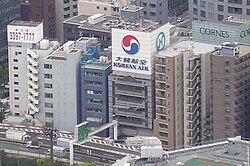
By the late 1960s, Hanjin began diversifying its operations to move beyond military trucking. On March 1, 1969, the company took over the state-owned Korean Air Corporation, which had been struggling financially at the time. Shortly after, in November 1969, Hanjin entered the containerized shipping business—the practice of using standardized containers to transport goods—by signing a deal with Sea-Land Service, Inc.
The infrastructure for this new venture materialized quickly, with the opening of Hanjin's first container yard at the port of Busan in September 1970. This set the stage for global expansion, particularly in the Middle East during the late 1970s, with key port contracts in Kuwait (Shuwaik, 1977), Saudi Arabia (Dammam, 1979), and Jeddah (1980).

Diversification and Global Reach
The 1990s marked a period of aggressive horizontal integration. In March 1990, Hanjin entered the trucking and warehousing sector by purchasing the Korea Freight Transport Company. This was followed by the 1992 launch of Hanjin Express, a courier service designed for small package delivery.
Hanjin also strengthened its presence in the United States through a joint venture with Total Terminals International LLC in August 1992, allowing them to handle cargo at the ports of Long Beach and Seattle. Further innovations included the initiation of container rail service between Busan and Uiwang in January 1993 and the hauling of grain to North Korea in May 1995.
| Year | Event | Significance |
|---|---|---|
| 1945 | Company Founded | Start of operations post-WWII |
| 1969 | Acquisition of Korean Air | Entry into aviation industry |
| 1969 | Sea-Land Service Deal | Entry into container shipping |
| 1992 | Hanjin Express Launch | Expansion into courier services |
| 2016 | Bankruptcy Filing | Collapse of Hanjin Shipping |
Leadership Transitions and Decline
Following the death of founder Cho Choong-hoon in 2002, the company's leadership was split among his sons. Cho Yang-ho inherited KAL (Korean Air), while Cho Soo-ho took over Hanjin Shipping. After Cho Soo-ho passed away from lung cancer in 2006, his widow, Choi Eun-young, assumed the role of chairwoman of Hanjin Shipping in 2007.
In June 2014, KAL acquired a 33.2 percent stake in Hanjin Shipping. However, the financial stability of the shipping arm proved fragile. On August 31, 2016, Hanjin Shipping filed for bankruptcy after creditors withdrew their support, citing an inadequate funding plan provided by the parent company.
Frequently Asked Questions
When was Hanjin founded?
Hanjin was founded in November 1945, shortly after the conclusion of World War II.
How did Hanjin enter the aviation industry?
Hanjin entered the aviation sector on March 1, 1969, by taking over the state-owned Korean Air Corporation.
What was Hanjin's role in the Vietnam War?
Hanjin provided essential transportation of materials for the U.S. armed forces, including the Army, Navy, and Air Force, earning $150 million in profits between 1966 and 1971.
Why did Hanjin Shipping go bankrupt?
Hanjin Shipping filed for bankruptcy on August 31, 2016, because its creditors withdrew support after determining that the funding plan proposed by the parent company was inadequate.
What was Hanjin-Senator?
Hanjin-Senator was a shipping entity that, at its peak, was the seventh largest container transportation and shipping company in the world before ceasing operations in February 2009.