Halfback Characteristics and Roles in American Football
In the complex machinery of an American football offense, the halfback serves as a versatile engine. While primarily known for rushing the ball, the modern halfback must balance a diverse set of skills, ranging from raw power and agility to precise pass-catching and strategic blocking. As offensive schemes have evolved, the requirements for the position have shifted from simple ball-carrying to a multi-faceted role that can dictate the tempo of a game.
Key Facts
- Primary Goal: Gain yardage through rushing while protecting the football from defensive strips.
- Vision: The ability to identify open rushing lanes and avoid tackles is critical for success.
- Versatility: Modern "every-down" backs must excel in rushing, receiving, and pass-blocking.
- Specialization: Teams often employ specific backs for third-down conversions or goal-line situations.
- Dual Threat: Some elite halfbacks can exceed 1,000 rushing yards and 100 receptions in a single season.
The Art of Rushing
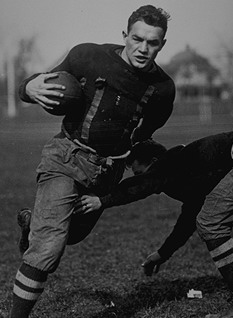
The core responsibility of a halfback is to advance the ball on the ground. To do this successfully, they rely on effective blocking from the offensive line and the fullback. Because most teams designate one primary halfback to handle the bulk of the carries, these players typically have more rushing attempts than any single receiver has receptions.
Beyond physical strength, a halfback needs exceptional vision—the ability to read the defense and find open lanes. Hall-of-Famer Emmitt Smith and Le'Veon Bell are prime examples of players who used patience and vision to navigate the field, proving that elite production is possible even without world-class speed.
The Evolution of the Receiving Halfback
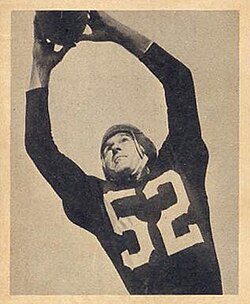
While rushing is foundational, the ability to catch passes has become a highly valued asset. In the 1970s, Chuck Foreman of the Minnesota Vikings pioneered this role, leading the league with 73 receptions in 1975. This evolution was further accelerated by the West Coast offense, a system that emphasizes short, horizontal passing and requires halfbacks to be reliable targets.
In these systems, halfbacks often run "checkdown" routes—safe options like hooks or curls—that provide the quarterback with a reliable target when primary receivers are covered. The San Francisco 49ers of the 1980s and 90s utilized this strategy with Roger Craig and Ricky Watters. Notably, Roger Craig became the first player in NFL history to record over 1,000 rushing and 1,000 receiving yards in one season.
The Third-Down Specialist
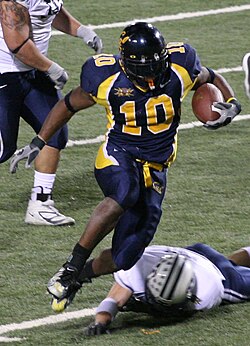
Some teams employ a "third down" back, a player specifically skilled at catching short passes or "picking up the blitz" (blocking blitzing defenders) during long-yardage situations. Darren Sproles exemplified this role; despite his 5'6" stature, his elusiveness and versatility led to over 4,800 career receiving yards. Modern examples include Nyheim Hines, Eno Benjamin, J.D. McKissic, and Jerick McKinnon.
Blocking and Physical Profiles
Halfbacks are not just targets; they are protectors. In passing situations, they often block blitzing linebackers or safeties. Conversely, on running plays, the fullback works to create the hole that the halfback exploits. This synergy was evident in LaDainian Tomlinson's record-breaking 2006 season.
Physical builds generally fall into two categories:
- Scat Backs: Smaller, agile players with a low center of gravity who dodge tacklers. Examples include Barry Sanders, Chris Johnson, and modern stars like Saquon Barkley and Christian McCaffrey. They are particularly effective in spread offenses that prioritize open space.
- Power Backs: Larger, stronger players who use brute force to run "North-and-South" (straight ahead). While traditionally slower, players like Jerome Bettis, Marshawn Lynch, and Derrick Henry use their size to break through tackles.
The Every-Down Back
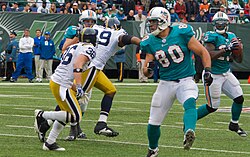
The gold standard in the modern era is the "every-down" halfback. These players possess the stamina and skill set to handle rushing, receiving, and blocking without needing to be substituted. Legends like Walter Payton and Emmitt Smith set the stage for modern versatile backs such as Dalvin Cook and Jonathan Taylor.
Specialized Roles and Rare Plays
Goal Line Backs
When an offense is within five yards of the goal line or needs a few yards for a first down, they may use a goal line back. These are typically power backs who are resistant to fumbling and can muscle through a dense mass of defenders to score a touchdown.
Special Teams and Passing
Some halfbacks contribute to special teams as punt or kickoff returners. Brian Mitchell holds the NFL record for both kickoff (14,014 yards) and punt return (4,999 yards) yardage by a halfback. Additionally, a backup may play "upback," acting as a blocker or receiving a snap during a fake punt.
Though rare, halfbacks may also throw the ball. This occurs during a halfback option or within the Wildcat formation, where the center snaps the ball directly to the halfback. The Miami Dolphins utilized this effectively with Ronnie Brown, who could run, pass, and receive from this set.
Summary of Halfback Types
| Type | Primary Strength | Typical Build | Key Role |
|---|---|---|---|
| Scat Back | Agility & Speed | Smaller/Lighter | Eluding tacklers in open space |
| Power Back | Strength & Power | Larger/Heavier | North-and-South rushing |
| Third-Down Back | Receiving & Blocking | Variable | Short passes & blitz pickup |
| Goal Line Back | Brute Force | Large/Strong | Short yardage & touchdowns |
| Every-Down Back | Versatility & Stamina | Balanced | All-around offensive utility |
Frequently Asked Questions
What is the difference between a power back and a scat back?
A power back uses size and strength to run straight ahead (North-and-South) and break tackles, whereas a scat back uses speed and agility to dodge defenders and navigate the edges of the field (East-and-West).
What is a "checkdown route"?
A checkdown route is a short, safe pass—such as a hook or curl—that a halfback runs to provide the quarterback with an easy target if the primary receivers are covered by the defense.
Who was the first player to rush and receive for 1,000 yards in one season?
Roger Craig of the San Francisco 49ers was the first player in NFL history to achieve both 1,000 rushing yards and 1,000 receiving yards in a single season.
What is the Wildcat formation?
The Wildcat is an offensive set where the center snaps the ball directly to the halfback instead of the quarterback, allowing the halfback to run, pass, or receive.
What does a "third down" back do?
A third down back is a specialist brought into the game during third-and-long situations because they are typically better at catching short passes and blocking blitzes than the primary starting halfback.