American Football: History, Rules, and Global Evolution
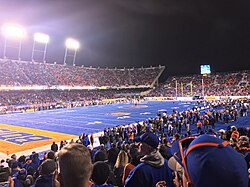
Often referred to as gridiron due to the markings on the field, American football is a high-impact team sport that has grown from a collegiate pastime into a global phenomenon. Defined by strategic complexity and physical intensity, the game pits two teams of 11 players against each other in a battle for territorial control and scoring.
The sport's origins date back to November 6, 1869, in New Brunswick, New Jersey, where the first intercollegiate game took place between Princeton and Rutgers. Over the decades, the game evolved from its rugby-like roots into the structured sport seen today, largely thanks to innovators like Walter Camp, known as the "Father of American Football."

Key Facts
- First Game: Played on November 6, 1869, between Princeton and Rutgers.
- Governing Body: The International Federation of American Football (IFAF) oversees the sport globally.
- Field Dimensions: A standard rectangular field is 120 yards long and 53 1/3 yards wide.
- Team Size: 11 players per side on the field, with free substitution allowed between downs.
- Olympic Status: Flag football is scheduled for the 2028 Summer Olympics.
The Mechanics of the Game
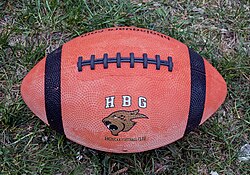
At its core, American football is a game of territory. The objective is to move an oval-shaped ball down the field to the opponent's end zone to score points.
Offense, Defense, and Special Teams
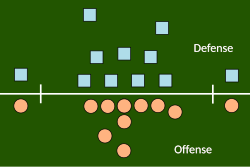
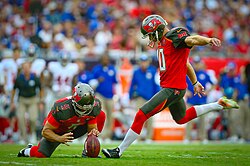
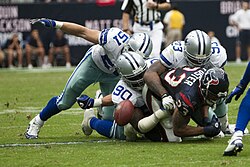
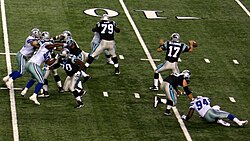
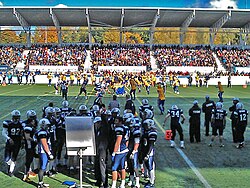
Teams are divided into three specialized units. The offensive unit possesses the ball and attempts to advance it via running or forward passes. The defensive unit works to stop the offense, often by tackling the ball carrier or intercepting passes. Finally, the special teams unit takes the field during kicking situations, such as punts, field goals, and kickoffs.
Advancing the Ball and Downs
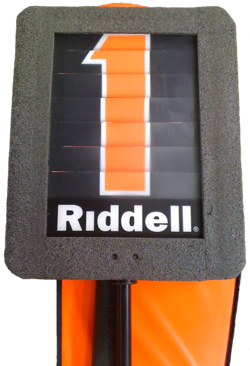
The offense has four attempts, known as downs, to advance the ball 10 yards. If they succeed, they earn a "first down," granting them another set of four attempts. If they fail to reach the 10-yard mark, the ball is typically turned over to the defense or kicked away (punted) to push the opponent further back.
Scoring Methods
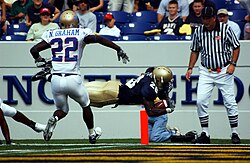
Points are primarily scored in two ways: touchdowns and field goals. A touchdown occurs when a player carries the ball into or catches it within the opponent's end zone. Following a touchdown, a team can score an extra point. Alternatively, a team may kick the ball through the goal posts for a field goal.

Equipment and Safety
Because it is a full-contact sport, protective gear is mandatory. Players wear a hard plastic helmet to protect the head, along with shoulder, thigh, and knee pads to absorb the impact of collisions.

Despite the equipment, the sport has faced scrutiny regarding safety, particularly concerning brain health and Chronic Traumatic Encephalopathy (CTE). This has led to the implementation of safer tackling techniques and limits on contact during practices, especially in youth leagues.
The Field and Officiating
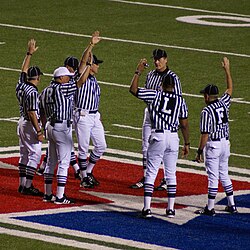
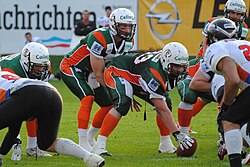
The game is played on a grass or synthetic turf field. Officials monitor the game to ensure rules are followed and to mark the line of scrimmage—the invisible line where the ball sits before a play begins.
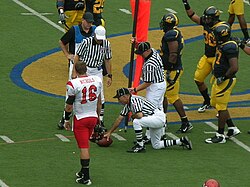
To determine if a first down has been achieved, officials use a chain crew to measure the exact distance the ball has traveled.
Global Reach and Variations
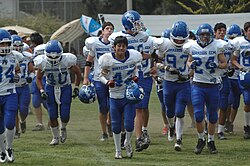
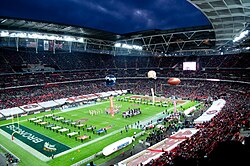
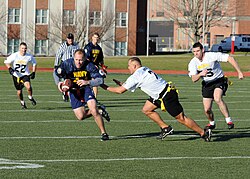
While most popular in North America, American football has expanded worldwide. From professional leagues in Germany to high school programs in Japan and Mexico, the sport's influence is growing. Variations such as flag football—a non-contact version where players pull flags from the opponent's belt instead of tackling—have made the sport more accessible and have paved the way for its inclusion in the Olympic Games.

| Feature | Detail |
|---|---|
| Field Length | 120 Yards |
| Field Width | 53 1/3 Yards |
| Players per Team | 11 |
| Primary Goal | Reach the opponent's end zone |
| Key Equipment | Helmet, Shoulder Pads, Thigh/Knee Pads |
Frequently Asked Questions
What is the difference between a touchdown and a field goal?
A touchdown is scored by carrying or catching the ball in the opponent's end zone, providing the highest number of points. A field goal is scored by kicking the ball through the goal posts, usually attempted when the offense cannot reach the end zone.
How many downs does an offense get to move the ball?
The offense has four downs to advance the ball 10 yards. If they succeed, they receive a new set of four downs.
What is flag football?
Flag football is a non-contact variation of the sport where tackling is replaced by pulling a flag off the ball carrier's belt. It is often used in youth programs and is an Olympic sport.
Who is considered the "Father of American Football"?
Walter Camp is credited as the Father of American Football for his role in evolving the game's rules and structure during his time at Yale University.
What is the line of scrimmage?
The line of scrimmage is the imaginary transverse line across the field that separates the offensive and defensive teams before a play begins.