Hail: The Science of Frozen Precipitation and Severe Storms
Hail is a form of solid atmospheric precipitation consisting of balls or irregular lumps of ice known as hailstones. While often confused with ice pellets (sleet), hail is a distinct phenomenon. Ice pellets typically fall during cold weather, whereas hail growth is actually inhibited by low surface temperatures.
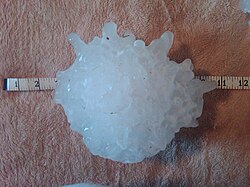
Unlike snow, which consists of delicate crystalline flakes, or graupel, which is made of rime ice, hailstones are denser and larger, typically measuring between 5 mm (0.2 in) and 15 cm (6 in) in diameter.
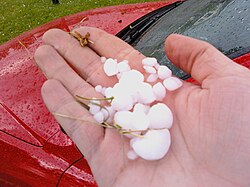
Key Facts
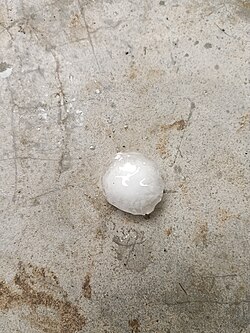
- Formation: Produced by cumulonimbus clouds during thunderstorms with strong upward air motion (updrafts).
- Size Range: Typically 5 mm to 15 cm in diameter; can weigh over 0.5 kg (1.1 lb).
- Damage Threshold: Stones larger than 2 cm (0.79 in) are generally considered capable of causing damage.
- Global Hotspot: Kericho, Kenya, holds a record for hail frequency, averaging 50 hail days annually.
- Velocity: Falling speeds vary by size, from 9 m/s for 1 cm stones to 48 m/s for 8 cm stones.
How Hail Forms
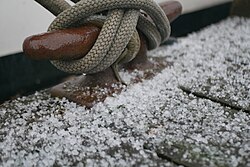
Hail is possible during most thunderstorms, as it is produced within cumulonimbus clouds. The process requires two primary environmental factors: strong upward motion of air (updrafts) and a lowered freezing level.
As a hailstone forms, it is suspended aloft by these powerful updrafts. It travels through the cloud, collecting layers of ice. This process continues until the stone's weight overcomes the updraft, causing it to fall to the ground. In the mid-latitudes, this occurs primarily near the interiors of continents, while in the tropics, hail is usually confined to high elevations.
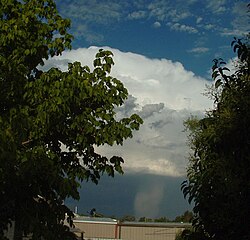
The Layered Structure of Hailstones
One of the most defining characteristics of hail is its layered nature. Hailstones are composed of transparent ice or alternating layers of transparent and translucent ice, each at least 1 mm thick. These layers are deposited as the stone moves through different temperature zones and liquid water content within the storm.
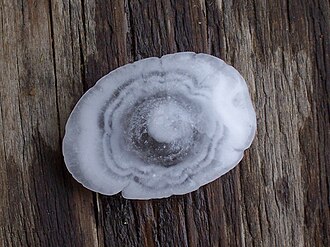
Factors Influencing Growth
The size of a hailstone is directly related to the strength of the storm's updraft. Stronger storms, such as supercells, can keep larger stones aloft longer, allowing them to grow. Conversely, weaker storms produce smaller stones. Growth becomes negligible when air temperatures drop below −30 °C (−22 °F), as supercooled water droplets become rare.
![Severe thunderstorms containing hail can exhibit a characteristic green coloration.[15]](/images/dc/14/dc148e740ae461c13bfa8c2ac26fc9775a91c6fa049505b11c2640cccc2b1859.jpg)
Size, Velocity, and Impact
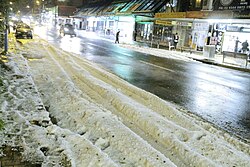
The impact of a hailstorm is largely determined by the size of the stones. In the United States, damaging hail is typically observed between 2.5 cm (1 in) and 4.4 cm (1.75 in) in diameter. Different countries set different warning thresholds based on local sensitivity; for example, grape-growing regions may be impacted by much smaller stones.
![Damage to automobiles due to a hail storm that affected the Dallas, Texas area on May 8, 1926, with hail as large as 4.2 inches (11 cm) in diameter[53]](/images/48/f9/48f929946d689abe40349a3a253b56264c0467e908843fc37128d610471c7f35.jpg)
Terminal Velocity
The terminal velocity—the speed at which a stone strikes the ground—depends on the stone's size, its drag coefficient, wind motion, and melting that occurs during the descent. Because hailstones are not perfect spheres, calculating an exact drag coefficient is difficult.
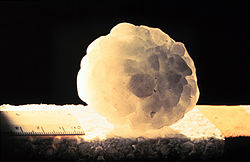
Size Comparison Table
| Diameter (Inches) | Everyday Object Comparison |
|---|---|
| 0.25 - 0.375 | Pea |
| 0.50 | Small Marble |
| 0.75 | Penny |
| 1.00 | Quarter |
| 1.50 | Walnut / Ping Pong Ball |
| 1.75 | Golf Ball |
| 2.50 | Tennis Ball |
| 3.00 | Large Apple |
| 4.00 | Softball |
| 4.50 | Grapefruit |
| 4.75 - 5.00 | Computer CD / DVD |
Detection and Records
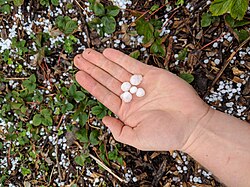
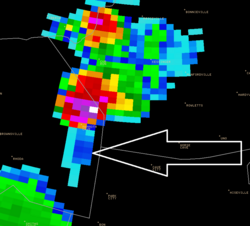
Meteorologists use various tools to detect hail. In METAR reporting, hail 5 mm or greater is coded as GR, while smaller hail and graupel are coded as GS. Advanced radar can identify "three-body spikes," which are weak triangular echoes behind a thunderstorm core that indicate the presence of hail.
Historically, some of the most extreme hail events have occurred in the United States and Kenya. Kericho, Kenya, is a global hotspot due to its elevation of 2,200 metres (7,200 ft), once recording 132 days of hail in a single year.
Frequently Asked Questions
What is the difference between hail and sleet?
Hail consists of larger, often layered lumps of ice produced by strong updrafts in cumulonimbus clouds during thunderstorms. Sleet (ice pellets) is generally smaller, translucent, and falls during cold weather.
How large can a hailstone get?
Hailstones can grow up to 15 cm (6 in) in diameter and can weigh more than 0.5 kg (1.1 lb).
Why do some hailstones have rings?
The rings are layers of transparent and translucent ice. They form as the hailstone moves through different temperature and moisture conditions within the thunderstorm's updrafts.
What determines the speed of a falling hailstone?
Terminal velocity is influenced by the stone's size, its drag coefficient, wind speed, collisions with other precipitation, and the amount of melting that occurs as it falls through warmer air.
Where is hail most common?
In mid-latitudes, hail typically forms near the interiors of continents. In tropical regions, it is generally confined to high-elevation areas.