Hadad: The Storm God of the Ancient Near East
In the pantheons of the ancient Levant and Mesopotamia, few deities commanded as much awe and terror as Hadad. Known by various names across different cultures—including Adad in Akkad and Iškur in Sumer—he was the supreme master of the weather, governing the thunder, rain, and hurricanes that could either bring life-giving fertility to the soil or unleash catastrophic destruction upon the land.
Hadad's influence spanned millennia, appearing in records as early as 2500 BCE in Ebla. As a deity of duality, he represented the precarious balance of nature: the benevolent rain required for agriculture and the violent storms that signaled divine rage.
Key Facts
- Primary Domains: Weather, storms, thunder, rain, and fertility.
- Common Names: Hadad (Canaanite), Adad (Akkadian/Assyrian), Iškur (Sumerian), Teshub (Hurrian).
- Symbols: The thunderbolt, the bull, and the lion.
- Equivalents: Zeus (Greek), Jupiter (Roman), and Set (Egyptian).
- Key Myth: The Baal Cycle, detailing his victory over the sea god Yamm and the death god Mot.
The Evolution of Adad in Mesopotamia
Originally introduced to Mesopotamia from the Levant by the Amorites, Hadad became known as Adad. In the south, he was identified with the Sumerian god Iškur. While Iškur was less prominent in early Sumerian city-states—where irrigation was more vital than rainfall—Adad's importance grew significantly after the First Babylonian dynasty.
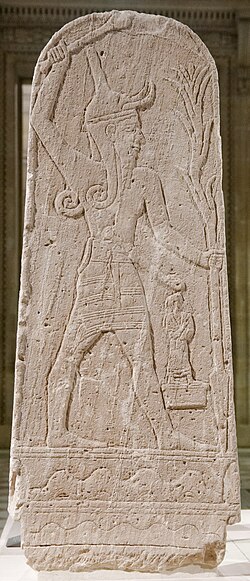
In Akkadian traditions, Adad was often called Rammanu (the "Thunderer"). He was frequently depicted as a bearded figure wearing a bull-horned headdress, wielding a club and a thunderbolt. His sacred animal, the bull, symbolized both strength and the raw power of the storm.
In Assyria, Adad took on a more warrior-like persona. During the Middle Assyrian Empire, he shared a double sanctuary with the sky god Anu in the city of Assur. He also formed a divine partnership with the sun-god Shamash; together, they were regarded as the patron deities of divination and oracles.
The Baal Cycle and the Myths of Ugarit
In the city of Ugarit (modern-day Syria), Hadad was often referred to as Baal (meaning "Lord"). The Baal Cycle, a collection of epic stories composed between 1400 and 1200 BCE, portrays him as the protector of life and growth whose absence leads to drought and chaos.
The Struggle for Sovereignty
The myths describe a power struggle between Baal and other deities. Initially, the supreme god El appointed his son Yamm (the Sea) as king. However, with the help of magic clubs crafted by the divine smith Kothar-wa-Khasis, Baal defeated Yamm, earning the title Rider on the Clouds.
The Conflict with Death
Baal's victory was not permanent. He eventually faced Mot, the god of drought and the underworld. This cycle of conflict and resolution mirrored the seasonal changes of the Levant, where the "death" of the storm god brought the dry season and his "return" brought the rains necessary for survival.
![A stele from Bethsaida (et-Tell) depicting a Canaanite deity, possibly Hadad. On display at the Israel Museum in Jerusalem.[29]](/images/1c/74/1c74061e1b2f72177a4e67d1abaf316edf28d28d90c1f5dfc388268b1cfda007.jpg)
Cross-Cultural Identifications
Because the storm god was a universal archetype, Hadad was frequently equated with other powerful deities across the Mediterranean and Near East.
Egypt and the Levant
In Egypt, the identification was complex. The Amherst Papyrus associates Baal Zephon with Horus. However, he was also linked to Set, the god of foreigners and storms. This duality likely stemmed from the fact that storm-like traits were viewed as "foreign" elements within the Egyptian landscape.
Greco-Roman World
Classical sources equated Hadad with Zeus and Jupiter (specifically Jupiter Dolichenus). These identifications were often centered around Mount Casius, where a statue of Zeus was believed to be an image of the local storm deity.
Hadad in Aram and Ancient Israel
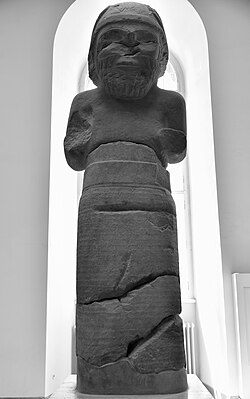
Hadad remained a central figure in the Aramean kingdoms. The kings of Damascus often used the title Ben-Hadad ("Son of Hadad"), and the city of Aleppo was considered his primary seat of power.
In the biblical Books of Kings, the cult of Baal (Hadad) is mentioned as a source of conflict, particularly when Queen Jezebel promoted its worship in the Northern Kingdom of Israel. Scholars suggest that the "Baal" mentioned in these texts may specifically refer to Baal Shamem (Lord of the Heavens), a title associated with Hadad.
| Region/Culture | Name | Primary Association | Key Symbol |
|---|---|---|---|
| Canaan/Ugarit | Hadad / Baal | Fertility, Rain, Sovereignty | Bull / Thunderbolt |
| Akkad/Assyria | Adad | Storms, War, Divination | Horned Helmet / Club |
| Sumer | Iškur | Cosmic Inspection, Rain | Bull |
| Hurrian | Teshub | Storms, Kingship | Thunderbolt |
Frequently Asked Questions
Who was Hadad in ancient mythology?
Hadad was the storm and rain god worshipped in Canaanite and ancient Mesopotamian religions. He was responsible for both the life-giving rains that allowed crops to grow and the destructive storms and hurricanes that caused chaos.
What is the difference between Hadad, Adad, and Baal?
These are largely different names for the same deity across different languages and cultures. Hadad is the Canaanite name, Adad is the Akkadian/Assyrian version, and Baal (meaning "Lord") was a title frequently used for Hadad in Ugaritic texts.
What was the significance of the bull in Hadad's worship?
The bull was Hadad's symbolic animal, representing raw power, virility, and the thunderous noise of a storm. He is often depicted wearing a bull-horned headdress or associated with the animal in hymns.
How does the Baal Cycle explain the seasons?
The Baal Cycle describes the struggle between Baal (the storm god) and Mot (the god of death and drought). Baal's victory and return symbolize the arrival of the rainy season, while his defeat by Mot represents the onset of drought.
Was Hadad related to the Greek god Zeus?
Yes, in the process of interpretatio graeca, the Greeks identified Hadad with Zeus because both were supreme storm gods who wielded thunderbolts and ruled the skies.