Gülen Movement: History, Global Influence, and Political Conflict
The Gülen movement, also known as Hizmet (meaning "Ministry" or "Service") or the Cemaat ("Community"), is a global social and religious network founded by the Turkish cleric Fethullah Gülen. Rooted in moderate Islam and the teachings of Said Nursî, the movement emphasizes education, humanitarianism, and interfaith dialogue as primary means of improving society.
From its origins in İzmir, Turkey, the movement expanded into a vast international network spanning banking, media, healthcare, and most notably, education. While it once maintained a cooperative relationship with various Turkish political entities, it eventually became the center of a severe conflict with the Turkish state, leading to its designation as a terrorist organization by Turkey and several other entities.

Key Facts
- Founder: Fethullah Gülen (1969–2024).
- Core Purpose: Education, interfaith dialogue, and humanitarian service.
- Global Reach: Estimated 3 to 6 million members worldwide as of 2015.
- Educational Scale: Approximately 2,000 schools globally, including 1,000 within Turkey.
- Headquarters: Originally İzmir, Turkey (1969–1999); later Saylorsburg, Pennsylvania (1999–present).
- Legal Status: Designated as a terrorist group by Turkey and other international organizations.
Organizational Structure and Reach
The movement operates through a decentralized but coordinated network of lay clergy, including Imams, Mullahs, and Shaykhs. Its influence is exerted through several key sectors:
Education and Academic Institutions
Education is the cornerstone of the movement. Gülen-inspired schools have expanded to over 100 countries across five continents. These institutions often focus on creating a professional elite capable of leading state functions and promoting moderate Islamic values.
![Ahmet Yassawi University, a private university affiliated with the Gülen movement located in Turkistan, Kazakhstan[62]](/images/c5/63/c56367b25dcdde80fc83d9de4cf98e10aa9d1756f18e5636b3a32fa805c81223.jpg)
Media and Healthcare
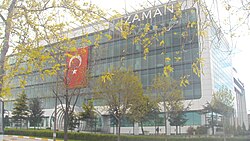
The movement established significant footprints in the media and health sectors. One of its most prominent ventures was the Zaman newspaper, which became one of the most widely circulated publications in Turkey before being seized by the government.
Interfaith Dialogue and Humanitarianism
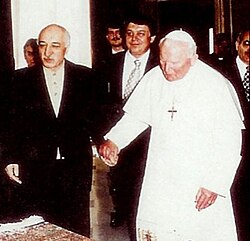
Hizmet promotes a vision of "Islamic Enlightenment," seeking to bridge gaps between different faiths and cultures. This commitment to dialogue has led to high-profile interactions with global religious leaders.
Conflict with the Turkish State
The relationship between the Gülen movement and the Turkish government shifted from alliance to open hostility. This tension culminated in the July 15, 2016 coup attempt, which the Turkish government attributed to the movement, referring to it as FETÖ (Fethullahist Terrorist Organization).
Purges and Legal Actions
Following the 2016 attempt, Turkey launched massive purges from state offices. By 2019, over 500,000 citizens had been detained for alleged links to the movement. High-profile figures, including Amnesty International's honorary president Taner Kilic and Idil Eser, were convicted of membership in 2020.
![Gökhan Açıkkollu, a teacher from a Gülen-affiliated school died in police custody after being imprisoned and tortured for 13 days post 2016 coup attempt.[53][54]](/images/dc/29/dc29b9c5c045e2d1915070ef4005e3703c1b5f96bc73c782b2e9f7cbf6508135.jpg)
International Implications
The conflict has extended beyond Turkey's borders. The Turkish government has sought the extradition of Fethullah Gülen from the United States and has been accused of abducting movement members from countries such as Azerbaijan, Kosovo, and Kyrgyzstan.
![Exodus, an award-winning movie focusing on the stories of a group of people forced to flee Turkey to seek asylum in Europe post 2016 coup attempt.[153]](/images/3f/53/3f531ce8995af1a512b58ef66663886afa344cc7c0efe381ab7a17dbfdd01655.jpg)
Summary of Movement Evolution
| Period/Year | Milestone/Metric | Detail |
|---|---|---|
| 1960 | Ideological Root | Death of Said Nursî, a key influence on the movement. |
| 1969 | Foundation | Movement founded in İzmir, Turkey. |
| 1999 | Relocation | Headquarters moved to Saylorsburg, Pennsylvania. |
| 2010 | Global Expansion | Over 1,000 schools established in 100+ countries. |
| 2015 | Peak Membership | Estimated 3-6 million members; 2,000 total schools. |
| 2016 | Political Rupture | Failed coup attempt leads to designation as a terrorist group. |
| 2019 | State Crackdown | Over 500,000 detainees in Turkey for alleged links. |

Frequently Asked Questions
What is the difference between Hizmet and FETÖ?
Hizmet is the name used by the movement's followers to describe their focus on "service" and education. FETÖ is the designation used by the Turkish government to classify the movement as a terrorist organization.
Who was Fethullah Gülen?
Fethullah Gülen (1969–2024) was the spiritual leader and founder of the movement. He lived in self-exile in the United States from 1999 until his death in 2024.
How many schools are associated with the movement?
As of 2015, the movement was estimated to have approximately 2,000 schools globally, with an equal split of 1,000 in Turkey and 1,000 in other countries.
What was the movement's role in the 2016 coup attempt?
The Turkish government officially claims that the Gülen movement orchestrated the failed coup attempt on July 15, 2016, to seize power from the elected government.
What are the primary fields of the movement's influence?
The movement is most active in education, but it also maintains significant interests in banking, media, and healthcare.