Guitar History, Types, and Technical Construction
The guitar is one of the world's most versatile chordophones—musical instruments that produce sound through vibrating strings. From its ancient roots as a plucked string instrument to the high-gain electric models of the modern era, the guitar has evolved through centuries of cultural exchange and engineering innovation.
Whether it is the nylon-stringed classical guitar used in intimate recitals or the solid-body electric guitar driving a stadium rock concert, the instrument's fundamental appeal lies in its ability to provide both melodic lines and harmonic accompaniment.

Key Facts

- Classification: A composite chordophone (Hornbostel–Sachs 321.322).
- Origins: Developed around the 13th century, with linguistic roots tracing back to the Ancient Greek kithára.
- Electric Innovation: First patented in 1937, allowing for solid-body designs that eliminate acoustic feedback.
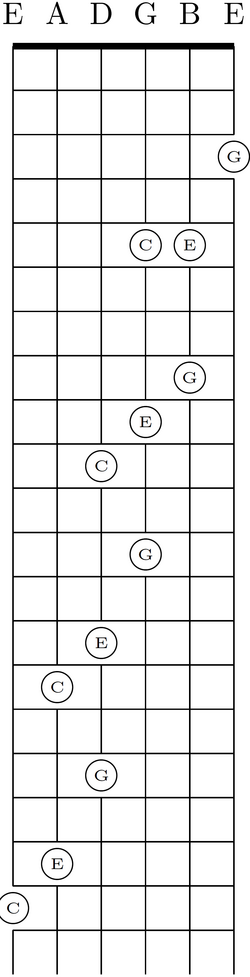
- Standard Tuning: E2, A2, D3, G3, B3, E4, featuring a unique major-third interval between the G and B strings.
- Fret Logic: Frets are placed using a mathematical ratio (the twelfth root of two) to achieve equal temperament.
The Evolution of the Guitar

The term "guitar" has been applied to various stringed instruments over millennia. Etymologically, the English word derives from the Spanish guitarra, which was influenced by the Andalusian Arabic qīthārah and the Latin cithara.
During the 15th and 16th centuries, the Spanish vihuela (known in Italy as the viola da mano) played a pivotal role. With its six courses of strings and guitar-like body, it heavily influenced the development of the baroque guitar. By the mid-16th century, the five-course guitar became established, though its origin was a subject of historical debate between figures like Vicente Espinel and other European contributors.

Types of Guitars

Acoustic Guitars
Acoustic guitars rely on a hollow sound box to amplify the vibration of the strings naturally. This category includes:
- Classical: Typically featuring nylon strings for a softer tone.
- Flat-top and Archtop: Common in folk, jazz, and blues.
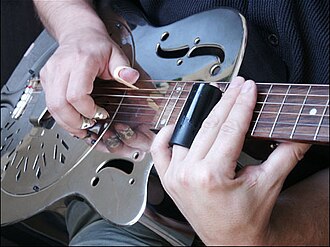
- Resonator: Invented by John Dopyera, these use aluminum cones to act like a loudspeaker, often featuring bodies made of brass or steel.
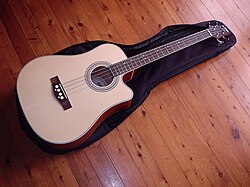
- Twelve-string and Acoustic Bass: Variations that expand the tonal range or provide deeper low-end frequencies.

Electric Guitars
Electric guitars use electromagnetic pickups to convert string vibrations into electrical signals, which are then amplified. This technology enabled the creation of solid-body guitars, which are less prone to feedback and allow for effects like distortion and reverb.
- Solid-body: The standard for rock music.
- Hollowbody and Archtop: Preferred for jazz and rockabilly.
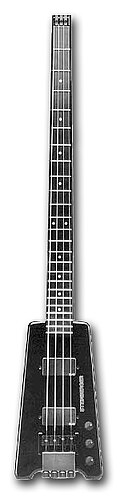
- Extended Range: Seven-string and eight-string models provide additional low-end notes, while specialized instruments like the "Sky Guitar" extend the fret range to match a violin's upper register.

Technical Construction and Anatomy
The guitar consists of three primary sections: the head, the neck, and the body.
The Neck and Fretboard
The fretboard (or fingerboard) is a piece of wood embedded with metal frets. The curvature of this surface is known as the fretboard radius; a smaller radius indicates a more pronounced curve. Most modern guitars use a 12" radius, whereas vintage models often used 6–8".
Frets are metal strips that divide the scale length into half-step intervals. Luthiers use the constant 17.817 to determine the precise distance between frets, ensuring the instrument is in equal temperament.
The Body and Electronics
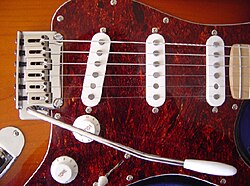
The body houses the bridge, saddle, and, in electric models, the electronics. Electric guitars typically use two types of pickups:
- Single-coil: Clear tone but susceptible to 50/60 Hz electromagnetic hum.
- Humbuckers: Double-coil pickups designed to "buck" or cancel out noise.

Tuning and Accessories

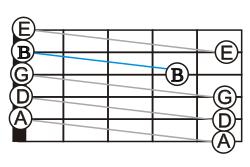
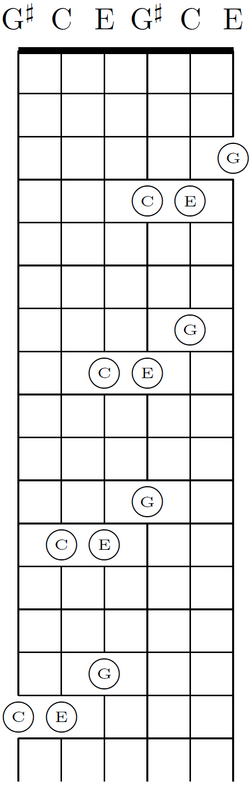
Standard tuning is the most common configuration, though scordatura (alternative tuning) is often used for specific musical effects. In standard tuning, the interval between the G and B strings is a major third, while all other adjacent strings are perfect fourths.
| String | Scientific Pitch | Frequency (Hz) | Interval from Middle C |
|---|---|---|---|
| 1st (Thinnest) | E4 | 329.63 | Major third above |
| 2nd | B3 | 246.94 | Minor second below |
| 3rd | G3 | 196.00 | Perfect fourth below |
| 4th | D3 | 146.83 | Minor seventh below |
| 5th | A2 | 110.00 | Minor tenth below |
| 6th (Thickest) | E2 | 82.41 | Minor thirteenth below |
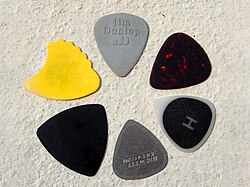
Players use various accessories to alter the sound, including capotastos (capos) to change the key, slides for a gliding effect, and plectrums (picks). Pick thickness varies by use: thin picks (0.2–0.5 mm) are ideal for strumming, while thick picks (0.7–1.5+ mm) are preferred for lead playing.
Frequently Asked Questions


What is the difference between a single-coil and a humbucker pickup?
Single-coil pickups use one coil of wire and are prone to electrical hum. Humbuckers use two coils with opposite polarity to cancel out that noise, resulting in a thicker, quieter sound.
Why is the G to B string interval different in standard tuning?
The major-third interval between the G and B strings is an irregularity in an otherwise perfect-fourth sequence. This affects chord shapes, meaning chords often change their finger patterns when shifted across these strings.
How are fret positions calculated?
Frets are placed according to a mathematical formula based on the twelfth root of two. Luthiers often use the approximation constant 17.817 to determine the distance from the bridge for each subsequent fret.
What is a resonator guitar?
A resonator guitar uses one or more aluminum cones instead of a traditional wooden soundboard to amplify the sound, functioning similarly to a mechanical loudspeaker.
What does the fretboard radius affect?
The radius refers to the curvature of the fingerboard. A smaller radius is more curved, which can make certain chord grips easier, while a larger radius is flatter, often preferred for lead playing and bending strings.