Gudarekhi Monastery: A Masterpiece of Medieval Georgian Architecture
Nestled on a wooded hill west of its namesake village, the Gudarekhi monastery stands as a testament to the spiritual and architectural heritage of medieval Georgia. Enclosed by the remnants of a protective wall, this historic complex blends structural elegance with deep religious significance, featuring a main church and one of the country's most significant early bell-towers.
The Main Church of the Theotokos
The centerpiece of the complex is the church of the Theotokos. Designed as a hall church—a rectangular building without a dome—the structure measures 16.2 by 9.5 meters. It is constructed from smoothly hewn yellowish stone blocks and terminates in a semicircular apse to the east, with its sole entrance located on the southern side.
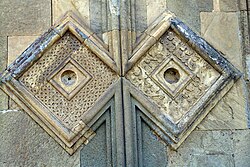
The exterior is not without artistic flair; the eastern facade features intricate stone carvings that draw inspiration from earlier Georgian domed churches.
Historical records are etched directly into the architecture. On the southern wall near the entrance, a seven-line inscription in asomtavruli (the oldest form of the Georgian alphabet) identifies the architect Chichaporisdze and mentions Queen Rusudan, her children, and Bishop Anton of Manglisi.
Interior Art and Sacred Spaces
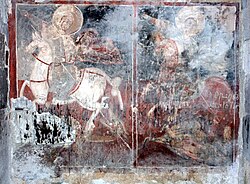
Inside, the church preserves the faded remnants of frescoes depicting the Archangels Michael and Gabriel—identified by 17th-century Greek inscriptions—alongside the saints George, Demetrius, and Theodore. While the Georgian inscriptions on the altar murals are now barely legible, they provide a glimpse into the site's liturgical history.
The church's layout has evolved over time. To the north lies an eukterion (a private prayer room), a later annex containing two stones with 10th–12th-century inscriptions that suggest the existence of an even earlier structure. To the south, the ruins of a columnated narthex, or entrance porch, remain. Additionally, fragments of a 12th-century stone iconostasis—the screen separating the sanctuary from the nave—have been moved to the Georgian National Museum in Tbilisi for preservation.
The Historic Bell-Tower
Located southeast of the main church is a free-standing stone bell-tower. Completed in 1278, it holds the distinction of being the oldest extant dated bell-tower in Georgia. The rectangular, two-storey building features an open lower level and an upper hypostyle hall (a space supported by columns), consisting of eight arched pillars with a small cell situated between them.
An asomtavruli inscription on the eastern wall of the tower commemorates King Demetrius II of Georgia and the priest Abraham.
Key Facts
- Oldest Dated Bell-Tower: The site features Georgia's oldest extant dated bell-tower, completed in 1278.
- Architectural Style: The main church is a hall church built from yellowish stone.
- Historical Figures: Inscriptions mention Queen Rusudan, King Demetrius II, and the architect Chichaporisdze.
- Ancient Script: The complex utilizes asomtavruli, the earliest Georgian script.
- Preservation: 12th-century stone iconostasis fragments are now housed in the Georgian National Museum.
| Structure | Key Feature | Notable Detail |
|---|---|---|
| Main Church | Hall church design | 16.2 x 9.5 m; yellowish stone |
| Bell-Tower | Rectangular plan | Completed 1278; oldest dated in Georgia |
| Eukterion | North annex | Contains 10th–12th century inscriptions |
| Narthex | South annex | Columnated; currently in ruins |
Frequently Asked Questions
What makes the Gudarekhi bell-tower historically significant?
The bell-tower is significant because it was completed in 1278, making it the oldest extant dated bell-tower in the entire country of Georgia.
Who is mentioned in the church's inscriptions?
The inscriptions mention the architect Chichaporisdze, Queen Rusudan and her children, Bishop Anton of Manglisi, King Demetrius II, and the priest Abraham.
What is an asomtavruli script?
Asomtavruli is the oldest form of the Georgian alphabet, used in the medieval inscriptions found on the church walls and the bell-tower.
Which saints are depicted in the church frescoes?
The frescoes depict the Archangels Michael and Gabriel, as well as the saints George, Demetrius, and Theodore.
Where can the original iconostasis be found?
The surviving fragments of the 12th-century stone iconostasis have been removed from the monastery and are preserved at the Georgian National Museum in Tbilisi.