Guayaquil: The Vibrant Pearl of the Pacific
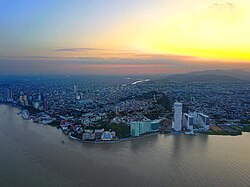
Known as La Perla del Pacífico (The Pearl of the Pacific), Guayaquil is the most populous city in Ecuador and a critical engine of the nation's growth. Situated along the Guayas River, this dynamic metropolis serves as one of Ecuador's two primary development poles, alongside the capital, Quito. As a major hub for business, finance, culture, and sports, Guayaquil blends a rich colonial history with modern urban ambition.
The city's strategic location has made it a cornerstone of trade for centuries. From its origins as a Spanish shipyard to its current status as a global commercial center, Guayaquil continues to define the economic landscape of the Andean Community.
Key Facts
- Population: 2,650,288 (City), with a metropolitan area of 3,193,267.
- Status: Most populous city in Ecuador and 10th largest in South America.
- Foundation: Definitively established in 1547 as Santiago de Guayaquil.
- Independence: First Ecuadorian city to achieve independence from Spain on October 9, 1820.
- Economy: A major financial and business hub with a 2023 GDP (PPP) of $42.9 billion.
- Geography: Located at an elevation of 4 meters (13 ft) in the Guayas Province.
History and Heritage
Guayaquil was definitively established in 1547 by Francisco de Orellana to serve as a shipyard and port for the Spanish Empire. Its role as a maritime gateway made it an essential economic hub, but also a target for aggression. In 1687, the city was looted by English and French pirates led by George Dew, Picard, and Groniet.
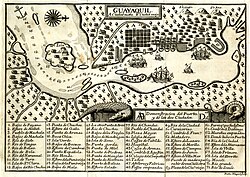
The city played a pivotal role in South American liberation. On July 26, 1822, the legendary generals José de San Martín and Simón Bolívar met in Guayaquil to coordinate the final stages of Peruvian independence and the broader liberation of Spanish South America. After achieving its own independence in 1820, the city briefly served as the capital of the Free Province of Guayaquil before joining Gran Colombia and eventually the Republic of Ecuador in 1830.
In more recent history, the city has faced significant challenges, including a severe impact during the 2020 COVID-19 pandemic, which overwhelmed local medical and mortuary services.
Geography and Climate
Guayaquil is located in the tropical lowlands of the Guayas Province. Its geography is defined by its proximity to the Gulf of Guayaquil and the Guayas River, which facilitate its role as a premier port city.
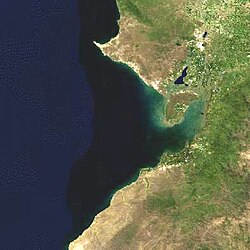
The city experiences a tropical savanna climate (Aw). It is characterized by high humidity and distinct precipitation patterns, with the heaviest rainfall occurring between January and April. The average annual precipitation is approximately 1,263.2 mm.
| Metric | Wettest Month (Feb) | Driest Month (Aug) | Annual Average |
|---|---|---|---|
| Mean Daily Max Temp | 32.2°C (90.0°F) | 30.5°C (86.9°F) | ~30°C |
| Mean Daily Min Temp | 23.4°C (74.1°F) | 20.7°C (69.3°F) | ~22°C |
| Average Precipitation | 332.0 mm (13.07 in) | 1.2 mm (0.05 in) | 1,263.2 mm |
| Relative Humidity | 85.3% | 81.7% | 82.8% |
Urban Development and Tourism
Since the early 2000s, Guayaquil has undergone an "urban regeneration" plan. This initiative focused on reconstructing sidewalks in tourist areas and upgrading the transit system with new bridges, tunnels, and speedways to reduce congestion.
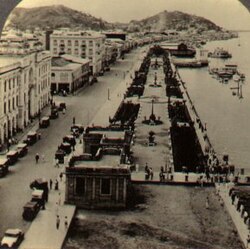
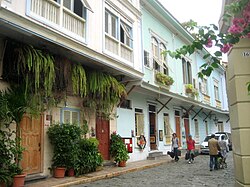
Visitors to the city often explore the Malecón 2000, a scenic waterfront promenade, and the historic Las Peñas neighborhood, known for its colorful architecture and cobblestone streets.
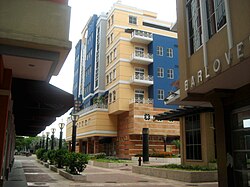
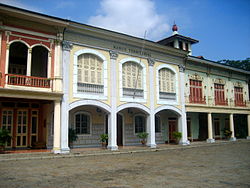
Other notable attractions include Puerto Santa Ana, a modern development blending luxury and commerce, and the Parque Histórico, which preserves the city's architectural and natural heritage.
Culture and Gastronomy
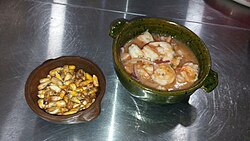
Guayaquil is a center for arts and literature, producing renowned figures such as writer José de la Cuadra and singer Julio Jaramillo. The city's culinary scene is highlighted by ceviche, typically made with shrimp, lemon, onions, tomatoes, and herbs.
Infrastructure and Society
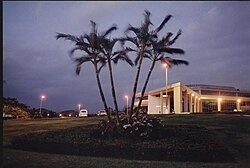
The city is supported by a robust educational network, including the Escuela Superior Politécnica del Litoral (ESPOL) and the University of Guayaquil. For transportation, the Metrovia bus rapid transit system, launched in 2006, moves approximately 400,000 passengers daily across three main lines.
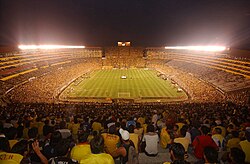
In terms of sports, the city is home to major venues like Barcelona's Stadium Monumental, one of the largest stadiums in South America.
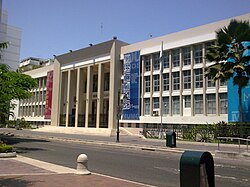
Spiritually, Christianity is the predominant religion, with 70% of the population identifying as Catholic. The Guayaquil Metropolitan Cathedral stands as the city's most prominent religious landmark.
Frequently Asked Questions
What is the significance of October 9th in Guayaquil?
October 9, 1820, marks the date Guayaquil achieved its independence from Spain, making it the first Ecuadorian city to do so. This event is celebrated annually and is commemorated in the city's anthem.
What is the Metrovia?
The Metrovia is a bus rapid transit (BRT) system that opened in 2006. It consists of three lines and 35 feeder routes, serving as a primary mode of public transport for hundreds of thousands of residents.
Which universities are located in Guayaquil?
Key institutions include the University of Guayaquil, Escuela Superior Politécnica del Litoral (ESPOL), Universidad Católica de Santiago de Guayaquil, and Universidad Laica Vicente Rocafuerte, among others.
What is the typical weather in Guayaquil?
Guayaquil has a tropical savanna climate with warm temperatures year-round. It features a rainy season from January to April and a significantly drier period from July to September.
What are the most popular tourist spots in the city?
Top attractions include the Malecón 2000 waterfront, the historic Las Peñas neighborhood, Puerto Santa Ana, and the Parque Histórico.