GTX: Transforming Seoul's Commuter Rail with High-Speed Connectivity
The Great Train eXpress (GTX) is an ambitious high-speed commuter rail project designed to revolutionize travel within the Seoul Metropolitan Area. By connecting distant suburbs to the heart of the city with unprecedented speed, the network aims to drastically reduce travel times for millions of commuters. While the project is being rolled out in phases, the vision includes a massive interconnected web of lines serving the entire region.
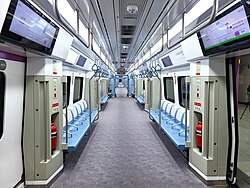
Key Facts
- Primary Goal: High-speed commuter rail service for the Seoul Metropolitan Area.
- Current Active Lines: GTX-A (operating in two sections).
- GTX-A Operating Speed: Up to 180 km/h (110 mph).
- GTX-A Train Capacity: 1,090 passengers per train.
- Projected Completion: Major lines are scheduled for completion by 2030.
GTX-A: The First High-Speed Link
The GTX-A, officially known as the Metropolitan Area Rapid Transit Line A, is the flagship of the network. It currently operates in two distinct sections to facilitate movement between the northern and southern parts of the metropolitan region.
Current Service Sections
As of late 2024, the line is divided into two operational segments:
- Southern Section: Running from Dongtan to Suseo. This section opened on March 30, 2024, with Guseong Station joining the route on June 29, 2024.
- Northern Section: Running from Unjeongjungang to Seoul Station. This segment commenced service on December 28, 2024.
In the southern section, trains run approximately three to four times per hour in each direction, with intervals between 15 and 30 minutes. The northern section offers higher frequency, with six services per hour and 10-minute intervals.
Technical Specifications and Infrastructure
The GTX-A utilizes a standard track gauge of 1,435 mm and is powered by 25 kV/60 Hz electrification. A significant portion of the route—approximately 30 km—shares existing rail with the SRT (Super Rapid Train), while an additional 9 km on the western end is entirely underground. The line is characterized by its underground structure and high-speed Electric Multiple Unit (EMU) trains.
Expansion and Future Development
The GTX project is a multi-decade endeavor. While GTX-A is the first to see service, several other lines are in various stages of development.
Planned and Under-Construction Lines
- GTX-B: Construction began on March 7, 2024, with a target completion date of 2030.
- GTX-C: Construction commenced on January 25, 2024. It is expected to be completed by 2028 and may include additional stations at Indeogwon and Wangsimni, with a potential southern extension to Cheonan-Asan.
- Future Lines (D, E, and F): The current administration has pledged to develop these lines, though specific routes are still being finalized.
- Regional Expansion: Plans for Lines G and H are also being discussed to expand service into the northern and southwestern regions of Gyeonggi Province.
The Samseong Station Connection
A critical link in the GTX-A network is the connection between Seoul Station and Suseo. While originally anticipated to open in August 2026, construction challenges at Samseong Station have caused delays. Due to issues regarding the adequacy of support columns at the fifth basement level, Samseong Station is currently not scheduled to open until October 2028.
GTX Project Summary
| Line | Status | Expected Completion | Key Feature |
|---|---|---|---|
| GTX-A | Operational (Sections) | Ongoing (Full connection 2026+) | 180 km/h operating speed |
| GTX-B | Under Construction | 2030 | Connects Seoul to Incheon area |
| GTX-C | Under Construction | 2028 | Potential extension to Cheonan-Asan |
| GTX-D, E, F | Planned | TBD | Future network expansion |
Frequently Asked Questions
How fast does the GTX-A train travel?
The GTX-A operates at a high-speed capacity of approximately 180 km/h (110 mph).
Why was the GTX-A project delayed?
The project faced delays due to land compensation issues and the discovery of archaeological ruins dating back to the Joseon period during construction.
What is the capacity of a single GTX-A train?
Each GTX-A train is designed to carry approximately 1,090 passengers.
When will the full GTX-A line be connected?
The connection between Seoul Station and Suseo is a major milestone. However, due to construction issues at Samseong Station, that specific connection is currently expected around October 2028.
Are there any criticisms of the GTX project?
Some critics argue that the high-speed rail network could lead to an over-concentration of economic and social power in Seoul, potentially impacting the stability of other provincial cities.