Green Party of the United States
The Green Party of the United States is a left-wing political organization dedicated to the principles of ecological sustainability, social justice, and nonviolence. Emerging from a split from the Greens/Green Party USA, the party seeks to provide a political alternative to the traditional two-party system by advocating for a systemic shift toward eco-socialism and grassroots democracy.
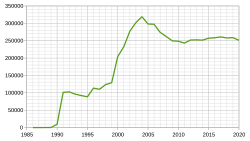
Headquartered in Takoma Park, Maryland, the party is governed by the Green National Committee (GNC). As of July 2025, the party maintains a membership of 261,091 individuals, with its youth wing represented by the Young EcoSocialists.
Key Facts
- Core Ideologies: Green politics, anti-capitalism, left-wing populism, progressivism, and eco-socialism.
- Founders: Howie Hawkins and John Rensenbrink.
- Governing Body: Green National Committee (GNC).
- Membership: 261,091 (as of July 2025).
- Electoral Presence: While holding no seats in the US Senate or House, the party had 163 other elected officials as of June 2025.
Ideology and Core Values
The Green Party's platform is built upon four primary pillars: Ecological Wisdom, Social Justice, Grassroots Democracy, and Nonviolence. These pillars are further expanded into the "Ten Key Values," which guide the party's policy positions.
The Ten Key Values
- Grassroots democracy
- Social justice and equal opportunity
- Ecological wisdom
- Nonviolence
- Decentralization
- Community-based economics
- Feminism and gender equity
- Respect for diversity
- Personal and global responsibility
- Universal peace
These values translate into specific political positions, including the advocacy for a Green New Deal—a comprehensive plan to address climate change and economic inequality—as well as strong stances on racial justice, LGBT+ rights, and criminal justice reform.
Organizational Structure
The party operates through two national committees recognized by the Federal Election Commission (FEC): the Green National Committee (GNC) and the Green Senatorial Campaign Committee (GSCC). To ensure diverse representation, the GNC includes several identity caucuses.
Recognized Identity Caucuses
- National Black Caucus
- Latinx Caucus
- Lavender Greens Caucus (LGBTQIA+)
- National Women's Caucus
- Young Ecosocialists
Additionally, the party maintains a presence across the country through various state and territorial parties, ranging from the Green Party of Alaska to the Wisconsin Green Party.
Electoral History and Performance
The Green Party has focused heavily on presidential ballot access to increase its national visibility. While it has not yet secured a seat in the US Congress, it has seen varying levels of success in local and state-level elections.
Presidential Campaigns
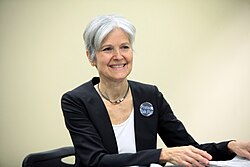
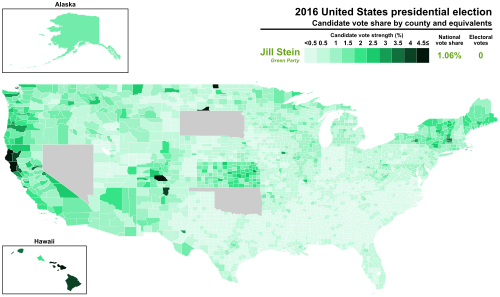
The party has run several high-profile candidates. Ralph Nader's 2000 campaign remains one of the most significant, capturing 2.7% of the popular vote. In more recent cycles, Jill Stein has been a prominent figure, serving as the nominee in 2012, 2016, and 2024.

Other notable candidates include Howie Hawkins, who ran in 2020, and Cynthia McKinney in 2008. The party's ability to appear on ballots has fluctuated, reaching a peak of 45 states and D.C. in 2016 and 2024.
Local and State Successes
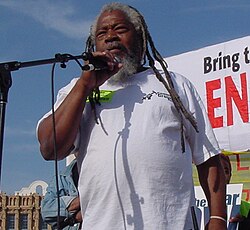
The party has found more consistent success in municipal and state legislative roles. For example, the party held a majority on the Sebastopol City Council (California) and the Fairfax Town Council (California) at various times. Notable candidates like Malik Rahim have also run for Congress to bring Green perspectives to the federal level.
Summary of Electoral Reach
| Year | Candidate | Popular Votes | Percentage | Electoral Votes |
|---|---|---|---|---|
| 2000 | Ralph Nader | 2,882,897 | 2.7% | 0 |
| 2016 | Jill Stein | 1,457,218 | 1.1% | 0 |
| 2024 | Jill Stein | 868,963 | 0.6% | 0 |
Frequently Asked Questions
What are the four pillars of the Green Party?
The four pillars are Ecological Wisdom, Social Justice, Grassroots Democracy, and Nonviolence.
Who is the most recent presidential nominee for the Green Party?
Jill Stein served as the presidential nominee for the 2024 election.
Does the Green Party hold any seats in the US Congress?
No, the Green Party currently holds 0 seats in both the US Senate and the House of Representatives.
What is the Green New Deal?
The Green New Deal is a central policy proposal of the party aimed at tackling the climate crisis while simultaneously addressing economic inequality and social injustice.
How many members does the Green Party have?
As of July 2025, the party has 261,091 members.