Green Line C Branch: A History of the Beacon Street Line
The Green Line C branch serves as a vital transit artery connecting Boston and Brookline. Originally established in the late 19th century, the line has evolved from early electric streetcars to modern light rail vehicles, navigating the challenges of urban growth and infrastructure modernization along Beacon Street.
The Early Years and Electrification
The foundations of the line were laid in 1888, with tracks extending from Massachusetts Avenue west to Coolidge Corner. By 1889, the route was expanded to Cleveland Circle and electrified, marking the beginning of a new era in urban mobility. During this period, the line also connected with Washington Square, facilitating travel from Brookline Village.
As Boston's transit network grew, the line integrated with the city's emerging subway system. The Tremont Street subway opened on September 1, 1897, allowing Beacon Street service to route into the Public Garden incline. This was followed by the opening of the Boylston Street subway on October 3, 1914, which extended the network westward and brought the Beacon Street line just east of Kenmore Square.
Throughout the early 20th century, service patterns shifted frequently. By 1926, the Washington Street shuttle was converted to bus service, eventually becoming route 65. In 1932, a significant infrastructure upgrade occurred with the opening of an underground Kenmore station, which split the tunnels for the Commonwealth Avenue and Beacon Street lines, with the latter surfacing at Saint Mary's Street.
The Era of PCC and LRV Streetcars
The introduction of PCC streetcars (Presidents' Conference Committee cars) on April 16, 1945, revolutionized the line's efficiency. These cars initially operated in two-car trains, with three-car trains entering regular service by September 1946. From 1940 until it was officially designated as the C branch in 1967, the line was known as route 61.
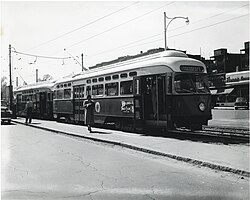
The mid-century saw further integration, including the 1959 connection of the Riverside Line (now the D branch) near Mountfort Street. By the late 1970s, the MBTA began transitioning to Boeing LRVs (Light Rail Vehicles), which first appeared on the line on January 20, 1978. While these modern cars were intended to improve service, early maintenance issues led to a temporary return to PCC cars in 1979.
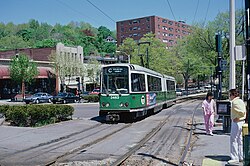
The 1980s and 90s were marked by various terminal changes and track replacements. In 1982, the line was briefly replaced by buses for track work, resulting in the permanent closure of four stops to increase travel speeds. Service terminals shifted between Government Center and North Station over the following decades.
Modernization and Accessibility
Accessibility became a primary focus at the turn of the millennium. The introduction of low-floor LRVs in 2000 enabled the MBTA to implement the Light Rail Accessibility Program. Between 2002 and 2003, raised platforms were installed at key stops, including Cleveland Circle, Washington Square, Coolidge Corner, and Saint Mary's Street.
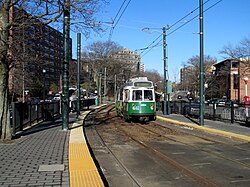
Recent efforts have focused on making the remaining surface stops accessible. Following track work in 2018–19, designs were developed for several stations, including the consolidation of Fairbanks Street and Brandon Hall into a single stop and the closure of Kent Street. In May 2024, the Federal Transit Administration awarded the MBTA $67 million to construct accessible platforms at 14 B and C branch stops, with construction beginning in May 2026.
Operational Challenges and Traffic Management
Unlike fully grade-separated railways, the C branch operates in a dedicated median on Beacon Street but must navigate 18 grade crossings. Because streetcars must stop at traffic signals, travel times are often impacted by road congestion.
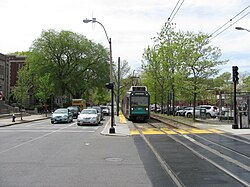
To address this, the concept of traffic signal prioritization—using sensors to give streetcars a green light—has been studied. While the Town of Brookline and the "Go Boston 2030" plan have advocated for this technology to speed up transit, the MBTA has historically questioned the cost-effectiveness of the project.
Key Facts
- First Tracks: Laid in 1888 from Massachusetts Avenue to Coolidge Corner.
- Route Designation: Known as route 61 until 1967, when it became the C branch.
- Rolling Stock: Transitioned from early electric cars to PCC streetcars (1945) and later to Boeing LRVs (1978).
- Infrastructure: Features 18 grade crossings along its dedicated median on Beacon Street.
- Recent Funding: Received $67 million in 2024 for accessibility upgrades at 14 stops.
| Era/Event | Key Detail | Date/Period |
|---|---|---|
| Initial Construction | Tracks laid to Coolidge Corner | 1888 |
| Subway Integration | Tremont Street subway opening | 1897 |
| PCC Introduction | First two-car PCC trains | 1945 |
| LRV Transition | First Boeing LRVs in service | 1978 |
| Accessibility Push | Low-floor LRVs introduced | 2000 |
Frequently Asked Questions
What was the C branch called before 1967?
Before it was designated as the C branch in 1967, the Beacon Street line was known as route 61.
How has the MBTA improved accessibility on the C branch?
The MBTA introduced low-floor LRVs in 2000 and installed raised platforms at major stops like Cleveland Circle and Washington Square. More recently, a $67 million grant was awarded to make 14 additional stops accessible.
Why do C branch trains often slow down at street crossings?
The line has 18 grade crossings where streetcars must obey standard traffic signals, which can lead to delays unless traffic signal prioritization is implemented.
What happened to the Washington Street service?
The Washington Street streetcar service was converted to a bus in 1926, eventually becoming the route 65 bus.
Which stations are being consolidated or closed in recent plans?
Under recent accessibility and design plans, Kent Street station is slated for closure, while Fairbanks Street and Brandon Hall stations will be consolidated into a single station.