Greater Roadrunner: The Fast-Running Cuckoo of the American Southwest
The greater roadrunner (Geococcyx californianus) is a distinctive, long-legged bird belonging to the cuckoo family, Cuculidae. Native to the Aridoamerica region of Mexico and the Southwestern United States, its scientific name literally translates to "Californian earth-cuckoo." While many are familiar with its pop-culture image, this bird is a highly adapted survivor, known by various names including the ground cuckoo, snake killer, and chaparral cock.
Unlike many of its cuckoo relatives, the greater roadrunner is built for life on the ground. It is the largest cuckoo species in the Americas, blending a unique combination of avian agility and terrestrial speed to thrive in some of the harshest environments in North America.
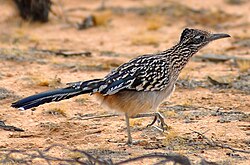
Key Facts
- Top Speed: Can reach speeds of 20 mph (32 km/h), with reported bursts up to 26 mph (42 km/h).
- Diet: Omnivorous, eating insects, lizards, mice, and even young rattlesnakes.
- Habitat: Arid and semiarid scrublands from the Southwestern US to northern Mexico.
- Status: Classified as Least Concern by the IUCN.
- Unique Trait: Uses thermoregulation (biological heat management) to survive extreme desert temperatures.
Taxonomy and Evolutionary History
The greater roadrunner has a fossil record extending back to the Pleistocene and Holocene epochs. Evidence has been found across Texas, New Mexico, Arizona, and California, as well as Nuevo León, Mexico. The oldest known fossil, discovered in a New Mexico cave, is estimated to be 33,500 years old. Notably, 25 fossil fragments have been recovered from the La Brea Tar Pits.
Interestingly, prehistoric remains suggest that until approximately 8,000 years ago, these birds inhabited sparse forests rather than the scrubby deserts they occupy today. This evolutionary shift toward arid environments, combined with human-led landscape changes, has recently prompted the species to expand its range northeast into areas with forest environments similar to the prehistoric Southwest.
Physical Description
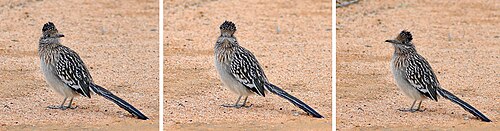
Measuring between 52 and 62 cm (20–24 in) in length with a wingspan of 43 to 61 cm (17–24 in), the greater roadrunner is a robust bird. Its upper body is primarily brown with black streaks and occasional pink spots, while its belly is white. A prominent crest of brown feathers sits atop its head, and a patch of orange and blue skin is located behind each eye; in adult males, the blue is often replaced by white, except for the area immediately adjacent to the eye.
The bird possesses a long, grayish-brown beak with a hooked tip, ideal for grasping prey. Its feet are zygodactyl, meaning it has four toes on each foot—two facing forward and two facing backward—which provide stability and grip during high-speed chases.
Locomotion and Speed
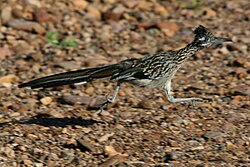
While the greater roadrunner is capable of limited flight, it prefers to travel on foot. It can maintain a steady speed of 18–20 mph (29–32 km/h) over long distances, using its tail as a rudder to steer. While it is the fastest running bird capable of flight, it is slower than the flightless ostrich, which can reach 40 mph (60 km/h).
Vocalizations and Communication
The species utilizes seven distinct vocal variants to communicate. Males frequently emit a slow, descending sequence of six low "cooing" sounds from high perches in the early morning, which can be heard up to 820 ft (250 m) away. Females produce short, low-frequency shrills resembling coyote squeals, audible up to 1,000 ft (300 m).
During the incubation and chick-rearing periods, both sexes use a series of five or six chatters accompanied by groaning, a common vocalization that can carry for 700 ft (200 m).
Distribution and Habitat
The greater roadrunner is non-migratory and resides within the Aridoamerica ecoregion. Its range covers several US states—including California, Arizona, New Mexico, Texas, Nevada, Oklahoma, Utah, and small portions of Colorado, Kansas, Louisiana, Arkansas, and Missouri—as well as numerous Mexican states from Baja California to Puebla.
They are typically found in arid scrublands with less than 50% vegetation cover and plants shorter than 3 meters (9 ft 10 in). Their elevation range is broad, from 200 ft (61 m) below sea level up to 7,500 ft (2,300 m), though they are rarely seen above 9,800 ft (3,000 m).
Behavior and Life Cycle
Breeding and Nesting
Greater roadrunners are monogamous and form long-term pair bonds. The breeding season runs from mid-March to early September, beginning with a complex courtship of chasing, tail wagging, and play-fighting. A unique behavioral trait is that mated couples continue copulation rituals long after fertilization is necessary, which is believed to strengthen their pair bond.
Couples defend territories ranging from 7,500 to 8,600 ft (700 to 800 m). The nest is a collaborative effort: the male collects materials while the female constructs a platform of thorny branches lined with grass, feathers, and sometimes snakeskin. These nests are typically placed 3–10 feet above ground in bushes or cacti. A clutch of three to six eggs hatches in 20 days, and chicks fledge in another 18 days.
Diet and Predation
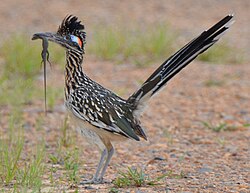
As opportunistic omnivores, roadrunners use their speed to hunt a wide variety of prey. Their diet consists mainly of insects, spiders (including tarantulas and black widows), scorpions, lizards, mice, and small birds. They are famously capable of hunting young rattlesnakes. They also consume plants and occasionally scavenge on the carcasses of larger mammals, such as bats or ground squirrels.
Despite their hunting prowess, they are preyed upon by ground predators like coyotes, bobcats, and cougars, as well as aerial predators such as red-tailed and Cooper's hawks.
Survival Adaptations: Thermoregulation
To survive the intense heat of the desert, the greater roadrunner employs several thermoregulation strategies. During the hottest parts of the day, they rest in the shade, becoming active only from sunrise to mid-morning and again in the late afternoon.
Physiologically, they conserve water through liquid reabsorption in the cloaca, rectum, and caecum, while specialized nasal glands eliminate excess salts. To cool down, they release water vapor through breathing or panting. At night, they reduce energy expenditure by lowering their body temperature from 104°F to 93°F (40°C to 34°C).
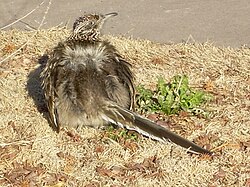
In the morning, they recover heat through sunbathing. By standing perpendicular to the sun with wings apart and ruffling their black feathers, they expose their black skin to maximize solar absorption. This process can last for several hours in the winter.
Cultural Significance and Human Relationship
The greater roadrunner holds a place of honor in various cultures. Some Pueblo Native American tribes, such as the Hopi, viewed the bird as a protector against evil spirits. In Mexico, folklore once suggested the roadrunner brought babies, similar to the European white stork. In the US, it is the state bird of New Mexico and serves as a mascot for various institutions, including the University of Texas at San Antonio and California State University, Bakersfield.
Globally, the bird is most recognized through the Warner Bros. animated series featuring Wile E. Coyote and the Road Runner, which has run since 1949.
| Feature | Details |
|---|---|
| Scientific Name | Geococcyx californianus |
| Average Length | 52–62 cm (20–24 in) |
| Weight | 221–538 g (7.8–19.0 oz) |
| Max Speed | Up to 26 mph (42 km/h) |
| Diet | Omnivorous (Insects, reptiles, small mammals) |
| Conservation Status | Least Concern |
Frequently Asked Questions
Can the greater roadrunner actually kill snakes?
Yes, the greater roadrunner is an opportunistic predator that feeds on various reptiles, including lizards and young rattlesnakes, which has earned it the nickname "snake killer."
How do roadrunners stay cool in the desert?
They use behavioral and biological adaptations called thermoregulation. This includes resting in the shade during peak heat, using nasal glands to excrete salt, and lowering their body temperature at night to conserve energy.
Are roadrunners migratory birds?
No, the greater roadrunner is not migratory. It remains in its home range within the Southwestern United States and northern Mexico throughout the year.
What is a zygodactyl foot?
A zygodactyl foot is one where two toes face forward and two toes face backward. This foot structure provides the roadrunner with better stability and grip while running on the ground.
Do roadrunners only eat meat?
No, they are omnivorous. While they primarily hunt small animals like insects and lizards, they also consume some plants and carrion.