Graupel: The Science of Soft Hail and Snow Pellets
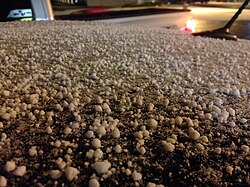
When winter weather strikes, not all frozen precipitation is created equal. While most people are familiar with snowflakes and hail, there is a distinct middle ground known as graupel. Also referred to as soft hail, snow pellets, popcorn snow, or hominy snow, graupel consists of small, opaque balls of crisp rime—frozen water droplets—that typically measure between 2 and 5 mm (0.08–0.20 in) in diameter.
Though it may look like tiny pieces of polystyrene, graupel is a unique meteorological phenomenon with a specific formation process that separates it from both traditional snow and hard hail.
Key Facts
- Composition: Formed when supercooled water droplets freeze onto falling snowflakes.
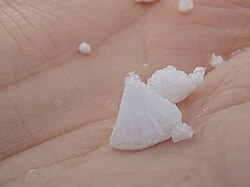
- Appearance: Opaque, white, fragile pellets that crumble when pressed.
- METAR Code: Identified by the code GS in aviation weather reports.
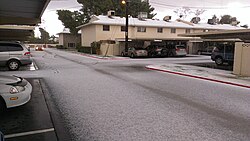
- Occurrence: Common in thunderstorms (cumulonimbus clouds), winter storms, and high-altitude regions.
- Avalanche Risk: High density and low viscosity make it a primary contributor to slab avalanches.
How Graupel Forms
The creation of graupel begins with supercooled water droplets. These are liquid droplets that remain in a liquid state even at temperatures as low as −40 °C (−40 °F), provided they are above the homogeneous nucleation point of water. These droplets typically have an average diameter of about 10 μm (0.00039 in).
When a falling snow crystal encounters these supercooled droplets, the liquid freezes instantly upon contact. This process of growth is called accretion. Crystals that have these frozen droplets on their surface are described as rimed. As accretion continues, the original shape of the snowflake—whether it was a plate, dendrite, column, or needle—becomes completely obscured, resulting in a ball-like pellet of graupel.
The Physics of the Fall
As graupel descends through the atmosphere, it often deforms into a conical shape. This geometry dictates how the particle travels:
- Under 1 mm: Particles generally fall with the conical base facing downward.
- 1 mm to 3 mm: Particles exhibit persistent oscillations around the center of the conical base.
- Over 3 mm: The particles begin to tumble.
Graupel vs. Hail and Ice Pellets
While graupel is often called "soft hail," it is scientifically distinct from true hail. Hail is formed in hard, uniform layers and occurs almost exclusively during thunderstorms. In contrast, graupel is fragile, soft, and oblong. While it can occur in thunderstorms, it is also a common feature of wintry mixes and winter storms, often falling alongside ice pellets.
| Feature | Graupel | Hail | Snow |
|---|---|---|---|
| Structure | Fragile, opaque rime | Hard, layered ice | Crystalline flakes |
| Formation | Accretion on snowflakes | Layering in updrafts | Deposition of vapor |
| Texture | Soft, crumbles easily | Hard, solid | Light, fluffy |
| Typical Weather | Winter storms/Thunderstorms | Thunderstorms | Cold weather/Winter |
Microscopic Structure
Due to the limited resolution and depth of field of standard light microscopes, the topography of graupel is difficult to record. However, using a low-temperature scanning electron microscope (LT-SEM), scientists have observed frozen cloud droplets measuring up to 50 μm (0.002 in) on the surface of the crystals. This riming process eventually hides the original snow crystal entirely.
Impact on Avalanche Safety
In high-altitude climates, graupel poses a significant safety risk. Because it is denser and more granular than ordinary snow, it has low viscosity. When layers of graupel reach 20–30 cm (8–12 in) or more, they can create unstable slopes prone to dangerous slab avalanches.
Even thin layers of graupel can be hazardous. When falling at low temperatures, these pellets can act like ball bearings beneath subsequent layers of stable snow, making the entire snowpack liable to slide. Generally, graupel takes one to two days to compact and "weld" (stabilize), depending on the temperature and specific properties of the pellets.
Frequently Asked Questions
Is graupel the same as sleet?
While the term "sleet" is used variously to describe different types of frozen precipitation, graupel is specifically formed by the accretion of supercooled droplets onto a snowflake, whereas sleet typically refers to frozen raindrops.
Why is graupel called "soft hail"?
It is called soft hail because it resembles hail in its pellet-like shape, but unlike true hail, it is fragile and will typically fall apart when pressed.
Can graupel fall without a thunderstorm?
Yes. While graupel is common in cumulonimbus clouds during thunderstorms, it also frequently occurs during winter storms and at high elevations.
How does graupel contribute to avalanches?
Graupel's density and low viscosity make it unstable on slopes. It can act as a lubricating layer (similar to ball bearings) under newer snow, increasing the likelihood of a slab avalanche.
What is the difference between riming and graupel?
Riming is the process where supercooled droplets freeze onto a snow crystal. When this process continues until the original shape of the snowflake is no longer identifiable and it becomes a ball, it is classified as graupel.