Gojong: The Last Monarchs of Joseon and the First Emperor of the Korean Empire
The history of the Korean peninsula at the turn of the 20th century was defined by rapid modernization, intense foreign encroachment, and a desperate struggle for sovereignty. At the center of this turbulent era stood Gojong (r. 1864–1907), a ruler who transitioned from the 26th King of the Joseon Dynasty to the first Emperor of the Korean Empire. Known also as the Gwangmu Emperor, his reign spanned 43 years, witnessing the end of centuries of dynastic rule and the beginning of Japanese colonial occupation.

The Rise of a Young King
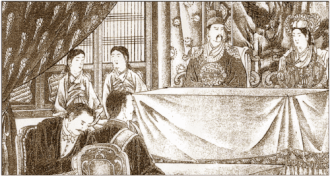
Born Yi Jaehwang in 1852, the future monarch ascended to the throne at the age of 11 following the death of the heirless King Cheoljong. Because of his youth, the early years of his reign were dominated by powerful regents. Initially, Grand Queen Dowager Hyoyu held authority, followed by his biological father, the influential Grand Internal Prince Heungseon (Heungseon Daewongun).
During the Daewongun's regency, Korea maintained a policy of strict isolationism—a refusal to engage in foreign trade or diplomacy. This period was marked by efforts to restore the authority of the monarchy and rebuild the Gyeongbokgung Palace, while simultaneously suppressing foreign influences, including Catholicism. However, as neighboring Japan underwent the Meiji Restoration and modernized rapidly, the pressure on Korea to open its borders became unavoidable.
A Reign of Instability and Conflict
The mid-to-late 19th century was a period of profound instability for Gojong. The 1876 Treaty of Ganghwa, forced upon Joseon by Japan, marked the beginning of unequal treaties and increased Japanese economic and territorial encroachment. This era was punctuated by several significant internal and external crises:
- The Imo Incident (1882): A riot by the traditional army, enraged by unpaid wages, which led to the intervention of Qing Chinese troops.
- The Kapsin Coup (1884): A political attempt to shift power that further complicated foreign involvement in Korean affairs.
- The Tonghak Peasant Revolution (1894–1895): A massive social uprising that drew in foreign military powers.
- The Assassination of Queen Min: The tragic death of Gojong's wife, Empress Myeongseong, at the hands of Japanese agents, which deepened anti-Japanese sentiment.

The Proclamation of the Korean Empire
In an attempt to assert sovereignty and elevate Korea's status on the global stage, Gojong declared the establishment of the Korean Empire on October 12, 1897. By adopting the title of Emperor, he sought to signal that Korea was an independent state equal to its neighbors, China and Japan.
During this period, Gojong focused heavily on military reforms. Recognizing the need for a modern defense, he established a military academy in 1898 and appointed himself Grand Field Marshal. He invested heavily in the military, with approximately 44 percent of the Empire's total revenue dedicated to defense by 1901. Despite these efforts, diplomatic attempts to secure international support—such as seeking an alliance with Great Britain—were unsuccessful.

Internal Exile and Forced Abdication
Following the assassination of his wife and increasing Japanese pressure, Gojong sought refuge in the Russian legation in 1896, an event known as his internal exile. This move was a strategic attempt to use Russian influence to protect Korean sovereignty. However, the political landscape continued to shift against him.
In 1907, Gojong was forced to abdicate the throne. His son, Sunjong, succeeded him, while Gojong was relegated to the status of King Emeritus. Confined to Deoksugung Palace, Gojong made several unsuccessful attempts to escape and establish a government-in-exile to fight for Korean independence.

The End of an Era
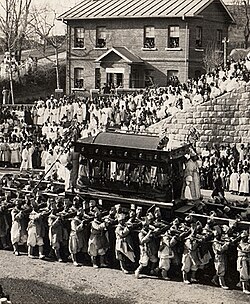
In 1910, Korea was formally annexed by Japan, and the Korean imperial family was absorbed into the Japanese Imperial house. Gojong died on January 21, 1919, at the age of 66. While the official cause of death was recorded as a cerebral hemorrhage, widespread rumors persisted that he had been poisoned by the Japanese authorities.
His death became a powerful catalyst for the March First Movement, a massive non-violent protest that bolstered the Korean independence movement and remains a defining moment in the nation's struggle for self-determination.

Key Facts
- Full Name: Yi Jaehwang (later Yi Hui).
- Titles: 26th King of Joseon; 1st Emperor of the Korean Empire (Gwangmu Emperor).
- Reign Duration: 1864–1907 (43 years).
- Spouse: Empress Myeongseong (Queen Min).
- Successor: Emperor Sunjong.
- Death: January 21, 1919 (Age 66).
Summary of Gojong's Eras
| Period | Era Name | Primary Title |
|---|---|---|
| 1864–1894 | Qing Dynasty Era Names | King of Joseon |
| 1894–1895 | Gaeguk | King of the Great Joseon State |
| 1896–1897 | Geonyang | King of Joseon |
| 1897–1907 | Gwangmu | Emperor of Korea |
Frequently Asked Questions
Who was the father of Emperor Gojong?
Gojong's biological father was the Grand Internal Prince Heungseon (Heungseon Daewongun), who served as a powerful regent during the early years of Gojong's reign.
What was the significance of the Gwangmu era?
The Gwangmu era (1897–1907) coincided with the proclamation of the Korean Empire. It represented Gojong's attempt to modernize the nation and assert Korea's status as an independent empire equal to its neighbors.
Why did Gojong flee to the Russian legation?
In 1896, Gojong and the Crown Prince fled to the Russian legation to seek protection from foreign political pressures and to escape the influence of those seeking to undermine his authority, particularly following the assassination of Queen Min.
How did Gojong's death impact Korean history?
Gojong's death in 1919 served as a direct catalyst for the March First Movement, a major turning point in the Korean independence movement against Japanese colonial rule.
What happened to the Korean imperial family after 1910?
After the formal annexation of Korea by Japan in 1910, the Korean imperial family was absorbed into the Japanese Imperial house, and Gojong was stripped of his imperial title, becoming "King Emeritus Yi of Deoksugung."